

Between four and seven times in the year, the Earth, the Sun and the Moon are aligned to create a shadow show that we normally know as eclipses.
According to the National Aeronautics and Space Administration (NASA), An eclipse occurs when a planet or a moon stands on the road of sunlight. The orbit of the moon around the earth is inclined with respect to the orbit of the earth around the sun.
This inclination is the reason why eclipses are occasional and do not occur every month.
Exist Two types of eclipses: moles and lots.
Solar eclipses occur when the moon gets in the path of sunlight and projects shadow on the earth. This means that, during the day, the moon moves in front of the sun and hides its light. These phenomena usually occur only in a new moon phase.
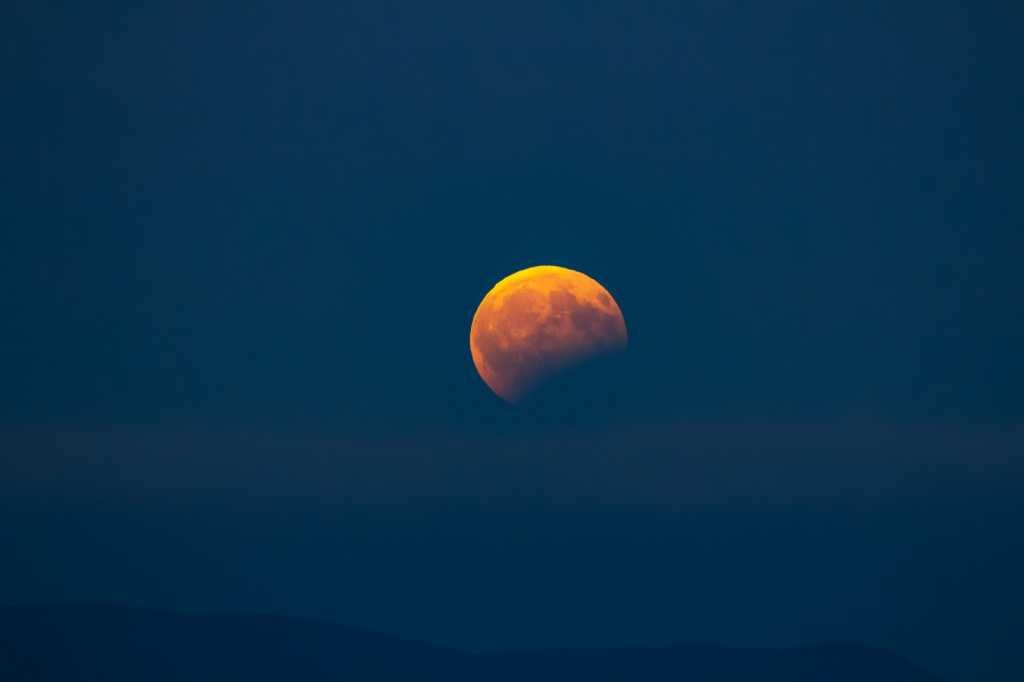
For its part, A lunar eclipse – which usually occurs in a full moon phase – occurs when the earth prevents the sunlight from reaching the moon. This causes, during the night, the moon disappears completely as the earth’s shadow covers it.
On some occasions, The moon can also acquire a reddish tonebecause the Earth’s atmosphere absorbs other colors.
When are the next eclipses
2025 will surprise lovers of astronomical events with Four eclipses: two moles and two lots. The Eleonora Poitevin engineerPresident of the Guatemalan Association of Astronomy (AGA), details them:
March 14, 2025
It will occur A total lunar eclipsevisible in the country from 9:57 p.m. on Thursday, March 13, when the moon will enter the gloom. Its maximum point can be observed at 0.59 hours on Friday, March 14. The good news is that it can be seen with the naked eye in Guatemala.
March 29, 2025
Approximately two weeks after the total lunar eclipse, a partial solar eclipse will occur. During this phenomenon, the moon will align with the sun, covering only part of its album, which will generate a visual effect similar to a “bite” in the sun.
The climax will be at 5.47 hours. This event can be observed in Europe, Asia, Africa, North America, South America, the Atlantic Ocean and the Arctic.
September 7, 2025
A total lunar eclipse will be recorded during the night of September 7. The moment of greatest intensity will be 1.11 hours, although it will not be visible in America. The regions where it can be observed include Europe, Africa, Asia, Australia and New Zealand.
September 21, 2025
That day there will be a partial solar eclipse, which will be visible only in Australia, Antarctica, the Pacific Ocean and the South Atlantic Ocean.
How do scientists know when will the next eclipse be?
According to NASAastronomers must begin by analyzing the geometry and dynamics of the orbits of the earth and the moon around the sun, considering the gravitational influence of these three bodies.
Using Newton’s laws, they perform mathematical calculations to determine the displacement of these bodies in a three -dimensional space, taking into account that they are not perfect spheres and have finite dimensions.
Subsequently, they incorporate the current positions and speeds of the Earth and the Moon in these complex equations, and use computers to integrate these equations, projecting them towards the future or the past, in order to determine the relative positions of the moon and the sun from the terrestrial perspective.
Eclipses correspond to particular configurations of these bodies, which can be identified by computer programs. Current eclipses predictions reach temporary precision of less than a minute, even when projecting in hundreds of years.