

Under the faint glow of candles in the temple of Candelaria, where time seems to stop between muthes of faith and legend, a secret is kept that has shuddered generations: the regrets of a Nazarene That cries before the tragedy.
Talk about Jesus of Candelaria It is talking about legend, tradition and faith. According to many devotees, he is the Nazarene who identifies the people of Guatemala, but also identifies with us, interwoven his story with ours.
Legend has it that, every time from the interior of the parish of Candelaria, pitiful groans are heard, a tragedy is coming. It happened before the earthquakes of 1917 and 1918on the eve of the Revolution of 1944 And again before earthquake of February 4, 1976.
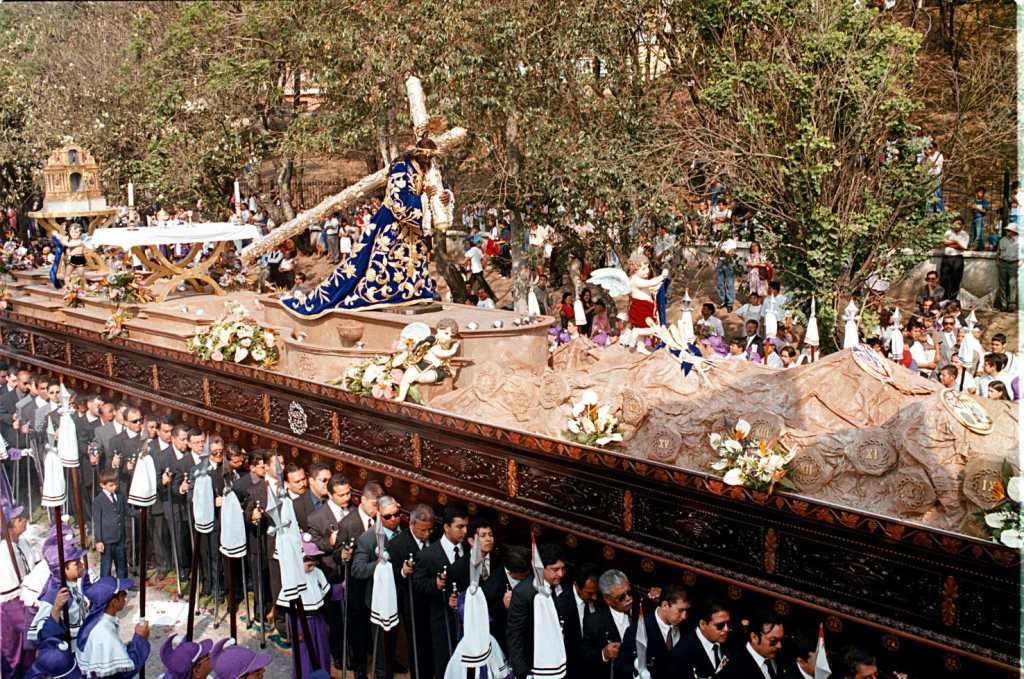
“Jesus of Candelaria cries for his people,” the devotees repeat in the ranks of every Holy Thursday, while the Nazarene travels through the streets of his beloved city, carrying not only a cross, but the weight of the omens.
This story is based on one of the books of The street where you liveof Héctor Gaitán.
The regrets of Jesus of Candelaria
They were other times, when they assaulted little and could still walk at night without fear. José returned home; At that time he lived for the Cerrito del Carmen.
Precisely because of the Dolphin alley, on the 3rd street of zone 1, a good stretch had walked, as it came from the Las Victorias on foot neighborhood. There was no longer a truck, less ruletero. But the night was quiet.
José toured the entire 1st street, thinking that when he arrived at San José Avenue would be closer to his home.
It is a matter of getting to the temple of Candelaria, crowning the Cerrito del Carmen, going to the alley of the Jew and climbing the 3rd street to get to my house in the Dolphin alley, he thought.
Introduced in his thoughts and wrapped in a nightlife, recalled the legends that his aunt Carmela always told him: legends of fright and appeared, of course.
Los Trees Avenue seemed deserted. Pure cemetery street. You didn’t see a soul.
Remembering those legends of Aunt Carmela, Don José did not realize at what time, but in a jiffy he reached the corner of the Candelaria temple.
When traveling along the side of the temple, at a side door on the 1st street, he heard some regrets that split his soul and freezed his blood.
He stopped for a moment, but fear drove him to continue. Even when they reached the corner of Juan Chapín Avenue, the groans resonated clearly. He did not stop until he got home, convinced that something terrible happened in the temple.
To make matters worse, his grandmother was asleep and José did not want to wake her up. He tried to call the police, but the phone did not respond, as if he had been silent.
José decided to prepare a cup of coffee to calm his nerves, meditating in the solitude of the night. Those regrets drilled his brain: they were regrets of a fair afflicted without mercy.
He thought that thieves had entered the temple and decided again to call the police, but the phone was still silent.
Suddenly, his grandmother appeared, smiling, asking for her very hot coffee cup.
José narrated everything that had happened to him, everything he had heard, step by step, without taking him or adding a detail.
She looked at him seriously and said:
“Call, son, and leave the phone alone.” What you heard were the regrets of the Lord of Candelaria. Whenever our Lord laments that way, it is an unequivocal sign that something will happen. Let us prepare and entrust us for what may happen.
The grandmother then remembered family stories: her late father had heard those same regrets before the 1900 earthquakes.
Years later, someone else listened to them, and shortly after the Spanish influenza swept Guatemala. Even Aunt Carmela had perceived them before the October 1944 revolution.
“Oh, millet, know what will happen.” You have to pray a lot and ask God for all, ”the grandmother finished, while taking the sip of her coffee cup.
That night, the grandmother cried and pursued in front of the image of the Lord of Candelaria they kept at home. Then he retired to sleep, while he remained in candle, reflecting.
Over time, the memory of the regrets vanished … until, unexpectedly, the tragic morning of February 4, 1976 came, charging thousands of lives under the rubble.
And so, it is said that when the Lord of Candelaria cries, the earth trembles and destiny announces its shadow.
The duel for the bishop
According to the historian Walter Gutiérrez, the oldest legend of Jesus of Candelaria dates back to 1563, when the image cried a Good Friday announcing the death of Bishop Francisco Marroquín, defender of the indigenous people. Jesus cries for his people. The Nazarene of Candelaria was revered by the Kaqchikeles in Santiago de Guatemala, and the bishop was his protector. That tear was an ethnic and spiritual message: the pain of an indigenous Christ for whom he fought for his people.
This tradition, collected by the journalist Víctor Miguel Díaz in his work The tears of the Nazareneaffirms that the image is as old as the city itself and that its crying marked the beginning of its role as a protector and prophet.
The predictor of the tragedies
But the legend did not end there. As the historian Fernando Urquizú recounts, the Nazarene of Candelaria became an omen of calamities.
Urquizú emphasizes that these narratives, although they mix reality and fantasy, are an intangible heritage: “It doesn’t matter if they are true; it matters that they cohesive to a people around their faith and history.”
This legend survives because it resists time. Whether because of the crying that announced the death of Moroccan or for the omens of earthquakes, the Nazarene remains a lantern in the dark, reminding us that, in Guatemala, the story and the myth are intertwined as the threads of his purple tunic.
So, every time he passes in front of his temple, pay attention: maybe he has the privilege – or misfortune – to listen to his regrets.