

The so -called “reciprocal tariffs” affect dozens of countries, including some of the largest economies on the planet.
The whip, however, did not fall the same for everyone. While China’s products will have to pay a 34% tax when crossing the US border (plus 20% previously decreed), those of the European Union will pay 20%.
Shock has been so great in other parts of the world, that in Latin America the news, despite marking a break in the US commercial history with the region, was received with some calm.
Even in Mexico there was a certain level of optimism because, as they say, they “saved” from the worst stage.
Mexico and Canada did not enter the list of reciprocal tariffs announced by Trump in what the president baptized as the “day of liberation.”
That calmed the waters, although these two countries will face the 25% tariffs that Trump previously imposed on steel, aluminum and cars.
In any case, the lien to the cars that cross the border from Canada and Mexico to the US will not apply completely, because there is a clause that establishes that the rate will only fall on the content of the “non -American” vehicle.
Among the least beaten
Almost all Latin American products will have to pay a 10%tariff, which is the minimum imposed by the White House in this new era of international trade that interrupts decades of a system based on rules that regulate the imposition of rates.
A tariff is nothing other than a tax on a foreign product. The countries usually apply when they want to protect national companies on the grounds that there is unfair competition by other nations.
This time, however, the US government skipped the rules and unilaterally decided to launch a tariff tsunami against almost everyone.
As the offensive was gigantic, Latin America was among the least beaten with the tax of 10%, with the exception of the products from Venezuela, which must pay 15%, and those of Nicaragua, which must pay 18%, the highest tax in the entire region.
Who pays the tariff? It is paid by the American importer in customs when the product crosses the border.
The direct effect is that the product that the final consumer buys in the United States is expensive.
What worries Latin American exporters is that, as the price of their products will be greater when crossing the border, they will sell less and that will end up affecting investment, employment and growth in the region.
But fears not only come for the blow that exporters will suffer. The new US tariff war has caused uncertainty in the markets, pause in investments, doubts about the future of the exchange and anxiety rate about how the most affected countries will respond.
Despite the storm, ”it seems that the region is better positioned than the rest,” says Joan Domene, chief economist for Latin America of Oxford Economics, in dialogue with BBC Mundo.
Anyway, he adds, “let’s see a global slowdown of trade.”
Many analysts are anticipating that economic brake in the United States, one of the main commercial partners of the region, something that directly impacts Latin American economies.
The economies are so interconnected that, if the growth in the US drops or a recession occurs, Latin America will feel it. But, for now, it is not known what will happen during the next months to the extent to rearm the pieces of the puzzle of international trade.
Felipe Hernández, economist for Latin America of Bloomberg Economics, comments that the tariff for the countries of the region “is a setback” in relation to the situation in which they were before.
However, Latin America is in a favorable relative position in relation to other regions of the world, he explains. “An opportunity opens in Latin America to gain participation in imports to the US at the expense of other countries.”
Anyway, he says, we must bear in mind that “the US economy is expected to grow much less” and that will affect everyone.
Products without tariffs
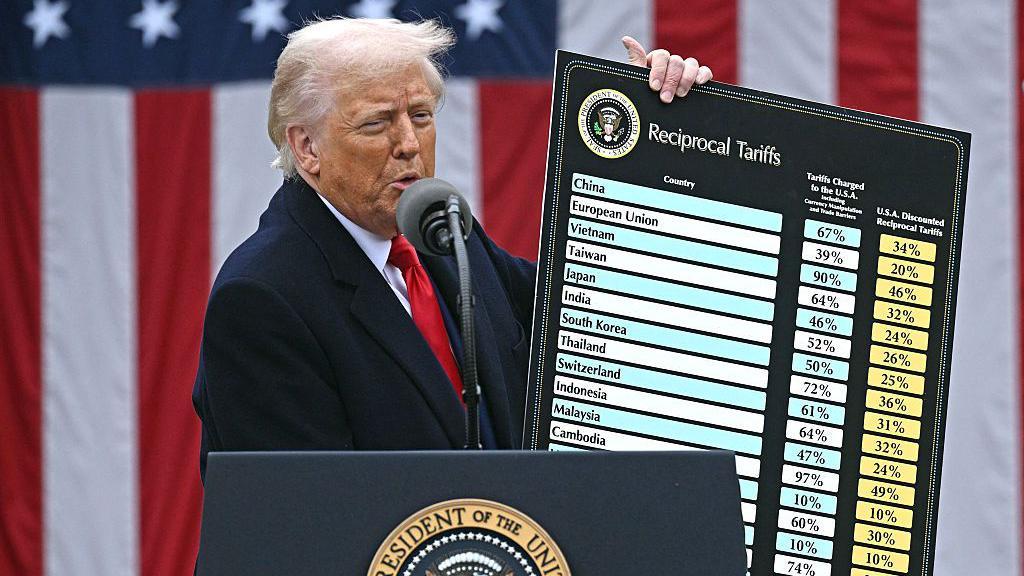
Although the base tariff is 10% for most Latin American products entering the United States, the White House reported in a document that the new tax policy includes exceptions.
Among the products that – now – will not pay the tariff is copper, pharmaceutical goods, semiconductors, wooden items, gold bullion, energy and other minerals not available in the United States.
Experts in the oil sector consulted by BBC Mundo think that by excluding the item from the “energy” of tariffs, oil exports are supposed to be affected.
As no more details have been delivered, governments are not sure about this point and are waiting to obtain bilateral meetings with members of the White House to have greater certainties.
In the scenario that oil and other Latin American energy products effectively are exempt from new tariffs, the effects in the region would be more focused on sectors such as agribusiness, although everything depends on each country.
The case of Colombia and Argentina
In Colombia, the main products exported to the United States are coffee and flowers, in addition to processed foods, chemicals and manufactures.
Although initially the Colombian president, Gustavo Petro, did not celebrate Trump’s tariffs, in a sudden change, said in the social network X that these are positive.
“Latin America, including Colombia, benefit from Trump’s policy on tariffs, in the first instance. But Colombian business should know how to take advantage of things,” he said.
If some products are more expensive in the US, “and if we can produce those cheapest goods, it is time to export there,” he added. “We will only make North American imports make us take jobs.”
The Argentine government also expressed a positive response through its spokesman, Manuel Adorni, who highlighted on Thursday the “wonderful relationship” between Argentina and the USA.
And President Javier Milei published in X a link to Queen’s song Friends Will Be Friendsalthough the markets did not receive with joy the tariffs of Trump.
It transpired that on Thursday night Milei could announce a possible agreement with President Donald Trump to reduce tariffs to Argentina. The main Argentine export item to the US is that of fuels and mineral oils, followed by aluminum and alcoholic beverages and liquids.
What happens to Peru, Brazil, Chile and Ecuador?
In the case of Peru, although China is the main destination of Peruvian exports, the US occupies second place. It is estimated that taxes can affect items such as clothing, non -metallic mining and agribusiness.
Peruvian blueberry producers were not satisfied, since the main export market for that fruit is the US, and although both countries have a free trade agreement, the pact did not save Peru from the taxes.
The Lima government announced that it will ask the Trump government to reconsider tariffs in the next few days. Some local experts said that, despite the damage that the measure can generate in sectors such as the textile industry, opportunities can be opened for Peru compared to other countries that were imposed on higher levies.
That is, despite everything and depending on the product, Peru could continue to sell cheaper than other competitors.
The Brazilian president, Luiz Inacio Lula da Silva, said Thursday that his government will face “all attempt to impose a protectionism that fits no more in this world” and that will adopt “all possible measures” against Trump’s tariffs.
“We defend multilateralism and free trade,” Lula said.
He also assured that the response to tariffs will be given with the “reference” to a law approved on Wednesday in the Brazilian Congress, which authorizes the adoption of reprisals for such cases, and also within the framework established by the rules of the International Trade Organization (WTO).
Brazil exports to the US products such as crude and refined oil, semi-flushed iron, soybeans, iron mineral, sugar and corn.
In Chile, agriculture and the fishing sector could be some of the most affected by tariffs imposed by the White House.
Products such as salmon, grapes or wine have been exposed to the unilateral taxes applied by the world’s largest economy.
The decision “has an undoubted effect for a small and globalized country such as Chile,” said the president of the Confederation of Production and Commerce, Susana Jiménez.
Despite the negative impact that the measure can have on the Chilean economy, the White House decided to leave two fundamental Chilean products out of the tax: copper and wood.
That made the blow not so hard, although a potential will gravamize copper in the future is an alternative that is still on the oval dispatch table.
In the case of Ecuador, shrimp, bananas, and cocoa are some of the products most affected by tariffs.
Business sectors of that country said they were evaluating “urgently” roads to mitigate the impact of the measure, while the government said it will continue to promote a closer relationship with its main commercial partner.
Central America in the sights
Among the most affected countries in the region by the tariffs announced on Wednesday are Central Americans for their high dependence on the US market.
The governments of that region have said that they are analyzing the situation and that, for now, they have not made decisions on how to move forward.
Although they are part of the Free Trade Agreement between the United States, Central America and the Dominican Republic (DR-CAFTA), the decision of the US government did not exempt them from the new tariffs.
Although commercial damage can be quite deep, countries in that region stressed that 10% was the lowest tariff applied by the US government globally.
“If the tide goes up and lifts all boats at the same time, it is a new reality. They are not punishing us in that regard,” said Costa Rica president Rodrigo Chaves.
In an analysis, the Citi Bank said that Honduras, El Salvador, the Dominican Republic and Panama, are some of the most vulnerable, due to commercial unbalanced with the US, migration and drug trafficking, the dependence of remittances and other factors.
It is possible that in the coming weeks and months there are focused changes in some Latin American products after negotiations of regional governments with the White House.
Until now, most countries do not seem to have in their plans the imposition of reprisals against the US.

Click here To read more BBC News World Stories.
Subscribe here To our new newsletter to receive a selection of the best content of the week every Friday.
You can also follow us in YouTube, Instagram, Tiktok, X, Facebook and in our WhatsApp channel.
And remember that you can receive notifications in our app. Download the latest version and act.