

Traveling through the country’s routes represents an odyssey; In some cases, due to the poor road conditions and, in others, by the road infrastructure that does not adapt to the current traffic conditions.
These inconveniences cause a displacement to extend more for the transport of products and goods, as well as for families that do tourism.
One of the main concerns for the users of the routes is that with the arrival of the rain, added to the uncertainty about many road maintenance and cleaning projects, the condition of the roads worsens.
A free press and news team Guatevisión completed a tour of several sections of the country, and evidenced the difficulties to which carriers and drivers face every day that for work, tourism or businesses must travel these routes.
Inter -American Route
Carlos Saldaña has 26 years of being a heavy transport pilot, but, for three, he has been traveling every day through the CA-1 West, since he moved cement from Santo Domingo Xenacoj, Chimaltenango, to Salcajá, Quetzaltenango. It is a 158 -kilometer route that takes between three and four hours on the way, as it must dodge potholes that have formed along the route.
Consider that if the journey were in a better state, you could complete the section in less time. “I have been fixed here for almost three years, and every day we live the situation of the asphalt. The truth is that there are parts where it should be improved; for what is seen, they have had it quite abandoned (the road),” says Saldaña. He adds that there are sections where signaling is missing and this raises the risk of accidents.
Along the section daily vehicles are observed with mechanical damage stranded at the edge of the road; Some of them, caused by holes and potholes, among other factors.
“The vehicles are damaged, a spring leaf is bankrupt, the tire is left to a small vehicle … And that causes an accident. Last time I broke a spring sheet and it is nothing cheap, and the pattern-the trailer dwell-is the injured party there,” says the carrier, while waiting for assistance at the Alaska Summit-Kilometer 166 of the CA-1. I had a breakdown
mechanics.
Throughout the route it was possible to show that the most damaged areas are after Sololá, between Totonicapán and Quetzaltenango, where there are even some holes that – according to the neighbors – have been without repair for more than a year, and over time they only become larger and deep, because no maintenance has been given.
“They are still encouraged to put the mandatory insurance. What a shame! Better to fix the roads first. There is enough money for the streets with the taxes,” says Manuel Guarchax, a resident of the Patzij canton, in Nahualá, Sololá, while indicating a group of potholes who are dodged by drivers to avoid injured.
This route is mainly used for the transport of vegetables, legumes and fruits of cold and temperate climates, as well as for construction materials, among other products that are taken from the central area of the country to the Altiplano, an important area for commerce, because of the population density of that region, says Héctor Fajardo, director of the Central American Chamber of Transporters (Catransca). It also states that although the authorities have tried to recover the route in recent years, the bad conditions still persist.
“Yes, (the road) is in quite a bad condition, although they have gone little by little, in the last two or three years, trying to recover the road, making repairs in the vehicle rolling folder, but persist the poor state of the route and the number of mounds in some areas; all that affects the speed of movement in terms of logistics,” he says.
CA-02: Eternal Traffic
Some 300 kilometers make up this road, which connects the ends of the country – from Ciudad Pedro de Alvarado, Jutiapa, to Tecún Umán, San Marcos.
It is the commercial route for products from the rest of Central America to Guatemala and our country to Mexico.
This route also communicates with the thematic parks of the Institute of Workers Recreation (IRTRA), in Retalhuleu, but the lack of road infrastructure that adapts to commercial and tourist needs make merchandise and visitors take more than expected to reach their destination, mainly, in the Succhitepéquez journey.
For drivers, the Odyssey begins when reaching kilometer 136.5, on the Nahualate Bridge, where – the cause of the poor state of the structure, which last October faced damage – must travel at lower speed. Then, the bottling is aggravated by passing through San Antonio Suchitepéquez, San Bernardino, Cocales and Cuyenango, Suchitepéquez. Transiting those places can represent carriers between one and three hours of line.
Rolando Bethancourt is a pilot who in the last 20 years has dedicated himself to this trade, and almost daily he must circulate on this route. Transfer on board a trailer different types of products from Guatemala City to Tecún Umán.
He prefers to drive at night to avoid vehicular congestion; Even so, it takes seven hours a day to travel around 279 kilometers. He states that, although most of the route is in “acceptable” conditions, one of the main problems he faces is the narrowness of the streets.
“If you realize, there are sections that are not finished and becomes dangerous for everyone,” laments the carrier, and refers to the fact that in several sections the road is reduced from four to two lanes, as a consequence of the unfinished works after the judicialization of the route by the Odebrecht case. This situation generates problems for drivers, mainly at night, due to little signaling, which has already caused accidents, according to some pilots.
Throughout the route, one of the main complaints is that they constantly find extra -urban buses in the opposite direction, whose drivers, in order to avoid row, circulate at the contrast, which is a risk, so those affected ask that the authorities increase the controls in the area.
In the opinion of the Catransca manager, the ideal is that infrastructure is built that allows to avoid passing through the populated areas of the area.
“There should be four lanes or, at least, there will be ghitations or places of passage, bookmarks that tell them, not to go through the populated areas, but they have never done so,” he says.
The route is also used by those who must reach the Altiplano, so they deviate in Retalhuleu to enter Quetzaltenango via the Palmar, until they reach Zunil. In that sector, the problem is no longer excessive transit, but the state of the road, mainly, in the area that divides both departments.
The vehicles must dodge the bumps and holes that, according to neighbors, are only covered with sand, but with the arrival of the rainy season the material is dispersed and ends in sliding mud in the houses.
“This road is already like that, there have even been accidents and the neighbors have come to throw stones, but the rain takes them again. Right now it is not raining, but when it rains it is washed and the holes are made again,” said Mayra Itzep, a neighbor of El Palmar.
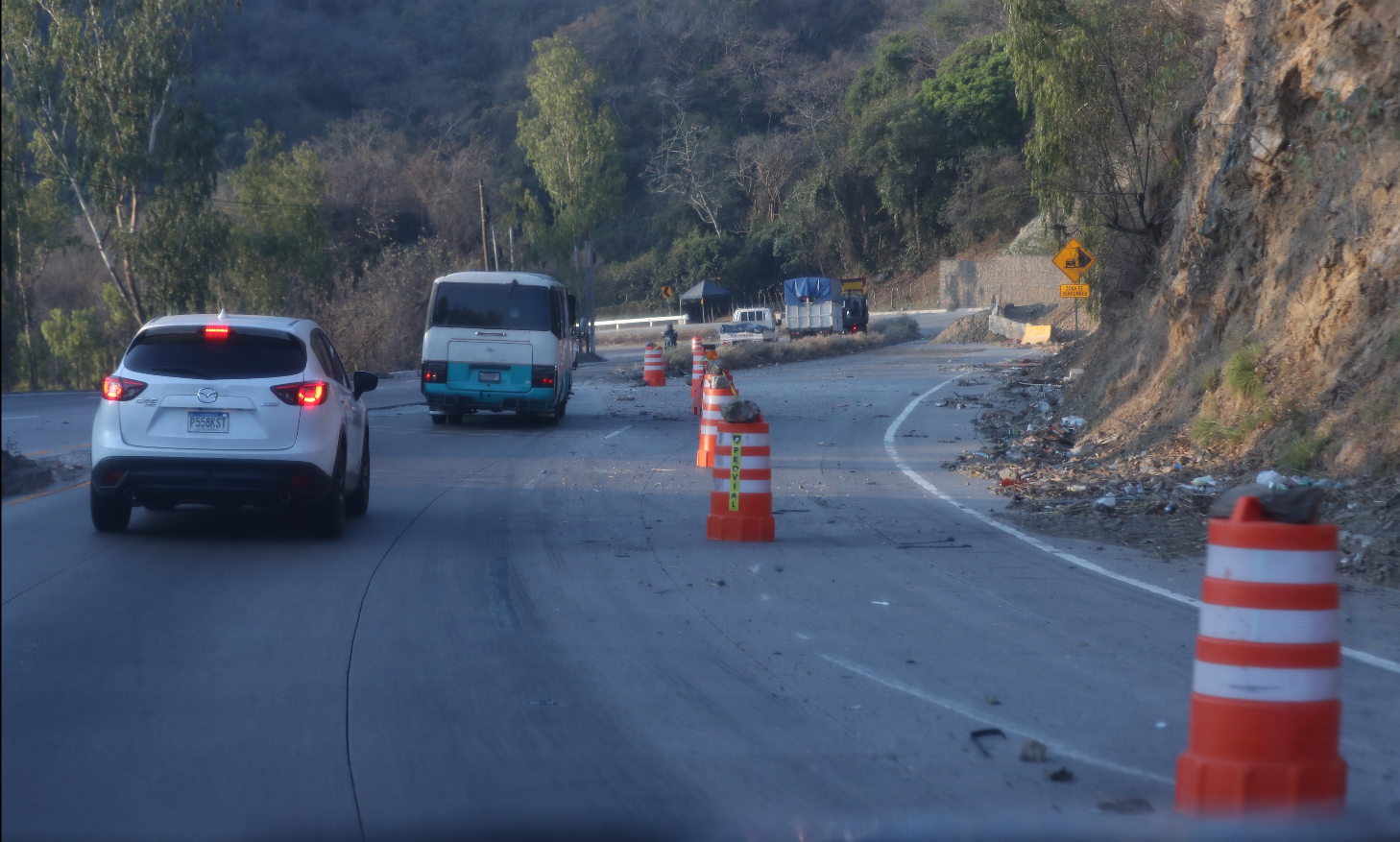
Along the route it is also common to find people who cover some holes and potholes with sand, earth and pebbles. They place objects such as stone and clothing in the center of the road, to be visible to drivers and thus try to get some money for work.
Towards the truthfuls
Another of the main trade routes in the country is the CA-14, which connects the capital with the East and the Verapaces.
Towards Cobán, Alta Verapaz, the section is traveling in an average of three hours, due to several factors that affect the journey, such as repairs in some areas where bumpy has just begun; For example, in Morazán, progress.
After that department, the state of the road improves and, although there are no potholes or holes, according to some carriers, one of the main fundamental are the mounds, many not marked, which damages the vehicles by not being visible, usually during the night.
Some conductors even perform maneuvers to try to make the tumuli not hit the lower part of the car, as some are large.
Santiago Quej Temú lives in San Miguel Chicaj, Baja Verapaz, where he is dedicated to peanut cultivation, beans and corn. He frequently uses this route to get to Cobán, a situation that represents sacrificing two and a half hours of his time. Beyond the distance, he explains that one of the main problems that harms mobility in that sector is the number of burials.
It ensures that, although this section is in good condition, there are other sectors where the road still needs repairs to be suitable for traffic.
Recover routes
According to the Director of Communication of the Logistics Guild attached to the Guatemalan Chamber of Industry (CIG), HERLINDO HERRERA, the most important thing is that the authorities recover the state of the roads that connect the borders of the country for cargo transport, such as CA-01 and CA-02, added to routes that connect the two ports in the country where national exports come out.
However, Herrera acknowledges that there are roads that are overcome by the flow of vehicles.
Maintenance
The maintenance of routes and infrastructure construction is vital in the country, since according to estimates of the Central American Transporters Chamber (Catransca) at least 30 percent of exports are mobilized by cargo transport in the country.
At the discretion of Fajardo, attention should also be paid to the CA-01 Oriente, which connects the national trade with the border with El Salvador through the land customs of San Cristóbal, but also states that in the case of the North CA-9, one of the main problems they have is the insufficient infrastructure for demand.
“Traffic is complicated, it occurs in places like Temulután, Río Hondo, Morales, the noisy, the road space is insufficient to absorb the traffic that goes to that part,” says the manager.
In October of last year, US $ 175 million was approved, representing Q1 thousand 352 million, as part of a loan to expand to four lanes the section of El Rancho, El Progreso, towards Teculután, Zacapa, although it is still pending that you begin to execute.
This credit also contains an environmental mitigation component that includes studies to carry out the following sections that would connect to Teculután, Zacapa with Puerto Barrios Izabal.