

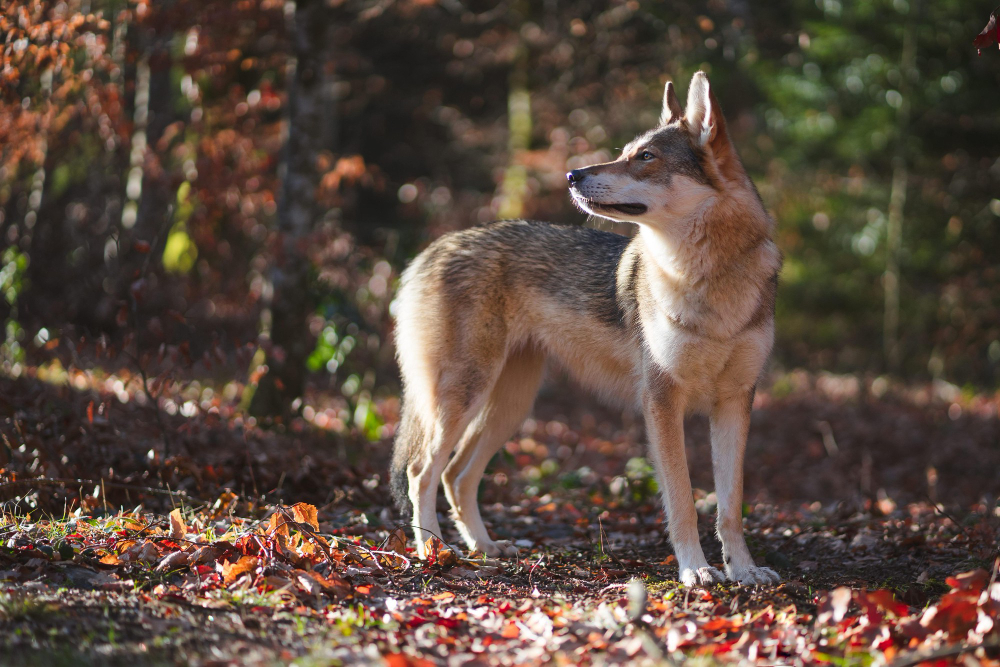
“You are listening to the first howl of a wolf Huargo.” With these words, the Colossal Bioscience company presented to Romulus and rowingconsidered as terrible wolves product of a genetic edition made by said company.
Both brothers were born in October 2024. However, this family of terrible wolves Another creature was added: Khaleesi, whose name is associated with the mother of dragons of the popular seriesgame of Throneswhere the existence of these animals is mentioned.
According to Colossal, The species of extinction was rescued through genetic modifications derived from a complete genome of this wolfrebuilt by the company from the old DNA that was in fossils between 11,500 and 72 thousand years old.
However, scientists point out that it is not a process of devincation, but genetically modified gray wolves.
What are the terrible wolves and what are their characteristics?
According to information from National Geographic, The terrible wolf was a kind of canid similar to the gray wolf that is currently known. The specialists consider that it was one of the most common carnivores that were in the Americas during the late Pleistocene.
The specialized source describes it as A robust animalof proportionally short legs. For a long time, the possibility that the giant wolves and gray had a kinship was contemplated. Nevertheless, The evidence was not conclusive.
Despite this, the magazine Nature He published a study that ensures that the terrible wolves, until about 13 thousand years ago, separated from other species of wolves around six million years, so they affirm that this species is a distant relative of the current wolves.
CRONOLOGY OF THE TERRIBLE LOBOS DEVELOPMENT
According to Colossal, This species reaches its total development at eighteen months. However, its growth is developed in six stages, classified as follows:
- Neonatal: 0 to 2 weeks
- Transitional: 2 to 4 weeks
- Socialization: 3 to 12 weeks
- Puppy: 3 to 6 months
- Adolescence: 6 to 18 months
- Adult: 18 months onwards
What do scientists think about this genetic edition?
Scientists point out that it is not a resurrected species, but genetically modified gray wolves with some giant wolf or huargo genes. The specialists have made this clarification after yesterday Colossal announced that he had “welcomed” this species.
The Spanish paleogenetist Carles Lalueza-Fox, researcher at the Institute of Evolutionary Biology (IBE), is clear: “You cannot speak of de-sextization, but of genetically modified wolves (in particular 14 genes),” he says.
“As the Huargo wolf genome has not been published, we do not know how many genes differentiate it from the gray wolf, but attending to the time of divergence of both species (about four or five million years), they will be several thousand,” and in the experiment they have only used genes with expression in the external aspect, he warns.
“If we compare it with us and the Neanderthals, whose lineages were separated only a tenth of the time of the two species of wolves, We have two percent of your genesbut no one would say that we are Neanderthals. Much less in the case of the giant wolves, “concludes Lalueza-Fox.
For Lluís Montoliu, researcher at the National Biotechnology Center of Madrid, the conclusion is the same: “Colossal has modified gray wolves using the CRISPR-CAS9 genetic editing technique and have obtained a wolf“That looks like the giant wolf but is not. It does not have all its genome,” he emphasizes.
And in statements to the scientific resources Platform Science Media Center in New Zealand, the director of the Paleogenetic Laboratory of Otago (New Zealand), Espic Rawlence, clarifies that to welcome a species you have to clone it before. The problem is that it is impossible to clone extinct animals because DNA is not well preserved enough.
For its part, Philip Seddon, of the Department of Zoology of the University of Otago, expert in bioethics and de -sextization, points out that “Colossal Biosciences, the company that is behind the efforts to resurrect the Lanudo Mammut, the marsupial wolf and the dodo, has just announced what he describes as the ‘welcoming’ of the giant wolf, a species that was extinguished about 10 thousand years. “
In this regard, he reiterates that although he speaks of de -duty, The nice puppies are not giant wolvesbut genetically modified gray wolves.
https://www.youtube.com/watch?v=quc90eca2vs
Technical and bioethical issues
But for Montoliu, the question to be asked is still no response: “What do you want to do this for? Do we want to make a zoo of impossible creatures? This issue should worry and see that it is not something that is being answered, “says Montoliu.
The geneticist remembers that, according to Colossal and its founder George Church, the goal of returning mammoths to nature is to “combat climate change, piss the tundra, compact the terrain and prevent greenhouse gases from escaping”, and that can “be more or less credible.”
In this case, “I don’t think it’s to welcome the wolf“He clarifies. However, Montoliu acknowledges that” technologically they are in charge of the use of Crispr-Cas9 tools and are able to edit hundreds, even thousands of genes at the same time, which is not simple. “
For Laueza-Fox, if it is true that in Colossal they have been able to modify 20 genetic positions in 14 genes-because this announcement is not supported by a scientific publication-it would be a positive perspective, because “The techniques could be applied to modify in danger and make them more resilient, for example, to climate change“
Seddon also believes that colossal genetic technology advances could have “implications for the conservation of existing species, not examous”, while Rawlence suggests that they should be used to preserve “what remains, not to resurrect extinct species.”
Lobo Huargo puppies are not the first colossal creation, which a month ago presented mice with mammoth hair, also made with genetic edition and generated the same controversies.