

The grandparents tell that every Holy Saturday, when the silence weighs and the city sleeps, The old amate tree Exhale a sulfur smell that escapes between its twisted roots. In those hours without Christ, when heaven still dresses and The resurrection It has not arrived, a dark presence lies the place and remembers the cursed pact of Diego Castillo, the man who sold his soul to the devil in exchange for wealth that he could never enjoy in peace.
In the streets of the Historic Center it is whispered that, when passing through the Amate on the night of Holy Saturday, a gloomy figure emerges from the mist. Its silhouette is drawn among the branches as a living shadow that offers power, fortune and success in exchange for the soul, a story that has been heard in Guatemala since 1779.
It is said that there are many souls that that hidden entity has gained between mist and sulfur. The elderly warned that those who fail to fulfill their part of the pact are dragged without a trace or redemption. The price of the easy life itself, they repeated among murmurs, because there is no wealth that justifies to get lost in the claws of the Lord of Amate.
The legend revives every Holy Week, when the city is covered with incense and penance. And in the heart of this story Vive Diego Castillo, a young man who, defeated by poverty and hopelessness, agreed to seal his destiny with the devil himself.
Diablo’s Fridays: Diego Castillo’s curse
They say that even today, among the ruins of the old house on theater street, the air becomes heavier every first Friday of the month. A smell of sulfur floats for no apparent reason. Some blame the dust or the old pipes, but others whisper that it is the mark of an eternal pact, the echo of a promise signed with the devil: the damn story of Diego Castillo.
It all started a Holy Wednesday, when the heat seemed to melt the stones of the historic center. In the San José neighborhood, Diego – Joven humble and dreamer – helped old teacher Paul to elaborate a sawdust carpet for Jesús de Candelaria.
“You want it not to rain tonight,” the old man murmured, covering the ground with sawdust flowers.
“If it rains, everything will be lost,” Diego replied. And so much that it has cost …
“It’s that if it doesn’t cost, it’s not worth,” Pablo said. Jesus collects with his steps the sacrifice of those who sow with sweat.
But Diego did not understand sacrifices. I wanted money. I wanted more.
“What has Jesus of Candelaria given to him after so many years?, Asked the young man.
“Paz … and hope,” said the old man.
-Bah. That is not eaten, I reasons, doing less what was said by your teacher.
“But you live. Pablo said.” Although you want easy money … ask the devil.
Between laughs and shadows, Paul told him an ancient story: in the Plaza del Amate, on Saturday night of Gloria, when the world still keeps mourning and the tree blooms silent, the devil appears. If one calls it … answer.
Diego smiled. But the seed was sown.
On Holy Thursday, while the Nazarene’s walk passed on the carpet, Diego felt something in his chest. An unknown emotion. But the desire was still there: he wanted fortune, power, recognition.
The Saturday night of Gloria, while the Judas de Colla were burned and the bustle filled the streets, Diego walked to the amate. The tree was waiting for him.
“Luzbel … Lord of the abyss … Listen to me said the young man.”
And the tree responded.
From the trunk a black, elegant and silent figure emerged.
“Did you call me, Diego Castillo?”
-Yeah…
“I’ll give you everything you want: fortune, respect, success.” In return, your soul will be mine when dying. And every first Friday of the month, you must return here.
Diego accepted.
Diego Castillo Pact with the devil deliver his soul when he died in exchange for wealth. (Illustration Free Press: Marcos Gálvez)
From that day, everything changed. Fortune arrived, business grew. His name, Don Diego Castillo, became synonymous with wealth. But every first Friday of the month, he had to return to Amate. I no longer saw the devil, but the smell of sulfur always received it.
Over time, he stopped fearing. The pact was part of its routine.
Until one day, passing through the Lord’s portal, he ran into the image of Jesus of Good Hope. He looked at him, and it was as if that look crossed his soul. Diego fell to his knees and cried.
Since then, he did not return to Amate. He sought comfort in prayer. But the devil does not forget. He pursued him in the mirrors, in the shadows, in the whispers of the wind. Always the same smell. Always the same silhouette.
Desperate, he went to the convent of San Francisco. There, the Fraile Emigdio listened to him and practiced an exorcism. It is said that that night, the friars saw a black shadow flee through the cloister runners.
The demon was expelled, but the price was high.
Diego lost everything. His fortune disappeared. His house was swallowed by abandonment. And he spent his last days as a sacristan, playing bells and frightening pigeons, consumed by repentance.
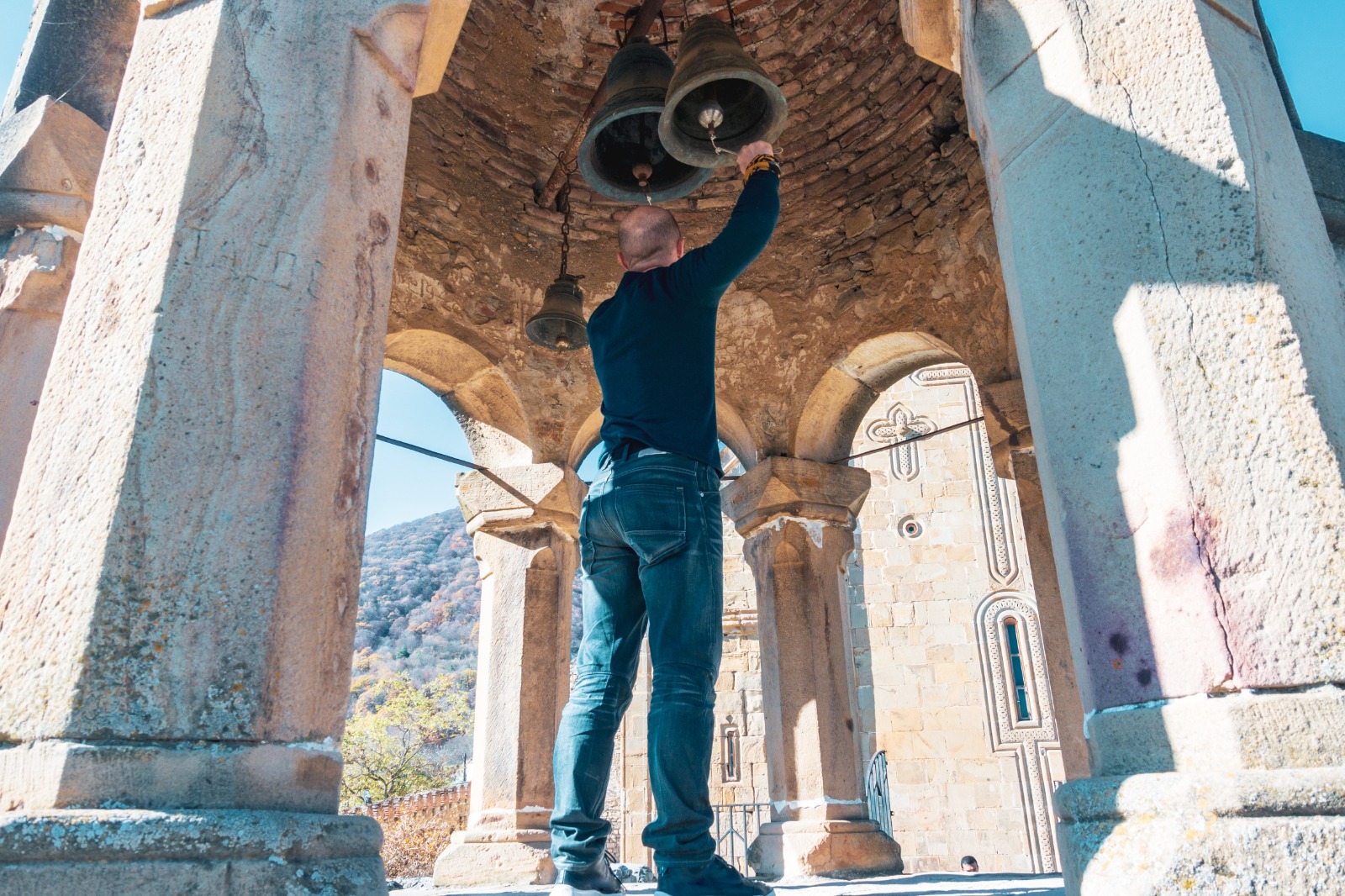
After breaking his pact with the devil, Diego Castillo took refuge in the church and dedicated himself to touching the bells until his death. (Free Press Photo: Shuttersock)
Since then, it is said that the first Friday of each month, the air next to the old Amate becomes thick … and the sulfur returns. As if the devil still awaits another ambitious soul, willing to repeat the story.
Between the sulfur of the devil and the shadows of the soul
In the streets of the historic center, a warning disguised as legend is still whispered. It is the story of the old amate tree, the one that, until the beginning of the 20th century, marked the boundary between the city and its peripheral neighborhoods. With roots that were entangled as sleeping snakes, the amate was more than a tree: it was the threshold between the visible and the hidden, between faith and temptation.
Walter Gutiérrez, historian and professor at the University of San Carlos School of History, explains that Amate not only represented a physical border, but also symbolic. It was located where the urban center ended and sectors such as San Gaspar began. There, on the periphery, the legends that sought to warn the youngest about the dangers of easy money and shortcuts without return were also gestured.
It is no accident that this story is located in a specific time: the night of Holy Saturday. According to religious symbology, it is the darkest moment of the liturgical calendar. Christ lies in the grave, God keeps silent … and the devil is loose. It is what some call “the hours without Christ.”
Óscar Cano, journalist and director of Portico, says it was during one of those nights when the first pact arose. The protagonist was a humble man, a railroad worker – more precisely, Brequero – tired of poverty and anxious to ascend. An acquaintance told him about Amate and told him that, if he went every Friday from Lent to midnight, he could make a deal with the devil.
History tells that, at first, the man doubted. But one night, after midnight, he dared. At the foot of the tree, he felt a strong smell of sulfur and an elegant figure arose between the mist. He offered him fortune and power … in exchange for his soul. And as a condition, he had to return to the tree every Friday, as a sample of fidelity to the pact.
For a while, he fulfilled. The devil was no longer shown, but the smell of sulfur marked his presence. Until, one night, Diego – there are some versions – went to party. It was Good Friday. He forgot to go to Amate. And that same night, when he returned home, he found him in his room. The devil, punctual and without clemency, had come to charge what was agreed.
According to Cano, the legend can be located between the late nineteenth and early twentieth centuries. “There are mentions of Cerro del Cielito, where the old Calvary was. The hill was disassembled in 1946 to expand the sixth avenue. It is also known that the tree was sown in 1779 and removed in 1925 to place the current CEIBA,” he says. These references allow to draw a real temporal frame to a history wrapped in the supernatural.
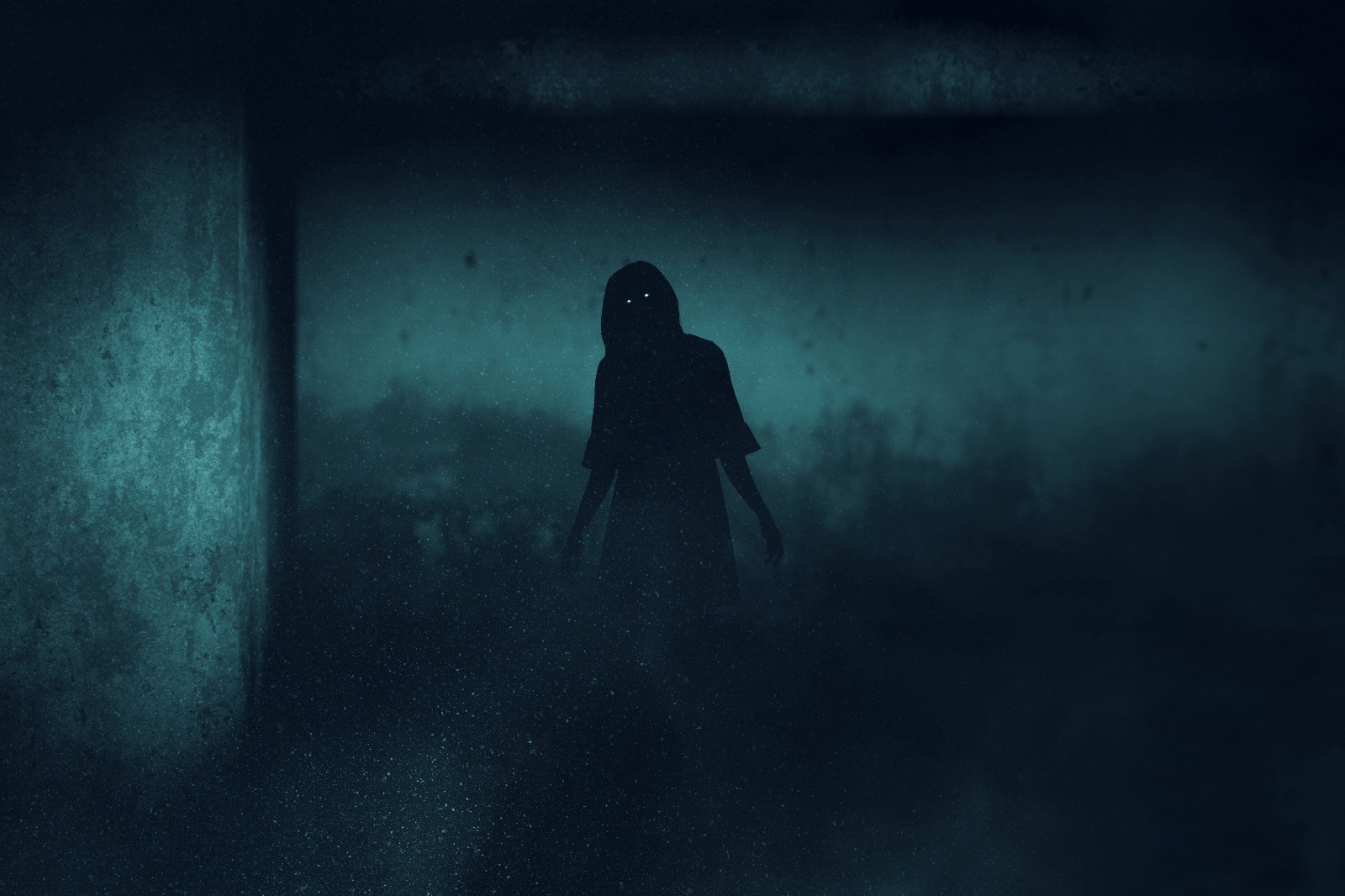
It is reported that the devil still appears in the amate trees of the Historic Center to offer a pact in exchange for the soul. (Free Press Photo: Shuttersock)
Why does the covenant occur in time without Christ?
Gutiérrez explains that symbolism is clear: between Good Friday and Sunday of Resurrection, Christ remains in the grave. It is the only time the devil is free to act. That is why many legends place their appearances in those days, when the world is without redemption, even for a few hours.
The variants of this story are multiple. Some versions say that man simply forgot the covenant; Others, who regretted and stopped attending voluntarily. But all agree on the essential: who makes a deal with the devil, sooner or later pays the price.
The smell of sulfur, a constant symbol in these stories, represents that connection with the underworld. Gutiérrez recalls that, in popular beliefs, volcanoes and the subsoil – hears loaded with sulfur – were associated with hell and, therefore, with the presence of the evil one.
Cano points out that many of these legends arose as pedagogical warnings. The curia and families transmitted them as parables disguised as fear. “It’s not that they tell you ‘do not rob’ or ‘no ambitions the alien’. They tell you that whoever does it, loses the soul,” he says. It is a form of teaching, a resource that combines tradition, mystery and faith.
And so, generation after generation, the amate legend is still alive. Some deny her, others remember her with suspicion. But everyone knows that, every first Friday of the month, if the air changes and smells to sulfur … Maybe someone else has gone to agree with the lord of the tree.
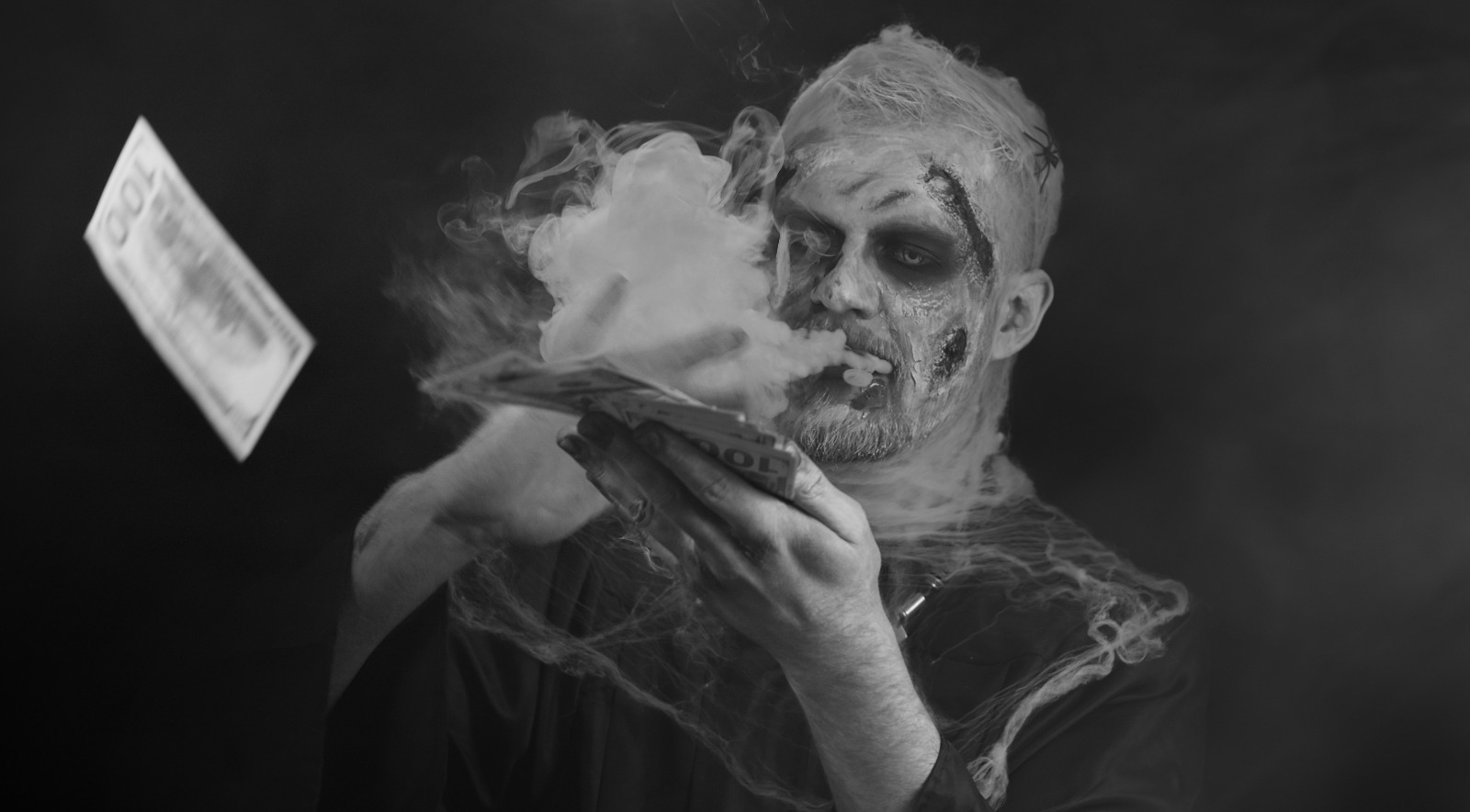
Between the afternoon of Good Friday and on Sunday of Resurrection the devil has freedom to act, in the so -called hours without Christ. (Free Press Photo: Shuttersock)