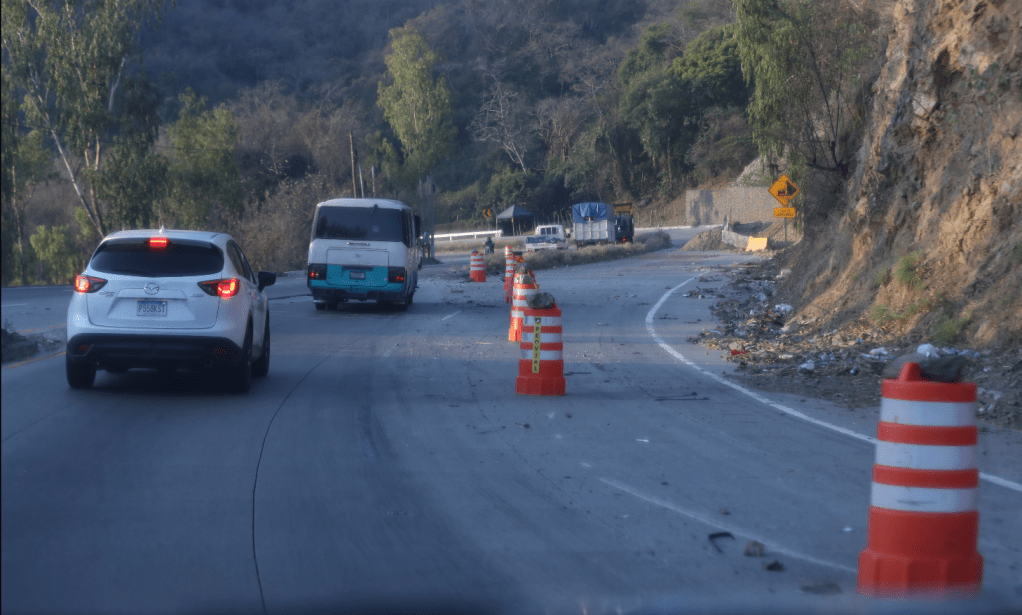
Due to administrative arrears in the tender, several road maintenance works were not carried out before the rainy season, so now the Ministry of Communications, Infrastructure and Housing (CIV) must wait for a short space during the cannula, scheduled for July, to intervene in the road network.
This year, according to the National Institute of Seismology, Volcanology, Meteorology and Hydrology (Insivumeh), an irregular rainy season is expected due to the girl’s meteorological phenomenon, so the CIV must compete against rainfall to make repairs to the road network, if it is taken into account that in the last February 66 contracts were canceled due to administrative problems; although the authorities of said portfolio claim that they work to correct errors.
In the Guatecompras portal, meanwhile, 240 events for road maintenance are recorded. The first offers must be presented on April 30 and the following on other dates next May. César George, an Insivumeh meteorologist, indicated that the cannula – dry period during the rainy season – could occur during the first half of July. However, meetings are held at the Central American level to analyze the climatic perspective from May to July 2025, the first part of the rainy season.
The CIV was consulted on how the rain could affect the maintenance work, but did not respond: before, on March 27, it was indicated that “the pothole tasks of paved routes will be programmed in the cannula or in spaces where the climatic conditions are favorable, taking into account that the presence of rain in the country tends to be irregular, allowing to work in different regions in which there is no rainfall.”
On that date they added: “Regarding the cleaning of the right of track, these will allow to maintain in full season of rainfall, longitudinal gutters, transverse pipes and clean and freed receiving boxes of waste or weeds that can obstruct the correct circulation of rainwater.”
Little time
Héctor Fajardo, director of the Central American Chamber of Transporters (Catransca), indicated that the period of the cannula is not enough for the maintenance of the road network, although he stressed that we would have to see what works they refer to, since there is material that can be poured even with rain.
“The hot bump cannot do it with rain, but the cold pothole does. We will have to see what work they refer; sometimes they speak lightly, without analyzing the issue, but it is required, because if not, we will have many emergencies,” he said.
“With the cleaning of gutters, emergencies are reduced; that can be done during the winter, but it is necessary to work for the time you can,” he added.
Damaged asphalt
At the beginning of this month, a team of Free press and Guatevisión news He made a tour of several sections of the country and evidenced the difficulties to which, they face carriers and drivers who, for work, tourism or business, must travel these routes.
Throughout the inter -American route, damage was observed after Sololá, between Totonicapán and Quetzaltenango.
In the CA-02, with a length of 300 kilometers, which connects the ends of the country from Ciudad Pedro de Alvarado, Jutiapa, to Tecún Umán, San Marcos, damages can be observed from kilometer 136.5, on the Nahualate bridge, where, because of the poor state of the structure-which last October faced damage-, vehicles must travel at a lower speed. Then, the bottling is aggravated by passing through San Antonio Suchitepéquez, San Bernardino, Cocales and Cuyenango, Suchitepéquez.
In the CA-14, which connects the capital with the East and the Verapaces, problems were also evidenced, mainly towards Cobán, Alta Verapaz, where the section is traveled in an average of three hours, due to several factors that affect the journey, such as repairs in some areas where bachelor has just begun; For example, in Morazán, progress.
Appointment
Through a statement, the CIV announced that the engineer José Juan Isupe Ibañez was appointed director of the Road Protection Unit (COVIAL). As indicated, it has experience in the execution and supervision of road projects and in quality control.
It was reported that he is a laboratory in soil mechanics and asphalt, and that he held several positions at the Asphalt Institute of Guatemala. In addition, he worked at the Engineering Research Center at the University of San Carlos de Guatemala (USAC) and has a master’s degree in Geotechnics.
Prior to the fact that a person was appointed in the position of director of Covial, there were disagreements between the Ministry of Communications, Infrastructure and Housing (CIV) and members of the Advisory Council, including representatives of the Chamber of Agro (Camagro), for how the process was carried out and demanded transparency.
The Advisory Council considers this position of relevance, by maintaining that it is the person responsible for ensuring because the contracts for the maintenance of the road network are made.
The names of the candidates for office was requested again and, in social communication of that portfolio, it was indicated that the application would be managed. It was also made on April 22, and it was indicated that the information is not public “because the inmate of the Advisory Council is handled.”