

The centenary tradition established by the Catholic Church, together with the rituals to certify the death of the pontiff and prepare the body for its wet, is clearly stipulated in the ecclesiastical regulations of the Vatican. These protocols have been applied at different times by pontiffs such as Juan XXIII, Juan Pablo II and Benedict XVI.
Among the mandatory rituals is the exposure of the body before the faithful in a public ceremony, considered a solemn act of farewell to the Pope as leader of Christianity. This process continues with the funeral rites and the funeral of the pontiff, guided by a strict liturgy and religious symbolism.
The recent death of Pope Francis, which occurred on April 21, has revived interest in knowing how the funerals of his predecessors developed, especially after the modifications introduced in the burial rite of the Roman pontiffs, which alter some traditional aspects of these ceremonies.
Each of the funerals of the last five popes has followed a line marked by tradition, inherited from the more than 260 leaders who have occupied Pedro’s headquarters. These funerals, loaded with symbolism and solemnity, represent not only the farewell of a head of state and spiritual guide, but also a milestone in the history of the Vatican and the Catholic Church worldwide.
This note reviews the last five papal burials made by the Vatican, chaired by the Cardinal Camarlengo on duty, key figure in the succession protocol and in the organization of pontifical funerals.
Benedict XVI funeral
Buried in a private ceremony, according to his own will, Pope Emeritus Benedict XVI (Joseph Aloisius Ratzinger) died on December 31, 2022 at the Vatican Mater Ecclesiae monastery of the Vatican, where he lived after his retirement from the papacy in 2013.
The burial was carried out in the crypt of the Basilica of San Pedro, in the place where the body of San Juan Pablo II remained until its transfer in 2011. As with other great and beloved pontiffs, the funeral of Benedict XVI brought together thousands of faithful in the Plaza de San Pedro. However, unlike other papal funerals, their death was not publicly announced or the usual bells established in Catholic regulations were sounded.
At the express request of Pope Emeritus, the ceremonies were “under the sign of simplicity.” His body was placed in the Chapel of the Mater Ecclesiae monastery from January 1 to 5, 2023, when the official funeral was held.
The funeral mass was carried out at 9.30 am (Rome time) and was chaired by the then Pope Francis. Subsequently, Benedict XVI was buried in the same grave where San Juan Paul II originally rested, before being transferred to the Chapel of San Sebastián in the Basilica of San Pedro.
There were more than 195 thousand people who managed to visit the coffin of Benedict XVI in the three days that was in the velation chapel.
Burial of John Paul II
Known as the most charismatic Pope, John Paul II had a historic burial, after receiving great magnitude tributes and the visit of prominent personalities of politics, royalty and the church. The Pontiff died on April 2, 2005 and was buried on the 8th of the same month, after an audience of almost three million people, a figure attributed to their proximity and deep connection with the people.
The funeral, held on April 8 and chaired by Cardinal Joseph Ratzinger, brought together more than half a million people in the Plaza de San Pedro del Vaticano. Assistants from all over the world agglomerated to pay tribute to the Pope Traveler, as it was known.
Records of the free press newspaperte library detail that those present chanted for several minutes “holy, holy, holy!” In farewell signal. Among the assistant personalities highlighted by US President George W. Bush, the Iranian Mohamed Jatamí, the Brazilian Luiz Inacio Lula da Silva and King Juan Carlos of Spain.
Ratzinger presided over a two and a half hours mass in the atrium of the Basilica of San Pedro, transmitted worldwide. At the end, the coffin was taken to the interior of the temple by 12 ujieres dressed in black and white, in a solemn procession.
Fulfilling his desire, John Paul II was buried in the Vatican Grutas, in a simple tomb covered only by a white marble tombstone, during an intimate ceremony that ended one of the most emotional funerals and remembered in the contemporary history of the Catholic Church.
John Paul I Funeral
Known as the “Pope of the Smile”, Juan Pablo I died on the morning of September 28, 1978, just 33 days after being elected pontiff. His death remains surrounded by one of the greatest mysteries of the Vatican, since, although some faithful speculated on a possible murder, the ecclesiastical authorities confirmed that he died due to a myocardial infarction.
Juan Pablo I was buried in the Basilica of San Pedro on October 4. His funeral ceremony brought together more than 100,000 people in the Plaza de San Pedro. The body of the pontiff was buried in a triple coffin of cypress, lead and oak, in a space located between the remains of their predecessors Juan XXIII and Paulo VI.
According to free press files of that year, attendees challenged an intense autumnal rain to give the last goodbye to the “Pope of Smile.” The Mass was directed by Cardinal Carlo Confalonieri, dean of the Cardenalicio College, and transmitted live to more than 30 countries, who followed with astonishment the surprising news of his death.
During the homily, Cardinal Confalonieri, 85, expressed the shock that the Church lived: no one would have imagined that, less than two months after having performed the funeral honors by Pope Paul VI, we would congregate again to fire his successor in Plaza de San Pedro.
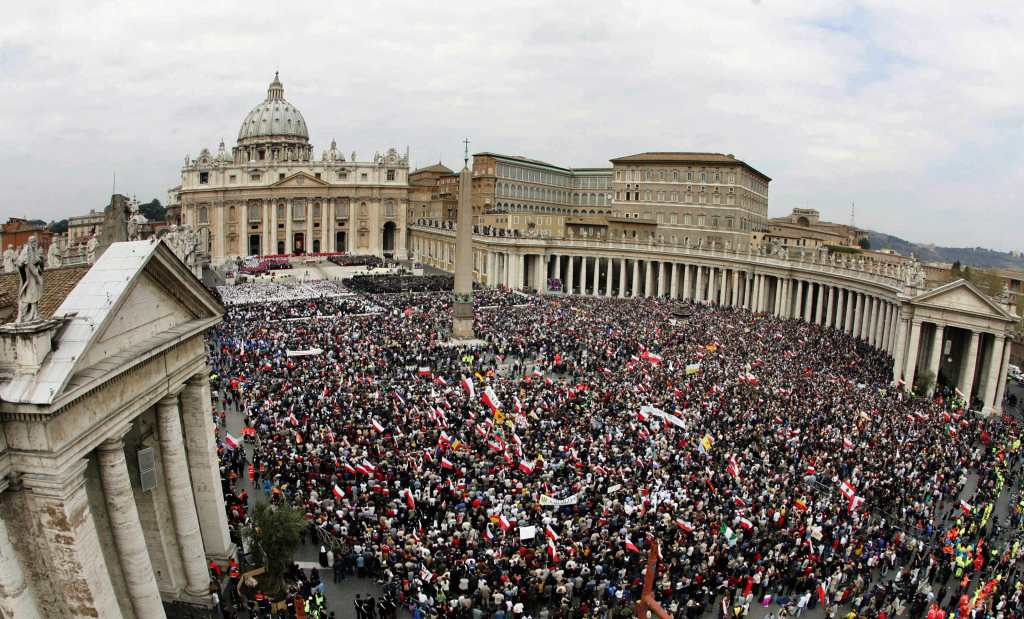
At the end of the ceremony, which was attended by faithful, diplomats and religious authorities, 12 ujieres moved the body of John Paul I to the interior of the Basilica of San Pedro, where he was finally buried in a private ceremony, according to the Vatican traditions.
Pablo VI’s funeral
In a simple but followed ceremony worldwide, Paul VI was fired on August 12, 1978, six days after his death. After his death, in the afternoon, the rites established by the Church and the Pontiff were exposed in burning chapel, first in the papal residence of Castel Gandolfo and then under the altar of St. Peter so that the faithful could say goodbye.
The burial mass, held in several languages, transmitted the message: I am the Alfa and the Omega, the beginning and the end. I will freely drink the thirsty of the source of life. This is recorded by historical free press files.
Twelve servers of Pope Paul VI moved his coffin to the grave located in the subsoil of the Basilica of San Pedro, while the crowd cried and applauded him emotionally. In his path, the great bells of the Basilica folded, accompanied by a spontaneous choir that shouted: “Long live the Pope!”, Reflection of the love that the faithful professed after 15 years of leadership.
According to journalistic records, despite being the first time a papal outdoor funeral was carried out with the presence of 107 cardinals, the Mass was developed very devout and simple, as Paul VI had requested.
His remains were buried in the Chapel of the Madonna de Donatello, in the crypt of San Pedro, under a brown marble gravestone, fulfilling his desire not to have a monument. In an intimate ceremony, four cardinals deposited symbolic documents of his pontificate in the coffin, which was sealed within two sarcophagi, thus closing the emotional farewell to Pope Peregrine.
The funeral of John XXIII
Called the “Pope of goodness”, Juan XXIII died on June 3, 1963, after suffering for eight months of stomach cancer. His funeral, which extended for several days, brought together more than 50,000 Romans in the Plaza de San Pedro to pay tribute.
Dedicated his entire life to work for the brotherhood among men and known for his proximity to the people, John XXIII was fired among applause on June 6. In a solemn procession, ujieres and palatine guards moved their body to the crowd.
According to free press files on June 7, 1963: the procession reached the stairs of the square in front of the Basilica of San Pedro, where it stopped briefly. The coffin was raised so that the crowd could see and say goodbye in silence.
After the public act, the pontiff’s body was returned to the basilica and placed in a cataphalco before the papal altar, next to his triple coffin of cypress, lead and walnut. After the Mass, he was buried in the caves of the Basilica of San Pedro, near the tomb of the Apostle St. Peter, first Pope of the Church.
Read more: 5 symbols of Pope Francis’s coffin that already rests in the Basilica of San Pedro