

Scenery
The Mayan clothing suit of Palín, Escuintla, which is part of the series “Mayan Textile Tradition” and which is published in Magazine D, stands out for its brocades of geometric shapes, zoomorphic, fitomorphic and anthropomorphas.
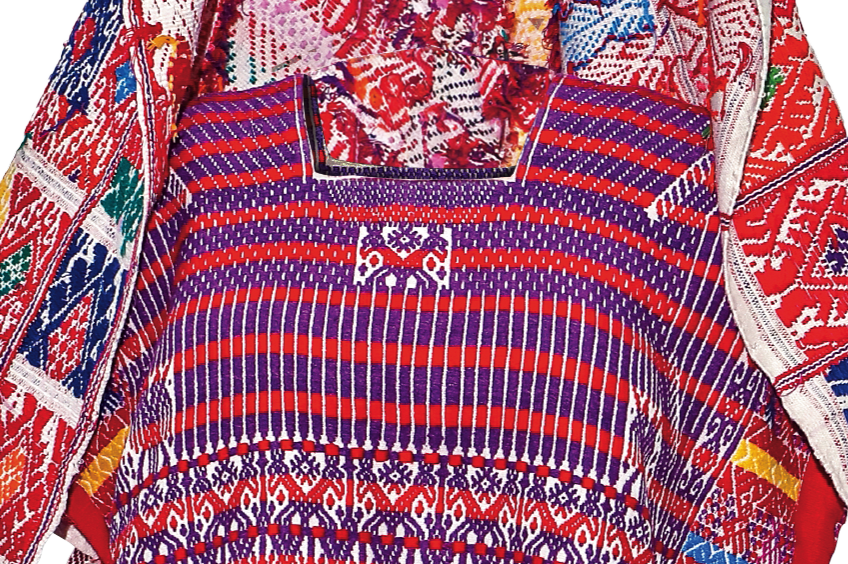
Broked figure in the center of the Huipil of the Mayan clothing suit of Palín, Escuintla, which represents the two -headed eagle. (Photo Press Libre, Juan Diego González)
The traditional square neck huipil It is weaved in a single canvas, in waist loom, with geometric motifs and zoomorphs in supplementary plot threads, brocades It is a short huipil, so it is not used inside the cut.
The cut is weaved with blue background and thin white stripes; The most contemporary pieces include silver metal threads. This is rolled around the waist, with which pallets that are characteristic of the community are formed. At present this practice is in disuse, so you choose to wear the garment as tight to the body.
The girdle is wide and woven in waist loom, with multicolored geometric brocades on a red base.
The tun headdress is a red wool tape with blue shores, Very long, about 20 meters long, which is enrolled and knotted with hair, a particular form of this community.
The tun is considered as the representation of a snake, which acts as a protection for people to keep their distance. It is also a protective animal as mentioned in the Popol Vuh.

Design
- Linguistic community: Poqomam
- Ceremonial use
Huipil has vertical red stripes on both banks of the canvas that frame the decoration with brocades of geometric shapes, zoomorphic, fitomorphic and anthropomorphic. Among these, to the center, the two -headed eagle stands out, a reason for European origin that represents pre -Hispanic concepts: the great God who had two faces; one that saw forward and the other, backward; one that saw good and the other, evil, or one that saw the earth and the other, towards heaven.
This is one of the costumes that belong to The collection of IXCHEL Museum of the indigenous suit, whose support for the publication of this series is fundamental, especially that of its director and curator, Violeta Gutiérrez.
- The information on Mayan clothing costumes presented in this space depends on the temporality and context of the documents and people consulted by the Ixchel Museum.
- In the Mayan textile tradition, elements such as trends in each community influence the personal taste of the bearers and creators of this tradition. In some cases, the data is scarce or vague.