

The Alarms in Guatemala They lit at the end of April 2025, when Honduras complaints against a company that offered alleged began to circulate Investments in digital batteries through a mobile application.
The company, which operated under the names Keda and KMEC In that country, he stopped working suddenly, and the first investigations of the Honduran Public Ministry They revealed direct connections with similar activities in Guatemalan territory.
A poll carried out by Free press In various social networks it reveals that this scheme, similar to a financial pyramidhas been replicated in different countries in Central America with a well -defined strategy and adapted to different audiences.
The scam with digital batteriespromoted by alleged companies such as Keda, KMEC and Xtrait has apparently left many Guatemalans without their savings.
Keda, Kmec and Xtra operating ways
According to testimonies collected in social networks, the company changed its name To attract new investors.
In Guatemala, he operated under the brands Keda, KMEC and Xtraeach with one different investment mode. Next, the three main methods used to capture victims in Guatemala:
Investment in digital batteries through an application
One of the most recurring methods was to offer users the possibility of investing in a project supposedly linked to the Digital Mining and the Energy infrastructure. Through a mobile application, users downloaded a platform that simulated the activity of a digital battery.
According to the promoters, when recharging this battery in the app, daily gains were generated, which could be monitored from the cell phone. Presented the proposal as a Modern, technical and revolutionary investmentwith immediate returns. This narrative especially appealed to young people or with interest in the technology and the digital entrepreneurshipwho were looking for quick income without too much technical complexity.
Purchase of physical shelves with rechargeable batteries
Another modality detected in social networks and supported with audiovisual material consisted of an seemingly more tangible investment model. In a promotional video, apparently recorded in Guatemala, a modern stand with shelves that exhibit portable batteries marked by the name is shown KMEC.
In this case, investors were offered the opportunity to acquire such shelves along with a specific amount of rechargeable batteries. The argument was that these devices would be placed in strategic places (shopping centers, buse stations or public spaces), where citizens could rent them to recharge their mobile phones. It was assured that the investor would get profits as more people used the batteries.
@y..a..n..e..t..6..11 #Keda #Guatemala ♬ Original sound – Keda Guatemala 🤑
Investment in physical batteries installed abroad
The third identified method combines elements of the two previous modalities. In this case, the promoters offered the purchase of a physical shelf of portable batteriesbut with a particularity: these would not be located in Guatemala, but distributed in different countries, such as China, Colombia or the United States.
Investors were assured that they could monitor their shelves and the income generated by each battery rented through a mobile application. In theory, this allowed having control and monitoring of profits.
The Investment amounts initials ranged between Q5 thousand and q10 thousandbut as the commercial relationship progressed, the promoters demanded New contributions With the threat that investors would lose what they already contributed if they did not.
Some users report having invested Q11 thousand, Q25 thousand and even Q40 thousand. This was mainly due to two reasons: initially, observing alleged Quick earningsthey decided to increase their investment with the expectation of obtaining greater benefits; Subsequently, many gave in to the Psychological pressure exerted by the promoterswho warned that, if not contributing more money, they could lose everything invested.
Departments where they operated in Guatemala
The scam was aim main to departmental areasboth in Guatemala and Honduras. In the Guatemalan territory, complaints have been documented on social networks from at least the following departments:
- Suchitepéquez
- San Marcos
- Alta Verapaz
- Sacatepéquez
- Zacapa
- Chimaltenango
It is even suspected that in cities like Cobán They could have mounted physical offices to gain greater credibility. According to the company’s social networks, in these areas they had a place to serve the interested parties.
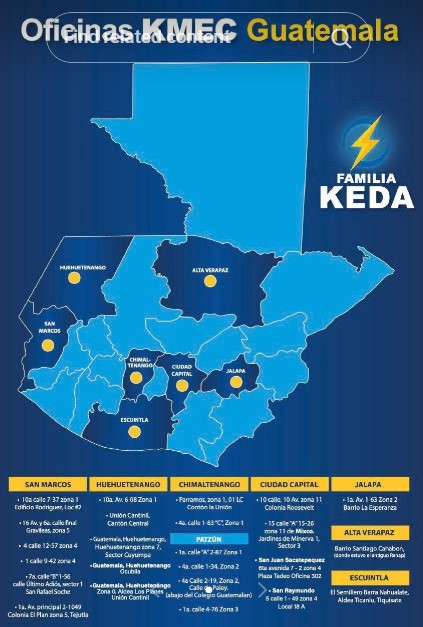
To date, the Guatemala Public Ministry has received at least 16 formal complaints related to this case, presented from September 2024.
A pyramidal scam disguised as technological innovation
The case has been compared to other Pyramidal scams that have emerged internationally. The alarm in Guatemala was lit when a company with the same way of operating stopped working in Honduras, generating multiple complaints in that country.
Experts in Economics and Fraud Prevention have indicated Free presson other occasions, that No legitimate investment guarantees an immediate returnwhich is a clear alert signal. KMEC offered profits from day one and promised duplicate or triple capital In just two months.
In addition, they applied the classic pyramidal system: they asked each new investor to They will invite two more peopleand the first to enter received payments financed with the money of the last to enter. This maintained the illusion of profitability … until the system collapsed.
Once a certain saturation point was reached, the promoters demanded new investments not to lose what has already been contributed. If the investor decided to contribute or not, the company simply disappeared. In many cases, physical offices also closed and eliminated every trace online.
Expansion of the scam in Latin America
Fraud not only affected Guatemala and Honduras. According to international media, the scheme of the “Digital Battery” has also been denounced in Nicaragua and the Dominican Republic.
In Argentina, a local media reported that in a small town, One third of the population was scammed With a similar system, which demonstrates the high level of sophistication and scope of this type of fraud.
Recommendations to avoid falling into scams
The Scams with technological investments They are increasingly common. In order not to fall into this type of deception, it is recommended:
- Distrust any investment that promises immediate or excessive returns.
- Verify if the company is registered and regulated by financial institutions.
- Consult with financial experts before making an investment.
- Get promotional videos or supposed success testimonies.
The case of Keda, Kmec and Xtra is a new reminder that Financial scams They continue to evolve and adapt to new technologies, taking advantage of those who seek rapid economic opportunities in difficult times.
Investigation
He Public Ministry He informed that he investigates a modality of Pyramidal scam by participation in Fraudulent investmentslinked to an alleged entity named Keda.
“In accordance with the denounced facts, the victims receive a Linkwhere they are asked Enter data that will serve to register an account in which they must perform different deposits and transfers in order to invest in this company and thus obtain greater profits, ”said the MP.
“However, when victims try to withdraw their yieldsthe supposed managers interrupt communication with them, ”added the research entity.
It was detailed that, so far a total of 16 complaints have been received. The first entered September 2024the second in March 2025 and, during the first days of May, 14 complaints have entered.