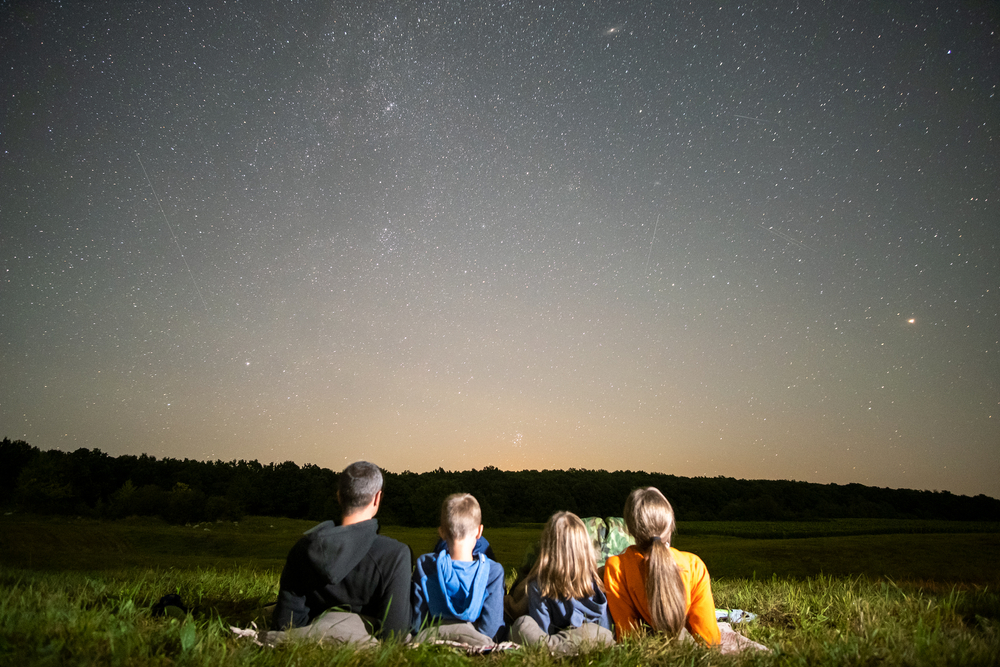
One of the Astronomical phenomena more impressive and frequent throughout the year They are the rains of stars, or meteor rains.
According to the American Society of Meteorsthis light blue phenomenon It consists of the observation of several meteors that radiate, or originate, from a point in the night sky called radiant.
These meteors are caused by currents of cosmic debris, called meteoroids, which enter the Earth’s atmosphere at extremely high speeds in parallel trajectories, which causes, visually, it will be observed as a rain.
In addition, the Meteor Data Center of the International Astronomical Union (UAI) It records more than 900 alleged star rains, of which about 100 are well established.
Although most are not visible, during the year there are many that can be observed easily and present more activity, although it is necessary to pay attention at the time and the lunar light conditions.
The recommendation of the American Meteor Society is to observe these rains after midnight, although each one has a different schedule.
2025 star rain calendar
In the remaining months of the year, astronomy fans of the northern hemisphere, especially in Guatemala, will have the opportunity to enjoy eight meteor rains, detailed below:
Perseids
They are one of the brightest meteor rains of the year. They occur every year between July 17 and August 24, and usually reach their maximum splendor between August 9 and 13.
The Perseids receive their name from the constellation Perseus because the direction of where this rainy rain seems to come with this constellation.
In 2025, its peak will be between Tuesday 12 and Wednesday, August 13.
Draconidas
Also known as giacobínides, it is one of the two meteor rains that adorn the skies annually during the month of October.
Its name comes from the constellation of Draco, the dragon and is formed when the earth crosses the remains of comet 21p/giacobini-zinner.
In 2025, the draconids will reach their maximum at night between October 8 and 9.
Orionaids
Orionaids are active every year in October, and usually reach their maximum around October 20 or 21. At its maximum point, you can see up to 20 meteors per hour. They are the second meteor rain of the month after the draconids.
This rain of stars is the second meteor rain created by the Halley comet, in charge of the star rain ETA Acuáridas de Mayo.
He receives his name from Orion, because the meteors seem to arise or radiate from the same area in the sky as this constellation.
In 2025, Orionaids will reach their maximum at night from October 20 to 21.
Táuridas del Sur
The South Táuridas are a rain composed of two main components: the annual component, which reaches its maximum on October 14, and the fireball swarm component, which reaches its maximum on November 4.
In 2025, being a year of swarm, The maximum will be from November 3 to 4, the 4th being the day of greatest activity.
Leónidas
Active in November, this rain reaches its maximum point between 17 and 18 of the month. It is called Leónidas because his radiant, or the point in the sky where the meteors seem to emerge, is in the constellation of Leo.
In 2025, it can be observed at its maximum point between November 16 and 17.
Geminids
Considered one of the most spectacular rainssince it allows to observe up to 120 meteors per hour at its maximum point, which occurs between December 13 and 14. Geminides are usually bright and intensely colorful.
This meteor rain owes its name to the constellation of Gemini because meteors seem to emerge from this constellation in heaven.
Unlike most stars rains, geminides are not associated with a kite, but with an asteroid: Faeton 3200.
In 2025, its maximum point will be between December 13 and 14.
Úrsidas
Activate between December 17 and 24, reaches its peak around 23 of that month. You can offer up to 10 meteors per hour.
It is called Úrsidas because they seem to radiate since the constellation of the minor bear and the Úrsidas are associated with comet 8p/tuttle.
In 2025, its maximum will be observed between December 21 and 22.
Quadr
Activates from the end of December until the second week of January. Reaches its maximum point around January 3 and 4.
Unlike other rains, its peak only lasts a few hours. Although their name comes from the extinct Quadrans muralis constellation, sometimes they are called Botidas, in honor of the Boötes constellation.
It will be the first rain of stars of 2026 and will reach its maximum between January 3 and 4.
Although in other regions of the world more stars are occur, those mentioned in this list are visible in the northern hemisphere.
In addition, the president of the Guatemalan Association of Astronomy (AGA), Eleonora Poitevin, shares the astronomical calendar of the institution, in which it is possible to find this and other phenomena to enjoy the night sky.
Tips for observing meteor rains
No special equipment or advanced skills are needed to observe a meteor rain. However, it is essential to be under a clear sky, away from light pollution, and have patience.
These are some recommendations:
- Dress according to the weather and try to be comfortable, especially if you plan to stay outdoors for several hours. You can carry a blanket or a reclining chair.
- Once located, go down and observe the sky. You can use specialized applications or websites to identify the best and place for observation.
- The higher the radiant on the horizon, the greater the chances of observing meteors.