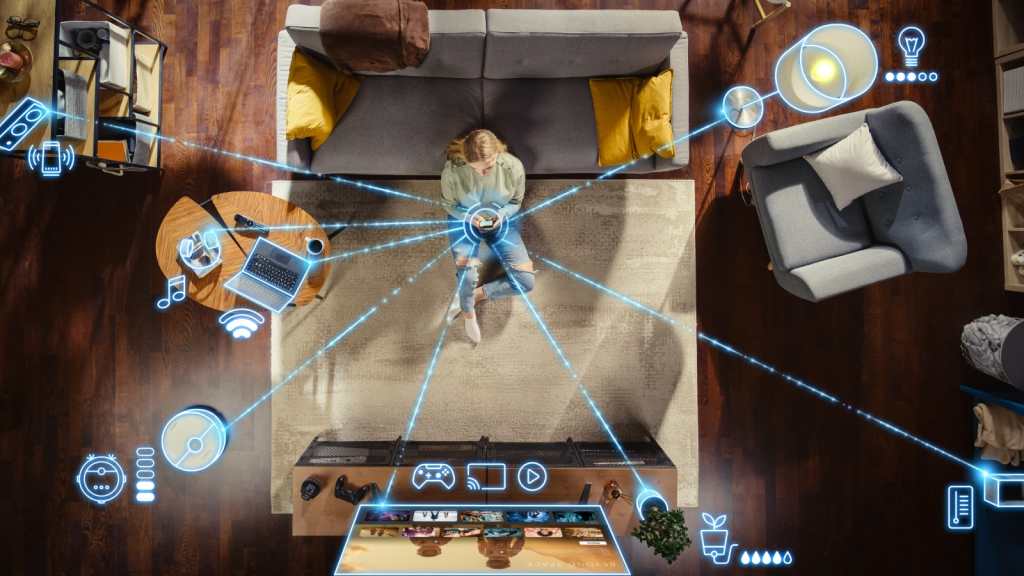
We live in a interconnected world. Messages, calls, payments, purchases, entertainment, among other activities, are some of the actions that we can perform online, either through a computer, A cell phonea tablet, or even from a TV or a smart watch.
But for all this to work, it was necessary to invent an element that allowed this interconnection: the Internet.
In 2025, the Internet is part of the routine of most people in the world, either for work, communication, leisure or even to do sports.
Its importance is so great that, at a conference from the United Nations Organization (UN) held in 2006, World Internet Day was established every May 17.
Origin of the Internet
With the passage of time, The characteristic sound of the internet ceased to exist. The connections are now successful, and things that we would never imagine that they would need a connection, such as a light bulb, are connected.
But how does the network arise?
The history of the Internet has its roots in The tense days of the cold war. When the Soviet Union launched Sputnik 1, in October 1957, United States He responded with the creation of the Agency for Advanced Research Projects (ARPA) in 1958, a division of the US Department of Defense made up of elite scientists and equipped with large funds to develop unconventional technologies that kept the country at the technological avant -garde.
Among the halls of university laboratories and military bases a revolutionary idea was created: create a decentralized network that allowed the exchange of information between geographically dispersed computers.
This vision began to materialize on December 1, 1969, when Arpanet was officially born, initially connecting four American universities: the University of California in Los Angeles, the Stanford Research Institute, the University of Utah and the University of California in Santa Barbara.
The network that changed the world
Joseph Carl Robnett Licklider, Researcher at the Massachusetts Institute (MIT) And director of the ARPA computer research program, was the first to describe a “galactic network” as a set of globally interconnected computers and accessible from any corner of the world. His vision laid the conceptual basis of what we know today as the Internet.
A crucial advance came from the hand of Leonard Kleinrock, also from MIT, who in 1961 published his package switching theory.
This innovative technique allowed to divide data messages into small units that could travel on different routes until they replace in their destination, making the most resistant network against possible failures.
The true technological leap occurred in 1973, when Vinton CERF and Robert Kahn began to develop the transmission control protocol/Internet protocol (TCP/IP), the common language that would allow communication between different networks. This protocol was officially adopted on January 1, 1983, date that many consider the birth of the Internet as we know it today.
From Arpanet to the World Wide Web
While Internet infrastructure grew during the 80s, its use remained mainly limited to academic and military circles. It was not until 1991 when Tim Berners-Lee, a scientist from the European Organization for Nuclear Research (CERN), presented the World Wide Web, completely releasing its code and committing not to charge for its use.
Berners-Lee created the fundamental tools that allowed the popularization of the Internet: HTML language to create web pages, the HTTP protocol for data transfer and the URL system to locate resources on the network. This transformation made the Internet an accessible space for non -specialized users.
The digital explosion
For their part, the 90s marked the entrance of the Internet to the homes.
The first search engines emerged, like Yahoo! (1994) and Google (1998), as well as pioneers online stores such as Amazon (1994) and Ebay (1995).
As of the year 2000, with the expansion of infrastructure, the world experienced one of the greatest cultural and social revolutions with platforms such as Facebook (2004), YouTube (2005), Twitter (2006) and Instagram (2010).
The exponential growth of connected devices has generated new challenges. Between the rise of artificial intelligence and adaptation to new technologies, today we no longer listen to the characteristic sound of the modem connecting to the Internet, but the network is more present than ever in our lives.
What began as a military project during the Cold War has become the connective fabric of modern society, joining continents, cultures and people in real time, and completely redefining our way of communicating, working and living.