

Scenery
Gioconda Belli presented his latest book “A silence full of murmurs” in Sofos, zone 10. Almost 300 people were present to meet the author. On Friday, May 23 will be in another activity.
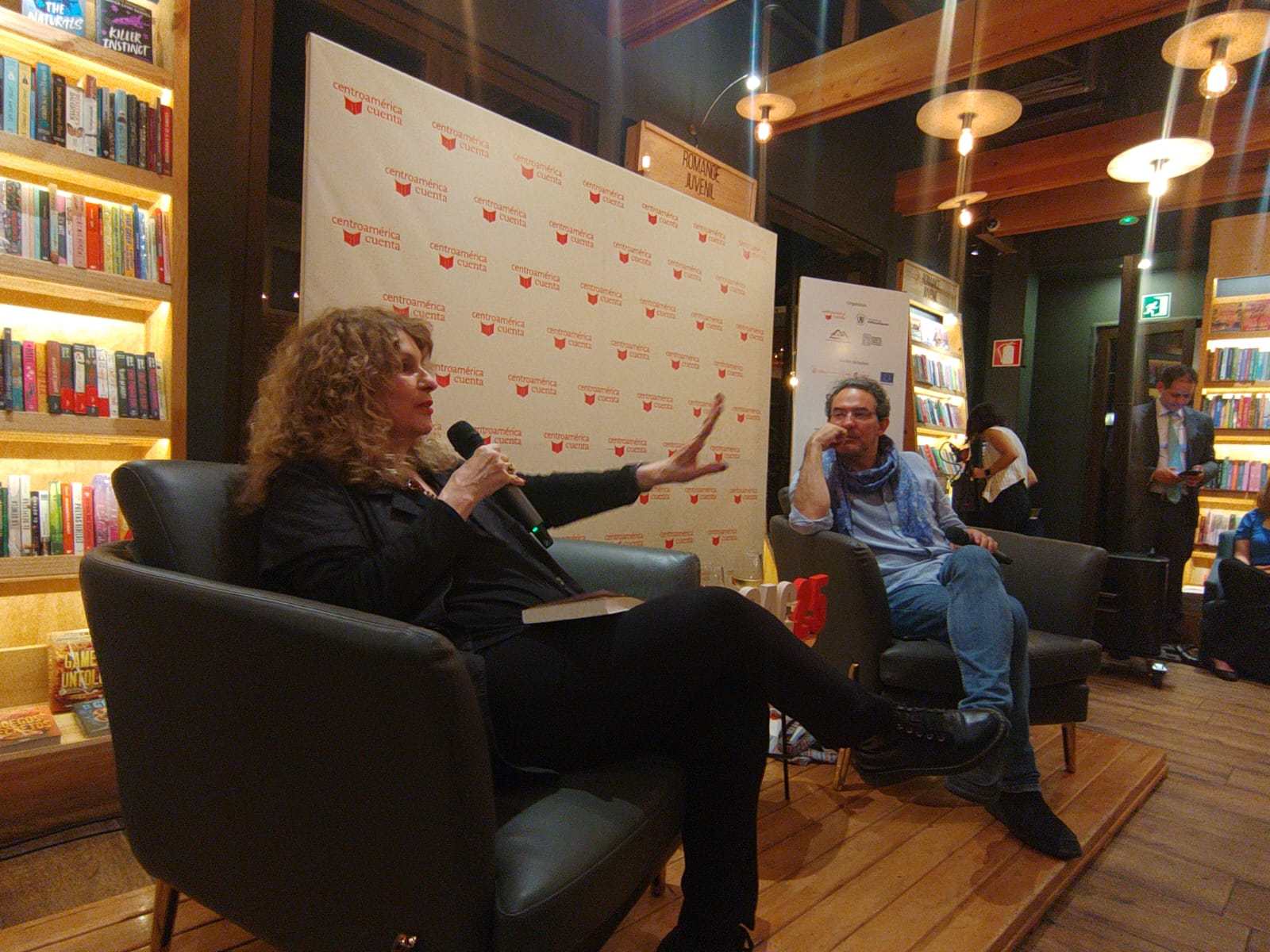
Gioconda Belli during his presentation in Sofos, zone 10 during the presentation of his book a silence full of murmurs.
Central America’s activities started, CAC 2025, On Monday, May 19 with activities in Totonicapán and San Juan Comalapa with conversations such as social movements and political transformation: resistance and democracy in Guatemala and peoples of memory: art, identity and resistance. Different organizations, Guatemalan leaders and international guests were part of them.
For those who failed to attend physically there are some of the recordings of the activities On the Facebook and YouTube page of the CAC.
In the capital city, the first activity that was developed It was the launch of A silence full of murmursthe last book of the prolific writer Gioconda Belli In Sofos, zone 10. About 300 people were present and almost 200 were standing during the presentation.
The Colombian writer Juan Gabriel Vásquez was in charge of it. Their opinion articles appear regularly in The spectator from Bogotá and The country from Madrid. In 2016 he was appointed gentleman of the Order of the Arts and Letters of the French Republic and in 2018 awarded with the order of Isabel la Católica.
With a wine in hand, writers shared a dynamic presentation with laughter, moments of impact and others in which the public intervery with their applause.
Next Friday, May 23, the author will also have another meeting with the public. There will be a dialogue with her that will be transmitted through the link of events of Free press For those who register. To fill your registration register here. In the dynamic, 10 subscribers will be selected to be in person in the event and live with it.
“The world is full of imagination, and in that world of imagination the writers we find ourselves. We find the things that torment us, with the things that make us happy, and the stories arise from that mixture of how we see the world. With this novel I began trying to find how Outdating a dictatorship, seeing the classmates themselves become dictators, is a very hard experience, and one cannot believe that what is happening in Nicaragua is happening, “says the author.
The writer also describes that in the novel, Valeria, the mother, fought against the Somocista dictatorship, and her Penelope daughter goes to Madrid to take care of the mother’s things when she dies, and finds a lot of secrets while she is confined in the pandemic. Thus he understands the mother, herself, who has gone through the 2018 rebellion in Nicaragua. “Political facts transform us, and political facts force us to make certain decisions and make certain changes in our lives,” he adds.

What is the story of the writer Gioconda Belli?
Gioconda Belli was born in Managua, Nicaragua. His talent, work and active struggle has made it a winner of recognitions, such as the Brief Library and Sor Juana Inés de la Cruz awards, for his novel The Infinite in La Palma de la Handa (Seix Barral, 2008). He was recognized in 2024 with the Ibero -American critical eye. In 2023 he won the Reina Sofía Poetry Award. He also received the Honoris Causa Doctorate from the state University of Costa Rica (UCR), for its contributions to culture, education and struggle for democracy and human rights.
In this article we also share an interview published on May 4 in D magazine, The writer opened a space to share her history, her thoughts and positions. Belli is for the second time in exile and speaks from an experience marked by resistance, memory and commitment to freedom of expression.

When does Gioconda Belli begin to write?
I was born in Managua, Nicaragua, and started writing at age 20. I had not written before, and I started writing, motivated by two things: one, for feeling that I was doing something useful, which was when I started to reflect politically and, on the other hand, I had always been surrounded by books. In my house there were many books. My mother was director of Experimental Theater of Managua. At first there was scandal because I talked about my body. He believed in the importance of claiming, in a way, the female body. Why were we going to embarrass him and why we were going to have him covered? The men were the ones who talked about the woman’s body, and we couldn’t talk about our own body, much less about man. I wrote poetry that was considered very transgressive in the seventies.
I won several awards, such as that of the National Autonomous University of Nicaragua. Then, the Casa de las Américas Award. Between 1984 and 1985, I decided to write a novel. I wrote a very autobiographical poetry and wanted to involve and put in my words the collective experience that had been trying to overthrow a 45 -year -old dictatorship. This has been part of my story. I got married, I divorced and I had three children.
What would Gioconda Belli or adolescent say?
Follow what you are doing. You see life back and be one saying “I would have done this, I would have done the other” it makes no sense. For me, the important thing is that one does not lose inner strength. I have a center that I have been building through everything that happened to me. This is my second exile. So, I say that my country is so small that it is portable and always charge it with me. Nicaragua are not going to take away the Ortega or the Murillo, or anyone; And nationality will not take it away either. That is something that belongs to me by birth right. So, that is a total abuse of these dictators who believe they can intervene in something as important, as is the root that one brings. My umbilical cord is buried in Nicaragua, and there is going to stay. I am happy with the life I have had; It seems to me that I have had a life with great and low, but I have also had a life that I feel that, if I die tomorrow, I do not die empty -handed.
How does female power see today and what paths are there to explore?
For me, the fundamental path is to reformulate care. One of the great problems of modern women is that he has to decide between a good career and motherhood, and because motherhood touches her first. The work world is organized for men who have wives. So, everything is organized for people who go to a job, who does not leave there until 5 pm, who does not have enough time to take care of their children, neither men nor women.
For me, there are more accessible child development centers for all women, who are handled by very capable people, studied on child psychology, because I always take care of people less studied; Let’s say, people who have more need are given. It is not that they are going to do it wrong, but to really have some children who have all the possibilities of developing their imagination, their wisdom, etc., because they need who guides them, and that guide them people who are trained and who know of education and pedagogy. Women have made important advances and there is a kind of fear of men, who are turning feminism into a kind of plague. They speak of feminism as that feminism is responsible for a lot of alterations in everyday life, and that is reflected in violence against women in Latin America. What we have advanced nobody will take it away, but we have to be firm and make them see the men that we both should have that possibility for women – which represents 52% of the world’s population – to participate fully and to develop the potential of both, and not only one of the genres.
She is currently Vice President of Central America, for you what is the most enriching of this festival?
Central America has a beautiful occurrence of Sergio Ramírez – with whom we are here (Spain) exiled – to try to achieve a conjunction between Central America, Spain and other countries.
So that the writers of both parties were known and there would also be the possibility of making support networks, editorial networks, among others. So, the festival has had enormous success. Important topics are discussed each year. This year will be what is happening in the world. How will it affect us, misinformation, immigration, the twist that Trump is giving to the entire world panorama?
I think we are going to have a lot of very interesting people. A large amount of gray matter is joined and that is enriching for people who will attend the sessions, because not only talk about literature.
What Guatemalans have you read?
Guatemala has been a country that has also marked our lives. I am very admirer of Francisco Goldman, who has written so much about Guatemala; David Unger, Rodrigo Rey Rosa, Carol Zardetto, Ana María Rodas And so many in my life. By Ana María Rodas we put a group that had the game of the erotic left. The only thing that has been dead is the arrest of Jose Rubén Zamora. I can’t forgive them to have him imprisoned.