

The United Kingdom, after obtaining consecutive agreements with the European Union and the United States, showed that, after all, I did not have to choose between its two largest commercial partners, mutually antagonistic. He could, as his ambassador to Washington, Peter Mandelson, said, “have the cake and eat it too.”
However, the limited scope and, sometimes, the very generous conditions of these agreements, which demanded painful concessions, reveal the weakened position of the United Kingdom in the era after Brexit. Far from being an agile free agent and that can reach opportunistic agreements, as Brexit’s supporters predicted in their day, the United Kingdom is caught between two heavyweights faced.
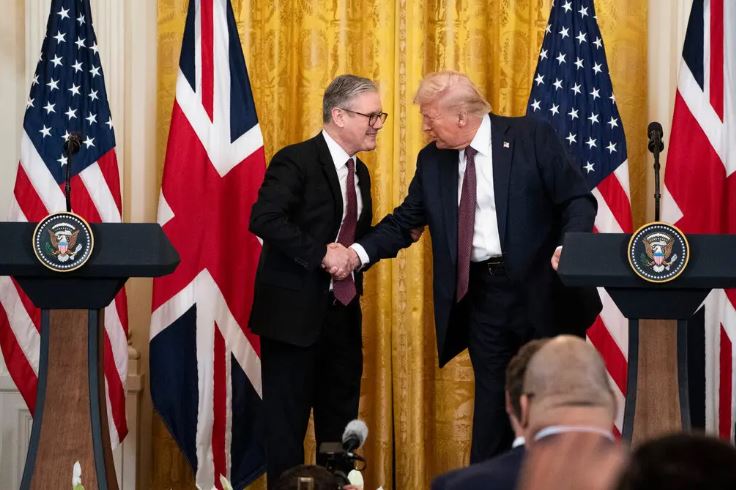
That does not mean that the two agreements of Prime Minister Keir Starmer, as well as a third with India, are not proof of a negotiating skill. His agreement with President Donald Trump was the first to be achieved with any country since he imposed generalized tariffs on dozens of commercial partners. The agreement with the European Union, which Starmer announced on Monday, is the first new significant agreement between the United Kingdom and the European Union since the commercial agreement that consecrated Brexit in 2020.
Each one has its advantages, whether the European Union allows British travelers to use electronic doors in some European airports – increasing the crazy queues for people who go on vacation – or that the United States reduces tariffs on the Jaguar, Land Rover and other British luxury cars to the US market.
“We are demonstrating that it is not a binary election between the United States and the European Union,” said Jonathan Portes, economy professor at King’s College in London. However, he added, the United Kingdom faced “a much more limited series of options.”
The agreement with the United States, for example, continues to leave the United Kingdom worse than it was before Trump’s arrival to power, with a basic 10 percent tariff on exports. Likewise, the United Kingdom had to make concessions to recover part of what it used to obtain automatically as a member of the European Union.
Although the agreement with Brussels will generate annual benefits worth almost 9000 million pounds, or 12,000 million dollars, until 2040, according to the British government, it will only add 0.2 percent to the Gross Domestic Product of the United Kingdom. Brexit cost the country 5.5 percent of its GDP, according to a 2022 study of the Center for European Reform, a London Research Center.
To close the agreement with the European Union, Starmer made a politically tense concession: allowing European drags to fish in British territorial waters for 12 years in exchange for reducing commercial barriers for British foods that enter the single market. And to achieve a partial postponement of American tariffs on British cars, the United Kingdom granted greater access to beef, ethanol and American agricultural products.
These concessions reflect the harsh reality of the United Kingdom as a medium economy that operates in a world of three gigantic commercial blocks: the United States, the European Union and China. An added challenge: one of these giants, the United States, has discarded the rules that govern world trade.
This is not the world that Brexit supporters had imagined when they defended a decade ago that the United Kingdom left the single market. They said that the United Kingdom, free of bureaucracy and Brussels regulations, could close favorable agreements, even with the United States. Trump, in his first term, applauded the Brexit project and offered as a reward the perspective of a commercial agreement.
The United Kingdom agreement with India, announced this month, represents a certain claim of the Brexit case. Starmer could not have reached the agreement, which will reduce British whiskey and gin tariffs in half, as part of the European Union.
“It was plausible to affirm that the United Kingdom, with an open and medium -sized economy, could work so well or better in an international order based on standards being agile and flexible than being a member of the EU,” Portes said. “But that world has disappeared, at least for the moment,” he added. “Now we are in a much more difficult environment, and the United Kingdom has to find its way.”
When Starmer came to power last summer, he made it clear that he wanted to readjust the relationship of the United Kingdom with the European Union, while preserving his ally status, perhaps the closest, of the United States. He has remained firm in that position, even after Trump’s return, who has disrupted the world trade system and threatened to withdraw his support for Ukraine in his war with Russia.
What began as an act of equilibrium has become a walk on the tightrope. Rahman said that, in commercial negotiations, the United Kingdom was being “squeezed between a very mercantilist European Union and a very predatory and hostile United States.”
The European Union, he said, considers the agreement that Starmer negotiated with Trump, and has no intention of replicating it. Given the antipathy of Trump by Brussels, it is not clear that he would accept a similar agreement with the European Union, although its largest size gives greater influence to its commercial negotiators.
Tensions between Washington and Brussels increased pressure on London. British officials, Rahman said, believed they had to conclude an agreement with Trump before Monday’s summit between the United Kingdom and the European Union, or risked to contradict him with images of the United Kingdom reviving their relationship with the block.
Ultimately, the calendar imported less than the basic dynamics of power. European Union officials may use a more diplomatic language than Trump’s assistants, but block officials were no less aggressive, especially when pressing Starmer to accept a long extension of European fishing rights in British waters.
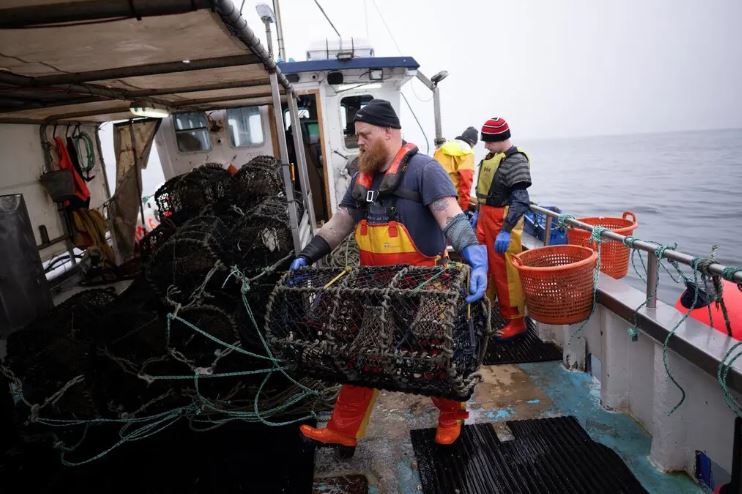
British newspapers, many of whom incline the opposition conservative party, hastened to criticize Starmer for “selling” British fishermen. The Daily Telegraph said Monday that he had tied his hands to future British governments with the fishing agreement. Boris Johnson, the former conservative prime minister who first used the phrase of “having the cake and eating it too” in 2020 to promote his own Brexit agreement, criticized Starmer’s updated version for being “irremediably unilateral.”
Starmer insisted that fishermen would benefit because the reduction of food export barriers would allow them to send more seafood to continental Europe. He described the two agreements, plus the one achieved with India, as proof that the United Kingdom was doing exactly the type of opportunistic negotiation that Brexit’s supporters imagined in their day.
“The United Kingdom has returned to the world scene, to work with our partners, to close agreements that will grow our economy and put more money in the workers’ pockets,” he said at a press conference, flanked by Ursula von der Leyen, president of the European Commission, and António Costa, president of the European Council.
“This is a new beginning,” said Von der Leyen, “for old friends.”