

On the Mazatenango route to Santo Domingo, in the department of Suchitepéquez, the neighbors built a mound. “They placed it with concrete on an asphalt structure. Without any vertical or horizontal signage, nothing,” says Allan Castro, a member of the Suchitepéquez coordinating joint of the College of Engineers of Guatemala, who lives a kilometer away from said obstacle. The Tumulus, Castro recounts, spent four days, and in that period there were about six accidents. This obstacle had no authorization to be placed, and the municipality of Mazatenango withdrew it.
Like this, there are several on the country’s roads. “No mound is put under some standard or a safety standard. They have no signaling. So what happens? They cause accidents,” says José Alejandro Ramírez, executive director of the Guatemalan Chamber of Cargo Transport (CGTC). This type of obstacles is usually present on routes where the speed is high.
At the discretion of Carla Caballeros, Executive Director of the Chamber of Agro (Camagro), far from being a security measure, what it does is cause accidents. “Many times it looks like a sidewalk and becomes a dangerous obstacle in the middle of the road,” says Caballeros.
More time en route
In addition to the risk they represent for road safety, the mounds have an impact on vehicles; For example, they affect suspension and hydraulic systems. “The springs are ruined, the brakes are heated and there are more fuel consumption,” Lista Ramírez lists.
These obstacles make hours and the transit route less efficient, and have a direct impact on transport costs. Ramírez and Caballeros agree that the mounds triple the transport time. This translates into “more time of the pilots en route, higher costs and we arrive late to the distribution centers or the ports,” adds Ramírez.
That time, which translates into commercial costs and the industry, ends up moving to the finished product and customers. “The cost associated with transport in an agricultural or agro -industrial company ranges between 15% and 25% of the total costs. The mounds become part of that cost of transport because it is associated with the bad road, they are factors that have to go much slower and that the time is greater of transit,” says Knights.
In addition to the impact towards transportation costs, Caballeros states that “it also has a direct affectation against tourism” ..
Smolles on roads
In Guatemala there is no official record of how many mounds there are or what roads are in. The question was launched on the social media: What is the road with the most mounds in Guatemala? To order the more than 500 comments, an artificial intelligence (AI) tool was used with which the routes mentioned by the users were grouped, by department:
- Alta Verapaz: Cobán, La Tinta, Teleman, Tucurú, San Pedro Carchá, Chisec, Fray Bartolomé de las Casas, Panzós, San Cristóbal Verapaz, San Juan Chamelco, Santa Cruz Verapaz, Tactic, Lanquín, Santa María Cahabón, Cahabón, Senahú, Semococh village.
- Baja Verapaz: Purulhá, Salamá, Cubulco, Rabinal, San Miguel Chicaj, Santa Bárbara, Granados.
- Izabal: Morales, Puerto Barrios, Livingston, Los Amates, Entre Ríos, El Estor.
- Petén: Potún, San Luis, Sayaxché, Laguna del Tigre.
- Zacapa: Zacapa, Gualán.
- Chiquimula: Esquipulas, Chiquimula, Camotán, Jocotán.
- Jalapa: Jalapa, San Luis Jilotepeque, nuns, San Carlos Alzatate, San Pedro Pinula, Mataquescuintla.
- Jutiapa: Asunción Mita, Jalpatagua, Pedro de Alvarado Ciudad, Compa.
- Santa Rosa: Barberena, Cuilapa, Santa Rosa.
- Progress: Sanarate, Guastatoya, El Rancho, San Cristóbal Acasaguastlán, San Agustín Acasaguastlán.
- Huehuetenango: Huehuetenango, Aguacatán, Nentón, San Pedro Necta, San Antonio Huista, San Sebastián Coatán, Santa Cruz Barillas, San Juan Atitán, San Miguel Acatán, San Gaspar Ixchil, Santa Eulalia.
- Quiche: Nebaj, Chajul, USPantán, Joyabaj, Chicamán, San Juan Cotzal, Zacualpa, Patzité, Chiché, San Pedro Jocopilas.
- Totonicapán: Santa Lucia the reform.
- Chimaltenango: eL Tejar, Santa Apolonia, San Andrés Itzapa.
- SACATEPÉQUEZ: RN-10 (step through the department)
- Guatemala: RN-1, CA-1, CA-9 South / North.
- San Marcos: Tecún Umán.
- Suchitepéquez: CA-2 West.
- Escuintla: CA-2 Oriente.
Ramírez indicates that, normally, “the tumulos are placed by the municipalities along the routes, especially the CA-2 route and the CA-1, the inter-American. So that means that they are out of law.” In addition, he estimates that in the CA-2, starting from Tecún Umán to Escuintla, there are more than 100 mounds. At Castro’s discretion, from Suchitepéquez to the border with Mexico there are more than 150 mounds.
The General Directorate of Roads, of the Ministry of Communications, Infrastructure and Housing (CIV), is the entity responsible for withdrawing these obstacles, according to the Law for Free Roads Circulation of any type of obstacles. In addition, article 6 of this law indicates that the fines for placing unauthorized mounds are between Q1 thousand and Q5 thousand.
José Rodrigo Orellana, technical deputy director of roads, states that they do not have a mapping or registration because, every day, the amount varies. “It has become a very common kind of activity,” he adds.
To remove them, Orellana indicates that the highest path for roads is to mobilize the machinery, because they need a Lowboy (Low platform towing designed for the transport of heavy and bulky loads). “That may be what would take cost, but this would vary based on the point where we are going to move,” adds the deputy director.
That same law, also known as Decree 8-2014, states that Caminos is responsible for “placing or authorizing the allowed means for speed reduction,” according to article 4.
Impact on asphalt
To authorize the construction of these obstacles, it is necessary to complete a study, which must be considered “number one, the speed with which the road is regularly travels in this case. Two, the speed for which the road was designed. Based on that, a study must be done taking into account the braking time,” explains Castro.
The mounds have an effect on the life of the road. “When someone comes and places a rigid material, which in this case can be a hydraulic concrete on flexible material, that is a problem. They are two totally different materials that one does not adhere to each other,” adds Castro.
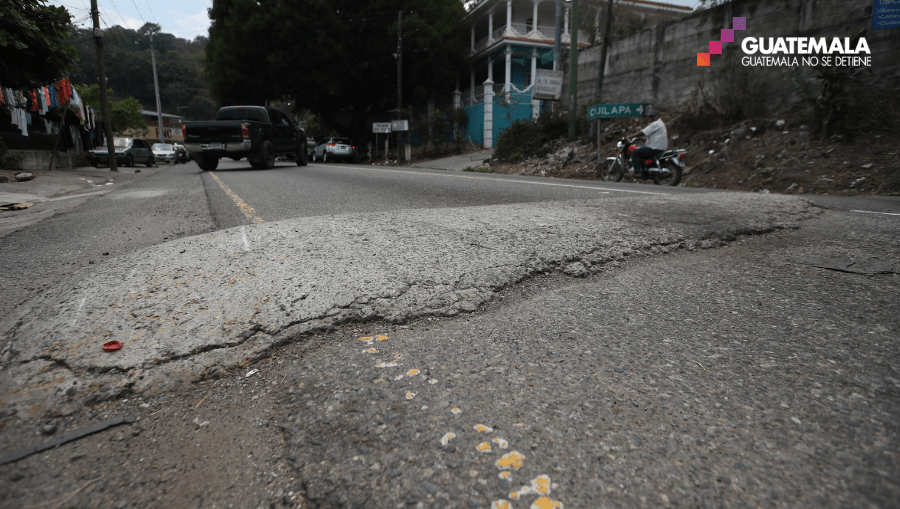
By joining these two materials, fissures and wear are generated in the rolling folder in the place where the mound is placed. That causes it to break, and over time it can become a bump. Castro estimates that “the life time of a material, in this case flexible, is designed for 8 years, 10 years or 12 years in constant maintenance.”
This life time of the road decreases to half at the time the traffic is interrupted fluently, the asphalt is exposed to constant braking and speed changes.
Apply the law and make mapping
For gentlemen, the tumulos are “a problem of disorder, of lack of application of the law.” Ramírez agrees and indicates that “we have to find that the authorities, both municipal and communications, enforce the law and regulations to authorize construction and to remove the tumuli.”
The first step to address this problem, according to Ramírez, is “to make a mapping of the routes, of the number of burials, although in the following month it already varied, but the routes are already identified.” In this inventory, the municipalities should also participate, says Caballeros, “to identify the responsibilities of each of the mayors and make a plan to eliminate the mounds in each of the routes, perhaps to be able to prioritize important routes that have become extremely dangerous due to the number of burials.”
Then, understand the justification of the population to place a mound. “-Caminos- has all the legal basis, they need to have a little dialogue with the population, because if they are going to take a mound, the next day they will put it,” says Ramírez. At the discretion of gentlemen, the population must also be given “certainty that, as well as they will eliminate the mounds, they will also ensure that transport complies with the rules of road traffic and, therefore, the population is not put at risk”.
Another alternative for the tumulos are the catwalks. “Economically, it is much more expensive, that’s why it is not done. And in the places where we are made again in the same error, we have no culture. Many times we prefer to pass under the catwalk to use the catwalk,” explains Castro.
The technical deputy director of Caminos proposes to create a technical table with the Legislative, the National Association of Municipalities (ANAM), the Government and the CIV, “to create a strategy of law and that the municipalities to ensure that public order of in the construction of the work. It must be evaluated whether this law is in accordance with the requirements of the population”.
Find more than Guatemala does not stop In our video channels of Free press and Guatevisión, A alliance content focused on journalism of solutions.