Until now, the main causes of the loss of global diversity have been overexploitation and the alteration of habitats but, as climate change intensifies, It will become the third great threat to land animals.
This is noted by a study by scientists from the United States and Mexico, whose details have been published on Tuesday in the magazine Bioscience.
The analysis, which figure in more than three,500 the number of animal species threatened by climate change, sheds light on the huge lagoons existing in the full understanding of the risk that the animal kingdom runs.
“We are at the beginning of an existential crisis for the wild animals of the earth,” warns the director of the study, William Ripple, Professor of Ecology at Oregon State University.
“Until now, the main cause of the loss of biodiversity has been the double threat of overexploitation and habitat alteration, but as climate change intensifies, climate change intensifies, We hope it will become a third great threat to land animals, “he summarizes.
More than 70 thousand species
The team analyzed data of 70 thousand 814 animal species of 35 classes, using two public data sets on biodiversity to evaluate vulnerability to climate change in wild animals populations.
They discovered that at least a quarter of the species of six different classes are threatened by climate change, including arachnids and chilopods (cempiés), Antozoa and hydrozoos (marine invertebrates related to jellyfish and corals).
“We are especially concerned about the invertebrate animals of the ocean, that absorb most of the heat of climate change. These animals are increasingly vulnerable due to their limited capacity to move and quickly avoid adverse conditions, “says Ripple.
The study warns that extreme phenomena such as heat waves, forest fires, droughts or floods can cause massive mortality in animals, which, in turn, will affect the feedback of the carbon cycle and the cycle of nutrients.
“These effects will also probably have an impact on the interactions between species, such as predation, competition, pollination and parasitism, They are vital for the functioning of ecosystems, “warns the professor.
Mass mortality
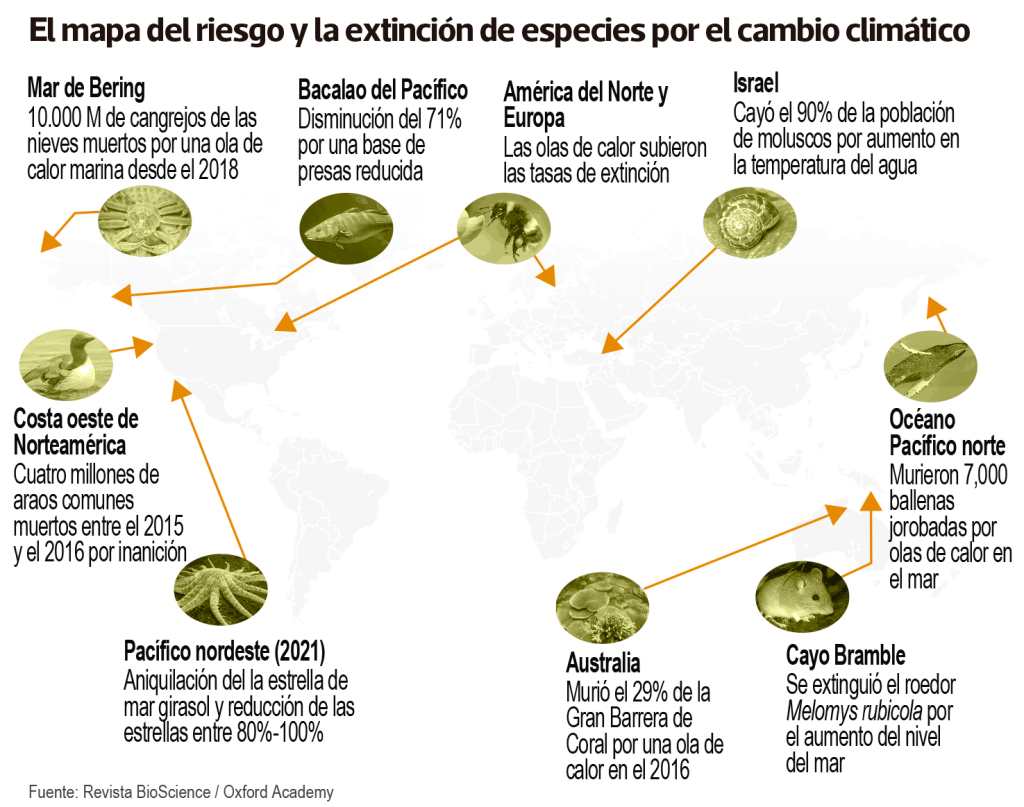
The study documents numerous population collapses related to climate change such as the disappearance of more than 10 billion snow crabs at Bering Sea Since 2018 and the seven thousand deaths of humpback whales related to heat waves in the North Pacific.
In addition, water warming has reduced the populations of mollusks of the coast of Israel by 90%, an example that demonstrates how susceptible the invertebrates are, the authors point out.
But mass mortality has not been limited to invertebrates: in 2015 and 2016, About four million common mere from the west coast of North America died of hunger Because of an alteration of the food network caused by an extreme marine heat wave that also caused a 71% decrease in the Pacific cod.
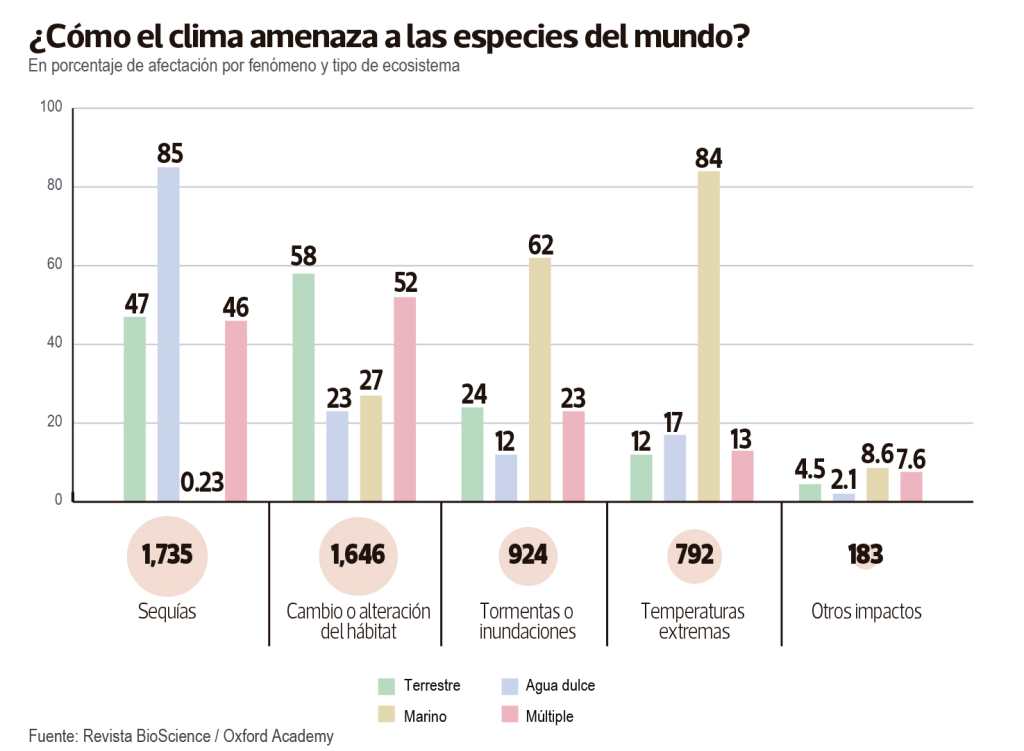
Faced with these data, the authors are concerned about the little information collected on the risks of climate change for wild fauna.
And is that while the conservation status of 72.6% of the vertebrate species has been evaluated through the Red List process of the International Union for the Conservation of Nature, SOlo 1.6% of invertebrates have received similar attention, Despite constituting the vast majority of animal biodiversity.
“We may be approaching inflection points in regard to the impact of climate change on land animals. We foresee that future risks of extinction and mass mortalities due to climate change will not only increase, but will accelerate greatly with each fraction of degree of increase in global temperatures,” the study warns.
In this context, “Understanding the risk is crucial to make political decisions with knowledge of cause”, Ripple states, who defends the need to have “a world database on mass mortality due to climate change for animal species of all ecosystems, and accelerate the evaluation of species currently ignored.”