

A day after the Republicans of the House of Representatives approved an expensive package of fiscal cuts that shook the financial markets, President Donald Trump returned to his other emblematic political priority by revealing a series of tariff threats that further drilled investors and raised the highest prices perspectives for US consumers.
For a president who has presented himself as a cunning administrator of the economy, Friday’s decision to intensify his world commercial war seemed curious and expensive. It was the one -week climax in which Trump ignored the repeated warnings that his program could make the country’s debt worse, harm many of his own voters, damage the finances of low -income families and contribute much less to the growth of what the White House affirms.
The discouraged response of the markets to the president’s economic policy strategy failed to convince Trump, who on Friday chose to revive the uncertainty he has kept companies and consumers in suspense. The president threatened to impose 50 percent tariffs on the European Union and 25 percent to Apple. Other technology companies, he said, could face the same rate.
Since his inauguration, Trump has rushed to promulgate his economic vision, with the aim of combining generous tax cuts with wide deregulation that, according to him, will expand the US economy. He has conceived his high world tariffs as a political club that will collect money, will encourage national manufacturing and improve the commercial relations of the United States.
But for many of its emblematic policies to succeed, Trump will have to demonstrate that investors are wrong, especially those who lend money to the government buying their debt.
At the moment, bond markets do not accept their approach. Where Trump sees a “golden age” of growth, investors see an agenda that entails more debt, higher financing costs, inflation and economic deceleration. Investors who previously saw public debt as a relatively risk -free investment, now require that the United States pay much more to those who give money.
This adds to companies, such as Walmart, who say they could be forced to raise prices as a consequence of the president’s world trade war. The avalanche of policy changes has also left paralyzed to the Federal Reserve, insecure at what time the economy will require lower interest rates in the face of persistent uncertainty. As a result, the costs of mortgage, cars and credit card loans remain onerous for Americans.
Even so, Trump continues to proclaim that his policies will bring prosperity. This week, the White House published data that showed that their tax cuts could increase US production to 5.2% in the short term, compared to the profits that would have been obtained if the bill was not approved. The Government has been the only one to offer such optimistic predictions on the effects of Trump policies on companies, average workers and the fiscal future of the country.
In a report after another, economists predicted this week that the tax package signed by Trump could add more than 3 billion dollars to the national debt. Some concluded that it is unlikely that the measure will produce substantial economic growth, and that it could enrich the richest Americans and harm the poorest, millions of which they could soon lose access to federal food aid and medical insurance.
Fiscal cuts are largely an extension of which Congress approved in 2017, which means that few taxpayers will see their income after taxes increased. In fact, some might see their financial situation worsen: many of the taxpayers with lower income could even see a reduction of about $ 1300 on average with the Republican bill in 2030, according to the non -partisan budget model Penn Wharton, which took into account the cuts proposed to federal social protection programs.
Before the avalanche of alarm signals and discouraging reports, the White House has remained optimistic.
“I think people have shouted a lot that the wolf is coming,” Stephen Miran, president of the president’s economic advisors, said in an interview, stressing that Trump’s agenda would “grow the economy.”
In the past, investors and companies could have been glad for Trump’s great proclamations on the reduction of taxes and regulations, and the opening of access to foreign markets. But the most common reaction this week was the concern about Trump’s rigid approach, which has renewed the fears that the economy can enter a prolonged period of difficulties.
“It is possible that you get a great benefit to growth, but the costs are so obvious and so clear that I think it is difficult to put a lot of faith in it for the moment,” said Eric Winograd, an economist of the investment firm Alliancebernstein.
According to most indicators, Trump inherited a solid economy. The layoffs were low when he assumed the position, and they have remained thus, contributing to keep the unemployment rate stable. And consumers, even in high prices, continued to spend at a good pace.
However, after four months of his second term, there are indications that the economy begins to suffer greater tensions, what experts fear is the prelude to a more substantial deceleration. Although economists do not expect the economy to be tilted completely towards a recession, they affirm that Trump’s tariffs, in particular, have increased the chances of a deceleration, as both companies and consumers begin to cut expenses.
Many of the president’s allies argue that Trump is doing exactly what he promised during the 2024 presidential campaign, acting from the belief that his vision can stimulate robust economic growth. In doing so, that can help create employment, increase wages and generate the type of activity that can decrease the fiscal imbalance of the nation, said Stephen Moore, a conservative economist who was one of Trump’s advisors during his first mandate.
“Many of these problems are the result of low growth,” Moore said about the economy. Trump’s goal is for growth to return to 3 percent, Moore added.
But, sometimes, the government has ignored a constant flow of data that suggests that its policies may not produce those benefits.
The disparity between vision and reality became evident on Thursday, when the Republicans of the House of Representatives voted in favor of a bill that would extend the set of fiscal cuts promulgated in the president’s first mandate. The measure also included Trump’s campaign promises to eliminate taxes on tips and the payment of overtime.
An analysis published Thursday by the Joint Tax Committee, a non -partisan advisory body of the Congress, concluded that the new republican measure could raise the average rate of growth of US production in just 0.03 percentage points compared to current expectations until 2034. The conclusion questioned the statement, has long sustained by the Government, that economic activity can contribute to reducing the deficit. The Joint Committee also said that the president’s tax package could add 3.7 billion dollars to the country’s debt during the next decade.
Look held on Friday that the analysts of Congress and others had underestimated the effects of Trump’s initial tax cuts, and that they had done the same this year.
“A better fiscal policy creates better economic growth, and better economic growth creates better income,” he said.
Focusing on the debt, Kevin Hasett, director of the National Economic Council of the White House, said Thursday in Fox News that there was “a lot of reduction in spending on this bill,” and added that Trump’s government would seek additional savings as the project advanced in the Senate.
The perspective of an aggravation of the fiscal imbalance led Moody’s Ratings last week to reduce the United States credit rating, citing the republican tax cuts and the propensity to the expense of the previous governments of the Republican Party. The legislators of the party quickly rejected this conclusion, but the bond markets took note and raised the yields of the long -term US debt. On Wednesday, the little demand at a 20 -year -old treasure bond auction gave the markets another shake, raising bond yields and ballasting US actions.
On Friday, Trump caused a new plicming drop from markets by abruptly diverting their attention to tariffs. He attacked the European Union and threatened to raise tariffs on their exports at a fixed rate of 50 percent. He pointed out an unequal appetite for negotiations, declare journalists in the Oval Office: “I don’t know. We’re going to see what happens.”
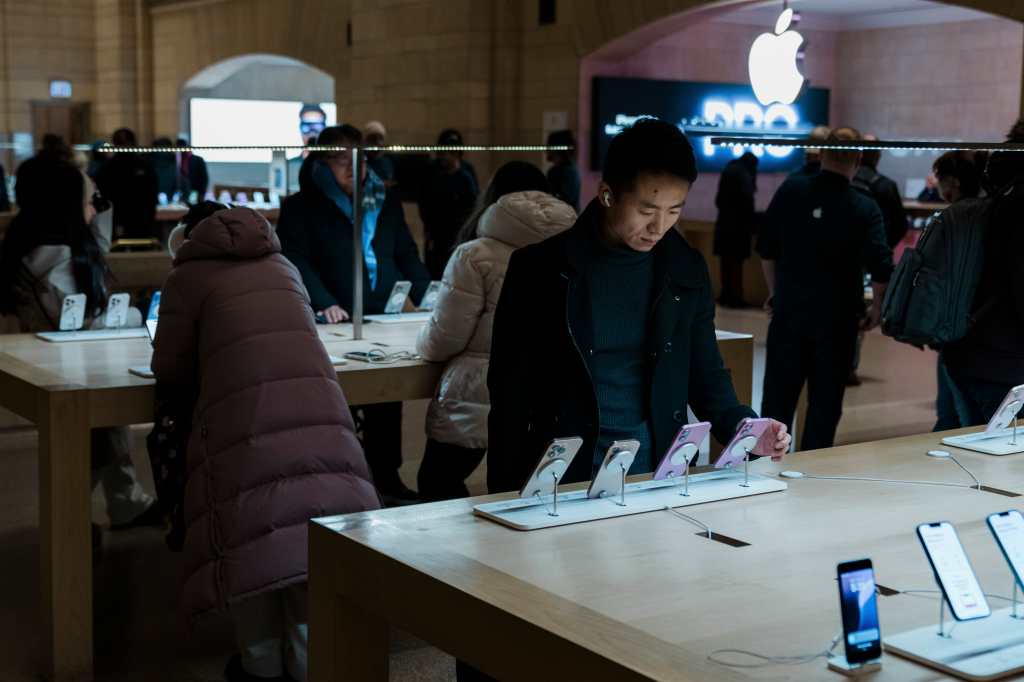
The president also pointed to Apple, and said he would impose a 25 percent tax on the importation of iPhones, months after his government more flexible some of his commercial policies to help technological giants. Later, Trump suggested that his new tariffs could also be applied to Samsung.
The S&P 500 index fell almost a percentage point on Friday and pushed the US dollar downwards in front of a basket of other currencies. Many, from Washington to Wall Street, once again struggled to decipher Trump’s intentions and determine to what extent the president is serious, if he is blushing or if he is willing to turn back again in his policies.
Some companies have planned price increases as a result of Trump’s tariff threats. A report of this week of Allianz revealed that many companies try to transfer tariff costs added to suppliers or consumers, and approximately half of the respondents said they could raise prices.
The possibility of raising prices while slowing growth raises a unique challenge to the Federal Reserve and its members with a vote, since it forces them to reconcile opposite missions: the objective of pursuing low and stable inflation, and the desire to maintain a healthy labor market.
“For me, the bar is a little higher to act in any direction while we wait to have some clarity,” CNBC Austan Goolsbee, president of the Chicago Federal Reserve and a member with the right to vote in the Feas Fixing Committee of this year, told CNBC.
Goolsbee recalled a recent conversation with the executive director of a construction company, who said: “We are at a time ‘stop writing'”. Now, Goolsbee said, companies “have to wait if every week, every day there will be a new important announcement.”
“They simply cannot take action until some of those things are resolved,” he added.