

In the National Palace of Culture the most recent discoveries were presented in the Uaxactún Regional Archaeological Project -Paru-. This work began new excavations on the site Uaxactun Since 2009 in about 1,200 km2 Where until now, studies have been sporadic or non -existent, researchers say. In this area, the project has identified several small and large settlements and has carried out several sitematic excavations.
The project led by the Enoius de Bratislava University, Slovakia, is directed by Milan Kovác. Kovác explained that they returned from Petén five days ago to present the new findings, for now 176 sites have been discovered, from which 20.
Within the studied area they found a new city called the grandparents, which is important due to their old characteristics. The city of grandparents, is located 21 km northeast of Uaxactun and was discovered by the project in 2023, when the first excavations were carried out and in this way the continuation of this investigation was planned in the field of April-May 2025.
Fernando Montúfar, consul of Slovakia, emphasizes the need for the preservation of these places that represent a heritage for the country,
Work process
The first excavations allowed the first map of the site and establish a preliminary chronology. The results surprised with a very early occupation from the Middle Preclassic (800-500 BC), very well preserved, which continued to the late preclassic, a fact that makes it a remarkable settlement for the study of the beginnings of the Mayan society in the Petén, reads in a document that shows part of the findings.
The site is made up of seven architectural groups in an area that covers approximately 16 km2. Its oldest center was identified in groups A and E, in which the first investigations were concentrated and where we continued working on this 2025 field season.
The settlement is made up of three e -type groups known as astronomical observatories, radial threepiramids, two triadic groups. In addition, 12 stone monuments were identified with unique preclassic iconography in the area, characteristics of the beginnings of the Mayan culture in the Petén. Among the monuments is a wake of the medium preclassic, still standing, frog -shaped altars and fragments of monuments with an iconography that can be compared with sites such as Naranjo and Kaminaljuyu in the Guatemala highlands.
The Los Abuelos site reached its boom from the Middle Preclassic, even much earlier than Uaxactun himself, when it was probably a regional power center.
Among the main findings are two large anthropomorphic stone figures that are the representation of a primary or ancestral couple, made by which the site has been appointed as “the grandparents.”
For its part, Dora García, director of the project, explains that each piece is forming a great legacy and is a huge amount of information that may need more studies and analysis. “The site is even older than Uaxactún itself and we want it to be known to ensure its conservation and continue excavations in the future,” says Garcia.
The sculptures of ancestors or grandparents
The 5A and 5B monuments were located in the Menor Square, Group E, E-54 platform, they are anthropomorphic figures carved in the stone of the style known as “bewless” with a height of almost a meter. The female figure has a bowl carved in the head, possibly to contain some type of offering and its height is less than the male anthropomorph that is much higher.
A detailed study shows that these figures were originally on the E-54 temple surrounded by several offerings. It is an ancestor couple that according to the analysis of the materials can be dated between 500 and 300 a. C., a similar couple identified in group M of Uaxactun. In both cases, the statues had their face turned west, indicating a connection with the ancestors and the underworld.
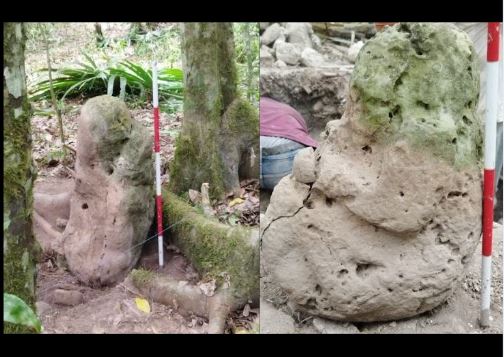
It is difficult to identify the exact function of this couple, although we can assume that it is related to a cult of the ancestors, the founders of a lineage or to the idea of the beginning of humanity. However, the examples offered of Mayan narratives would be comparable to the Ixpiyacoc and Ixmucane couple of Popol Vuh.
The importance of this cult is underlined by a unique preserved grave of the Mamom time (800-500 BC), which was placed together with an offering directly in front of the ancestral couple, the body of a male adult was preserved from the body. Just below the two sculptures were also found remains of two felines. The temple called E-Liv with the figures was undoubtedly an important place of worship on the Los Abuelos site for approximately 700 years according to the quantity offerings and burial. The latest activity records on the site are located at the end of the preclassic period, around 150 d. C. Subsequently, the city was abandoned for approximately 500 years.
The Mayan city of grandparents was one of the oldest ancestral centers. Its importance in the preclassic period was not so political and religious.
Cambrayal
It is located five kilometers north of the grandparents. On this site a huge statue of a bellk was found, very similar to those identified on the southern coast and other parts. It is a settlement pattern similar to that of Petnal and the grandparents, an important preclassic city, subsequently abandoned and repopulated at the end of the classic period.
This place has a system of palatial channels. This high quality and high quality channel system, with a diameter of up to 40 x 50 cm, is very regular, which in total have a length of up to 57 meters. They begin at the top of the palace, cross the entire interior and flow into the facade as drains.
The excavations have revealed an elongated pool of 60 square meters and 70 cm deep on the palace ceiling.
Petnal
In the same distance, in five kilometers, per east of the grandparents, the project discovered another preclassic city called Petnal. The city is dominated by a pyramid up to 33 meters high, which retains on its peak some rooms with remains of murals.
The scenes, which are currently subject to detailed investigation, represent various motives and figures painted with black lines on a white and red background. According to preliminary analysis, which must still be confirmed with carbon 14, the scenes date from the end of the preclassic period, between the 100s and 200 d. C.
In the city there are ball fields built in front of the other and an astronomical observatory, all of them from the preclassic period. Petnal, together with the grandparents, had up to four frog -shaped altars, very similar to the style of Kaminaljuyu and the Pacific coast. These data are interesting to establish the relations of the long distance sites.