

The international oil price has begun to react to the conflict, and one of the immediate consequences is the potential rise of this raw material. It is recognized that conflicts in the Middle East are latent, generating alarm about a possible interruption in the supply of crude, which could cause shortage worldwide, in a context already affected by various risks, both up and down.
Although the conflict remains focused between both blocks, There is the possibility of a escalation in fighting, which could cause an increase in the price of oil.
What is the stage?
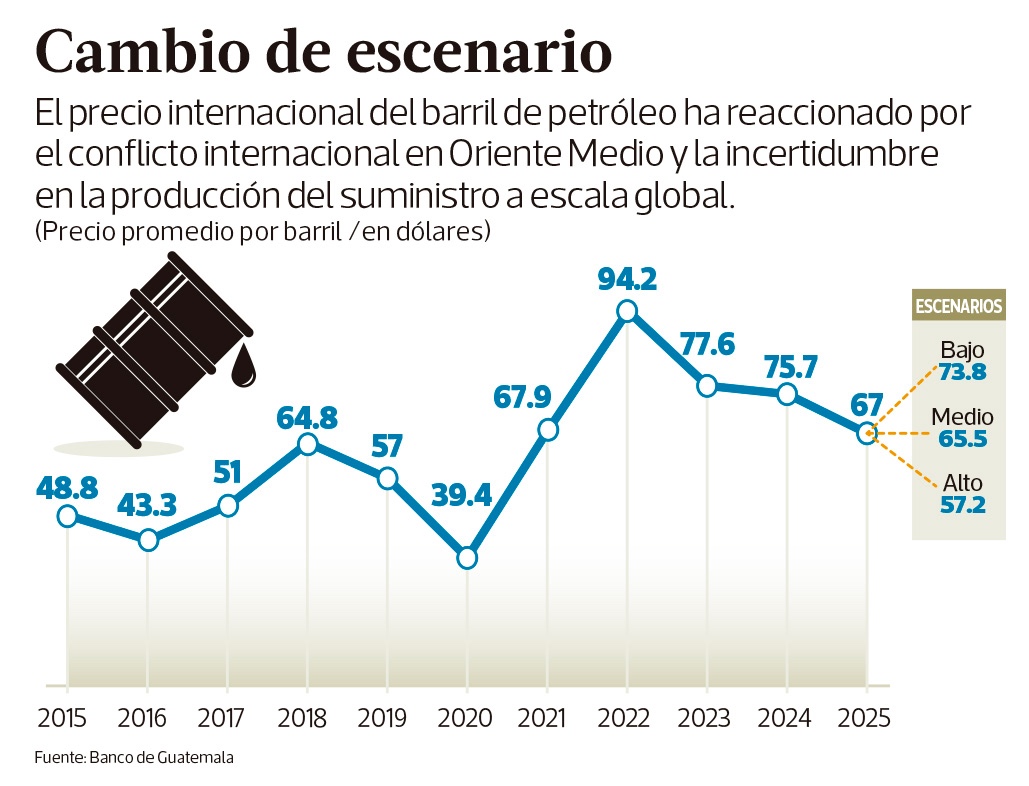
Five days after the outbreak of the confrontations, the Bank of Guatemala (Banguat) presented on Monday, June 16, the preliminary analyzes. The following scenarios are projected for the price of the barrel:
- High scenario: US $ 73.8
- Average scenario: US $ 65.5
- Low scenario: US $ 57.2
In June, the average barrel price is around US $ 67, lower figure compared to US $ 75.7 registered in 2024 and US $ 77.6 according to the history.
Álvaro González Ricci and José Alfredo Blanco Valdés, president and vice president of the Banguat and the Monetary Board (JM), together with Johny Gramajo, economic manager, explained that among the downward risks in the price of oil, supply factors are identified, such as the agreement between the OPEC and other producing countries to eliminate production cuts.
Regarding demand, one of the factors that generates uncertainty is the US tariff policy.
Upward risks in the price of oil
OFFER FACTORS:
- Geopolitical tensions in the Middle East
- Sanctions to the Iranian energy sector by the United States
Demand factors:
- Perspectives of greater demand from China
We have seen strong variations of 4% in one day (Thursday, June 12) and 5% to the following, which represents a 10% accumulated increase compared to the price observed on Thursday of the previous week. This generates uncertainty. We already saw that, in the US, the price of gasoline increased considerably, which generates an international alarm, Gramajo explained.
“Geopolitical conflicts are one of the most important risks that can cause an additional increase in the price of oil,”
Johny Gramajo, Banguat Economic Manager
He recalled that Geopolitical conflicts are one of the most important risks that can cause an additional increase in oil price, Although he also pointed out that, once the uncertainty period is exceeded, prices tend to stabilize or decrease.
Perspective for Guatemala
For now, the base scenario for Guatemala contemplates a stable price of oil, although the risks of rise are clearly identified.
Blanco Valdés commented that international calls to dialogue during the weekend, with the aim of curbing clashes, offer a perspective that the conflict could have a temporary nature, similar to other Israel clashes with Palestine or Yemen. Therefore, the confidence is maintained that it will not climb anymore.
At the moment, prudence prevails. There is caution and the issue is being monitored, said the vice president of the Banguat.
Pressure on prices in Guatemala
Regarding possible effects in the country, the authorities indicated that Current oil prices still do not affect inflation, which remains low (1.69% in May), which allows margin to continue fulfilling the annual goal.
In this situation, the main risk identified is the supply factor, that is, a possible reduction in production and supply.
In addition, international market reaction to expectations also influences. According to the Ministry of Energy and Mines (MEM), Guatemala has a storage capacity of oil derivatives for 90 days, of which 67%is currently used.
From that point of view, the price should not increase. However, in commercial practice, both in Guatemala and in other countries, increases are anticipated when the new inventory is expected to be acquired at higher prices. That is why in the US, prices rose significantly last Friday. But, to the extent that uncertainty is reduced by US interventions, prices tend to go down almost immediately, Gramajo added.
Fast adjustments in local prices
Gramajo also stressed that the variations in the international price of oil are quickly moved to prices in Guatemala. In general, the adjustments – whether they are upward – are reflected in two or three days, so fuel prices agilely react to international conditions.
The expectation is that, if there is an increase in domestic fuel prices, they will tend to decrease once uncertainty passes.
Guatemala is in a low inflation environment and current fuel prices are lower compared to last year. That means that fuels are helping to contain inflation, so, in inflationary terms, there would be no immediate effect, although prices could vary, González Ricci concluded.
There is instability
For the former Minister of Energy and Mines, Jorge García Chiu, the behavior in the price of the raw barrel recorded this Monday responds to the uncertainty regarding the management of future purchases. He explained that buyers, given this type of incidents, take advantage of current prices to secure orders for the future, which drives up rising prices.
Although oil production and market conditions have not changed substantially, it enters a period of instability among buying companies, refinitors and distributors. These resort to early acquisitions to guarantee the future supply, which generates an immediate reaction in the international price, he said.
García Chiu reiterated that Iran is a relevant producer of oil worldwide, and by getting involved in a conflict, the market reacts preventively. It is assumed that this supply could be out of circulation, which would reduce the global offer. Therefore, companies seek to ensure raw material through extraordinary purchases.
He also said that the international barrel prices could remain unstable, depending on how events evolve.
“If a truce is achieved, prices could stabilize immediately. Everything depends on a stop to fire,” he said.