

“Curioseando” is the title of the series of three books illustrated in digital format that David MoralesPharmaceutical clinic, makes available to Guatemalan children to introduce them, accessible, to the world of science.
These publications use simple and understandable language, and are written in Spanish, English and Kaqchikel. Thus, learning opportunities are extended through the dissemination project Science in Guate.
According to Morales to Free pressThe project seeks to bring science to the children of Guatemala, overcoming barriers such as the language and lack of access to books, which, “he said,” many times they move children away from scientific knowledge. ” Also, including three languages in the works seeks to promote pride in Mayan languages and encourage learning English from an early age.
Morales explained that the creation of the books began during the execution of his supervised professional practice unit and his university thesis, in which he deepened in the research area. With the arrival of the pandemic, he undertook a scientific dissemination project through the Disseminate podcast. Subsequently, the need to convey that knowledge to children arose, which gave rise to their first book, Curious.
“I realized that there was a great need: the lack of effective materials for children, especially in different languages. Therefore, I wondered how to bring science closer to all children without the language being a barrier,” he said. Thus the books were born Curious, Exploring your inner world and The magic of experimentingwhose objective is clear: “inspire the new generations to study scientific careers.”
Morales said that encouraging the study of science is essential in Guatemala, since there are many opportunities to explore and few scientists. “The most important thing is to demonstrate that this exists. It is difficult to dream of something that is not seen, but seeing that another can, they think: why don’t I?”
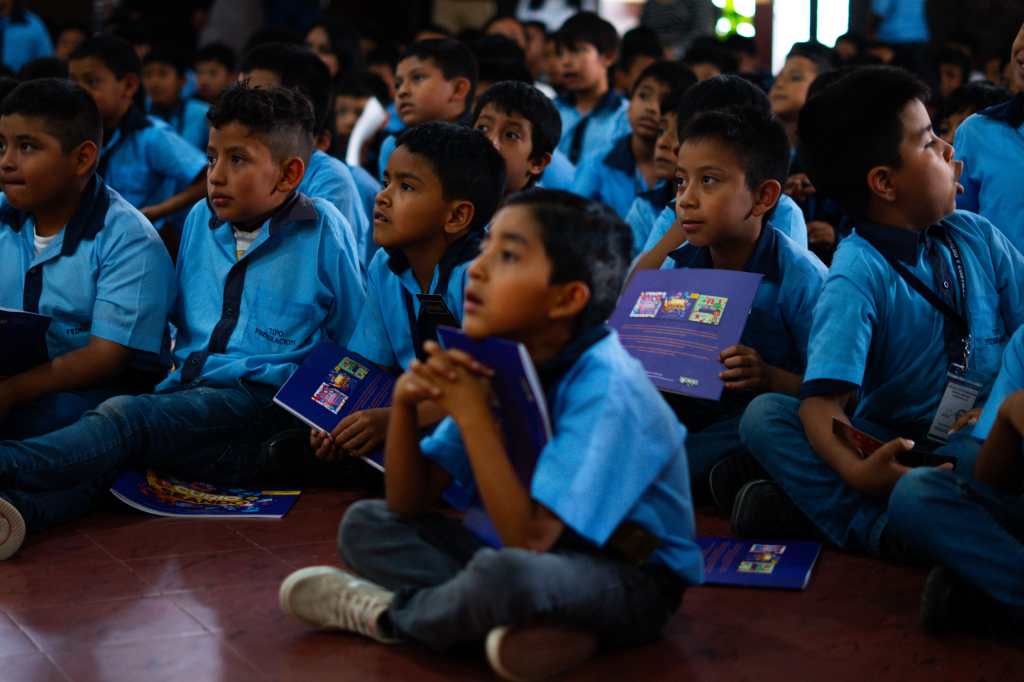
Currently, Morales, with the support of the National Fund for Science and Technology and the National Secretariat of Science and Technology, has distributed more than 1,500 copies in rural and community schools, as well as in orphanages.
What are books about?
“I didn’t want them to be books; I wanted to open a door and offer children a way to dream of science,” Morales said. These works address generalities about the sciences, curiosities of the human body and simple scientific experiments.
According to the official site of Science in Guatethe books present the following contents:
- Exploring your inner world: Describe the human body through the explanation of systems such as bone, muscular, nervous, cardiovascular, respiratory, digestive, endocrine, urinary and lymphatic.
- The universe of science: It presents scientific knowledge that stimulate child curiosity in areas such as astrophysics, biology, physiology, geology, geophysics, molecular biology, genetics, neuroscience, chemistry and the scientific method.
- The magic of experimenting: It proposes accessible experiments that combine physical and chemical principles with fun, promoting curiosity on issues such as static electricity, chemical reactions, physics, earth sciences and human perception.
How was the idea of integrating Kaqchikel?
Morales considers that giving a book is giving knowledge; Doing it in Kaqchikel is enriching the identity, dignity and future of speaking children of that Mayan language.
The decision to include this language responded to the desire to expand access to knowledge. “If one does not know English, it does not have access to top -level science, since everything is published in that language. And if you live in a village where only one mother tongue is spoken, the limitation is even greater,” he reflected.
Finally, Morales stressed that books are not addressed only to children, but also to people interested in experiencing and disseminating science.
Books are available for free and in digital format on the website www.cienciaenguate.com.