

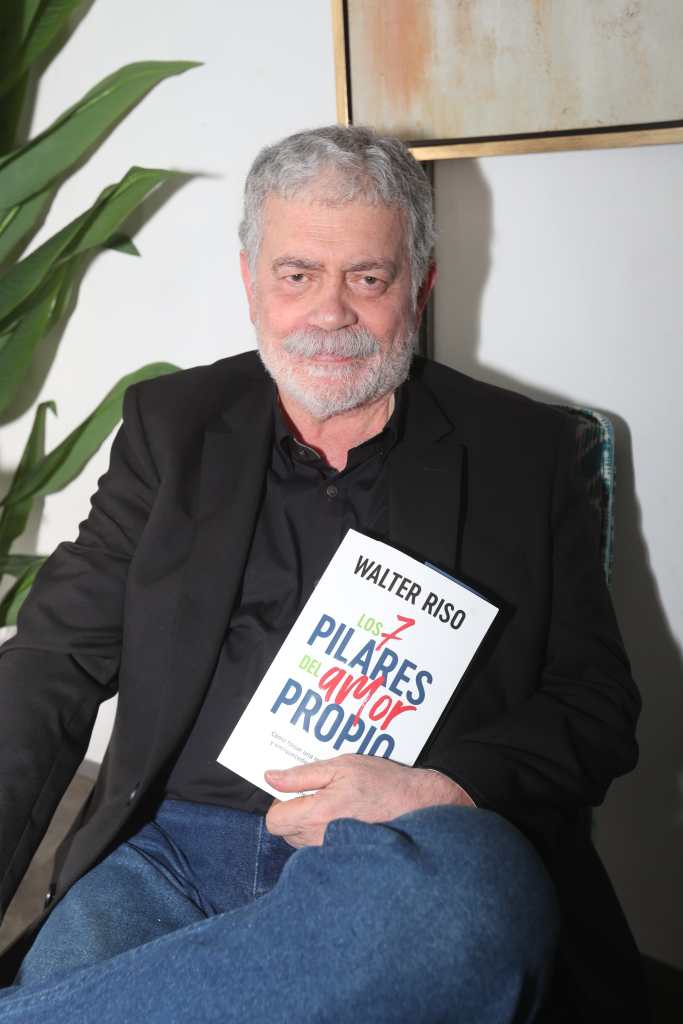
In the bustle of the Guatemala Book International Fairbetween the coming and going of avid readers and the constant murmur of literary conversations, Walter Riso stops to reflect, in an interview with Free pressabout one of the most urgent issues of our time: self -love.
“Do not do to yourself what you would not do to the people you love”it is one of the most powerful phrases in the book, because it summarizes what self -love means, says the psychologist about his last title, The 7 pillars of self -lovehighlighting how our own feeling is the basis on which we build our lives and our self.
“Own love is the beginning of any rebel attitude”says Riso, a statement that could sound contradictory at first, but makes sense when the author explains that loving oneself necessarily implies resisting the external impositions that damage us. “Own love will give you dignity. Indignation is anger in the face of injustice. The outrage gives you a strength to fight for your ideals”he explains, establishing a direct link between self -knowledge and the ability to transform our environment.
Riso’s proposal is not new in essence, but in his approach: “First there were five – pilares – then they went to 12, and then to 10, and then to 7, because one sees that he can define them fundamentally. (…) It is not a guide, it is a job that I, as the therapist, scientific and academic, I have seen. And after all the investigations, the book summarizes the essentials that people can use to give clear to their life.
The psychologist starts from a fundamental premise that challenges the culture of personal sacrifice: “I need to love me to be able to love others.” This statement – which defines as one that might seem selfish at first sight – finds its foundation in decades of psychological research that show that the relationship we establish with ourselves determines the quality of all our other relationships.
Self -love and the challenge of scientific self -help
In his book, Riso defines self -love as “the recognition and intrinsic assessment of oneself, based on the deep understanding of personal dignity and respect for who one is, without depending on the external approval or the results obtained.”
According to the author, “people are afraid of self -esteem. Self -esteem, but self -esteem depends on the results: if you do well, it goes up; if you go wrong, it goes down. It is fluctuating. On the other hand, self -love is independent of the results.”
In addition, Riso mentions that self -love has always trivialized. In a market saturated with promises of personal transformation, the author makes a crucial distinction: “People want everything to be easy. There is a scientific self -help and another that is not scientific,” he says, positioning his work in the field of evidence -based psychology.
“This was a very difficult book, he needed a lot of love and a lot of effort. Transfer the scientific and complex to a language that is simple and useful is very complicated, because suddenly you begin to explain and suddenly you do not know how to explain it, and if you do not know how to explain it, it means that you have not understood,” he says.
This distinction, for him, puts an important premise on the table: while the instantaneous happiness gurus proliferates, Riso proposes a more arduous but solid path, based on academic research and clinical practice.
The seven pillars proposed by Riso are not magical formulas, but concrete tools that require constant work and radical honesty with oneself. The author insists that building self -love is a process that demands time, patience and, above all, willingness to face those aspects of ourselves that we prefer to avoid. “Own love depends on the work you do in front of your personal dignity and it is intrinsic. It doesn’t matter if you have medals or not. It doesn’t matter if you have money,” says, or not: you have a human value because it exists. But it is born with you and dies with you. “
Social networks: the new battlefield
One of the most relevant aspects of the conversation arises when Riso addresses the impact of social networks on the construction of identity. “I do not see that social networks contribute to self -love. I see that it is a gigantic scenario where you are permanently subjected to the valuation of others, and many young people end up depending on that valuation,” he observes.
The psychologist’s reflection goes beyond simple criticism. Riso raises a disturbing phenomenon: “With social networks, your ‘I’ do not elaborate it alone or with your real friends. You put it on top of a table and you and a group of people make it. Your ‘I’ no longer belongs to you.” This observation touches one of the central dilemmas of the digital era for the author: identity construction as a collective and external process, where foreign validation becomes the only personal value thermometer and according to RISO, it is addictive but dangerous.
However, the psychologist does not adopt a completely pessimistic posture in front of technology. “For me, the networks have good things. I use them, but you have to take care of how one approaches that. And, above all, the Fake Newsthe lies, the myths, the things that are taught or the bad information they give you, affect your critical thinking, ”he explains, recognizing both the benefits and the risks of these platforms.

The price of the hyperconnected world
The author’s reflection on the cognitive impact of social networks is particularly revealing: “We have a slower mind and a more contaminated mind, but the same, if anyone knows how to handle the networks well, one can benefit super benefit.” This duality reflects the complexity of our historical moment, where the tools that connect us with the world can also get away from ourselves.
“Own love forces you to be attentive to things that, otherwise, you could not be attentive. Networks can lead you to your mind to function with less lucidity, with less decision -making capacity, but at the same time they lead you to have updated, deeper information,” says Riso, establishing a direct relationship between personal consciousness and the ability to critically navigate in the digital world.
The psychologist does not hide his concern for the future: “But if they gave me to choose, I would say that a ‘so far’ would have to be put here ‘, especially now with artificial intelligence.”
The inner applause revolution
“One of the characteristics of self -love is that it knows how to set limits, it knows how to differentiate the principles. What is negotiable and what is not negotiable. Therefore, when you have self -love, you can love better,” he says, while introducing one of the most powerful concepts that emerges from the conversation: the “inner applause.”
Riso explains: “It is not easy. You have been conditioned for many years to applaud you. On the other hand, when you have self -love, inner applause is worth more than external applause. Self -elogy is worth more than praise. You do not vourse by what people tell you, your personal worth you define you.
This idea perhaps represents the central core of its proposal: the construction of an internal validation system that does not depend on the fluctuations of external recognition. The author recognizes that this process implies unlearning deeply rooted patterns and developing a new way of relating to experience.
The scientific benefits of self -love
Riso bases its proposal not only on psychological theories, but on concrete scientific evidence. “Own love is the main immunity factor against depression, against anxiety, your immune system increases, improve your interpersonal relationships, especially loving, improves the cardiovascular system. It is impressive, because you feel an inner peace,” he lists, establishing connections between emotional well -being and physical health, that contemporary research confirms more and more.
A new relational paradigm
Riso’s proposal culminates in a radical redefinition of human relationships: “I love you and I love you. I am as important as you. I take care and take care of you. I worry about you, but I also worry about me. Why can I not be in the equation? I am also human,” says the author, encapsulating a relational philosophy where self -love is not the enemy of love towards others, but his condition of others.