
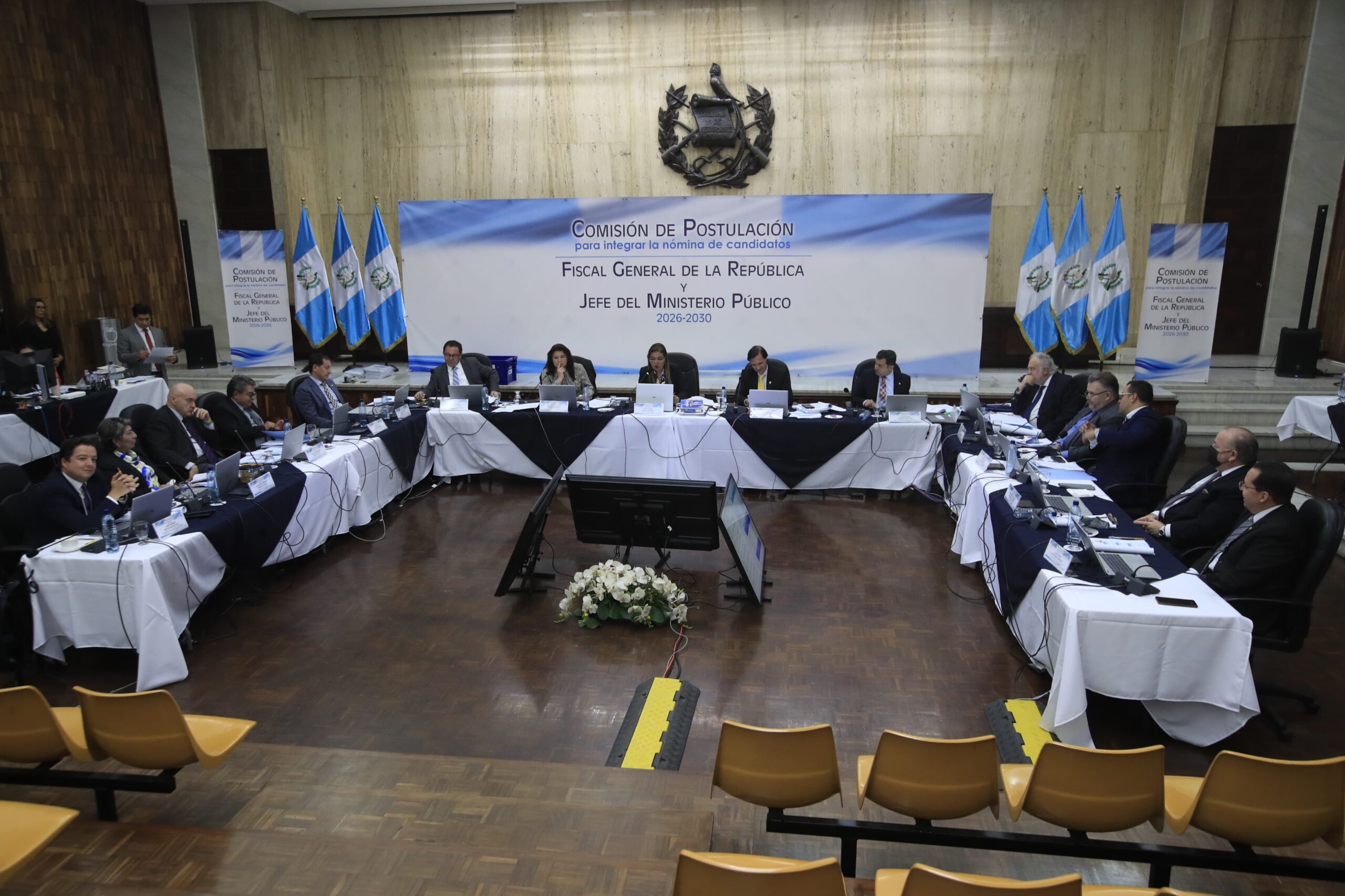
This Monday the Nomination Commission for Attorney General and Head of the Public Ministry (MP) began to assess the merits of the 48 candidates based on the grading table approved and modified last February. The day was marked by the commissioners’ attempt to exclude career judges from the process.
Not everyone shared the initiative; on the contrary, they warned that doing so would be illegally modifying the approved grading table that had already been applied to several applicants.
The candidate planned the qualification of the 48 files for this week, so that on April 17 the list of six candidates for attorney general will be formed. The list will be delivered to President Bernardo Arévalo so that he can name the new head of the MP for the period 2026-2030.
Currently the MP is under the direction of María Consuelo Porras, who was appointed for a first term by President Jimmy Morales, and was later re-elected by the president, Alejandro Giammattei.
Consuelo Porras, despite maintaining a public feud with President Arévalo, seeks re-election for a third term. He presented his file through a messenger and in total anonymity.
The nomination commission chaired by Claudia Paredes, president of the Supreme Court of Justice (CSJ), entered the final stretch of its work.
Paredes is related to the majority group of the CSJ that directly appointed magistrates after the creation of new appeals chambers, she is also noted for maintaining a friendship with deputy Allan Rodríguez, from the Vamos party.
The nomination committee is made up of the president of the CSJ; the presidents of the Board of Directors and the Court of Honor of the College of Lawyers and Notaries of Guatemala (Cang), and the 12 deans of the law faculties of the country’s universities.
The discussion
A few weeks ago, lawyer Raúl Falla, from the Fundación Contra el Terrorismo, presented an amparo action before the Constitutional Court (CC), which questions the aspiration of the judges as candidates for attorney general.
The action indicates that the exercise of a judge is not equivalent to the practice of law, so they would not meet one of the essential requirements to be considered as a candidate for attorney general.
Although this protection has not been resolved by the CC, Commissioner Luis Roberto Aragón Solé, dean of Universidad San Pablo, and alternate secretary of the commission, opened the discussion.
Some commissioners explained that taking a criterion to evaluate or not the work performance of judges would translate into an “illegal modification” to the grading table, for which they expressed their rejection.
#Urgent
Attorney General Nomination Commission seeks to exclude career judges by not wanting to value their years of professional practice. Dean Luis Aragón of U. San Pablo suggests voting, but Pablo Maldonado of U. Istmo warns that doing so would be illegal. pic.twitter.com/MAGqci3I6w—Douglas Cuevas (@dcuevas_pl) April 13, 2026
Aragón tried to justify himself by explaining that he was not seeking to alter the rating tool, but the commissioners demonstrated distrust and refused to let the issue be put to a vote.
At times it was seen how Aragón and Paredes were talking to each other, without using the microphones and without including the rest of the commissioners who were in the session.
Following these conversations, Paredes suggested calls for a vote that were stopped by the commissioners who stressed that at this phase of the process the grading table could no longer be altered.
Finally, the issue was not put to a vote and the commissioners agreed that the moment a judge’s case is presented, will be the moment in which they will begin to evaluate the case.