

The Department of Meteorological Research and Services of the National Institute of Seismology, Volcanology, Meteorology and Hydrology (Insivumeh)recently reported that the El Niño phenomenon will include in the rainy season in Guatemala in 2026, May-Octoberwith direct effects on climate, agriculture and food security.
This climatic phenomenon, in Guatemala, is characterized by the decrease of rainsthe increase in consecutive dry days, high temperatureslow cloudiness and high levels of solar radiation, conditions that favor the appearance of droughts, according to information from the FAO.
According to the forecasts of the Insivumehthe phenomenon would begin to manifest itself in May and would continue for June and Julyaffecting the normal behavior of precipitation.
Special Bulletin
Beginning of the Rainy Season
IELL-202604#SomosINSIVUMEH #PassionForScience #AlPuebloDignoSeLeResponde #CIV
(1/2) pic.twitter.com/bWQX6bSruT— INSIVUMEH (@insivumehgt) April 15, 2026
What is ENSO and how is it related to El Niño?
He ENSO (El Niño-Southern Oscillation) is a climate system that describes temperature variations in the equatorial Pacific Ocean and changes in the atmosphere that influence global climate.
This system has three phases: The Child, The Girl and a neutral phase. In the case of The Childthere is a anomalous warming of the Pacific Oceanwhich alters rainfall and temperature patterns in different regions of the world, depending on the World Meteorological Organization (WMO).

As reported by the Private Climate Research Institute (ICC)the probability of El Niño phenomenon in 2026analyzed on a quarterly basis, indicates that it would begin to strengthen between April and would conclude in October.
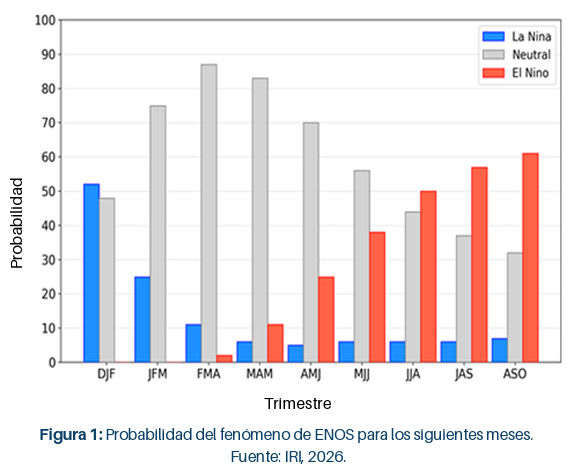
Early start of the rainy season
Although the rainy season in Guatemala It usually starts in May, for 2026, as indicated in the Insivumeh bulletin, could be brought forward to the second week of April in some regionsmarking a relevant change in the national climate pattern.
However, this early start does not guarantee constant rains, the institute’s report details. Between July and August, it is expected precipitation deficits throughout the country, with levels below average.
According to a publication by the National Coordinator for Disaster Reduction (Conred), derived from the climatic conditions of the El Niño phenomenon, the following effects are known:
- High temperatures prior to the rainy season.
- Severe dog days.
- Deficit or excess of rain on the Caribbean and Pacific slopes.
- Irregularity in the establishment, distribution and completion of the season.
Longer dog days and effects on agriculture
The strengthening of El Niño phenomenon will cause a Canicula more intense and prolongedcharacterized by decreased rainfall and increased temperatures, as explained by the Conred in past years.
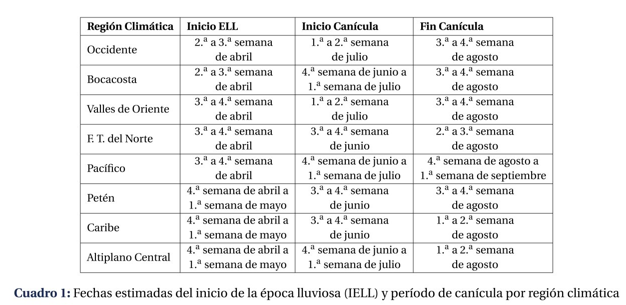
According to the report of the Insivumeh about the Rainy Season 2026the Canicula will affect the regions of Guatemala differently.
The heatwave 2026 in Guatemala could extend between 4 and 10 weeksdepending on the region, which shows a longer and more irregular period within the rainy season.
In general terms they could be:
- In regions like West, Valleys of the East and Bocacostathe dog days would begin between the end of June and the second week of July, and would last until the end of August, lasting approximately 6 to 8 weeks.
- In the Northern Transverse Strip and the Caribbeanthe dry period would be shorter, with an estimated duration of 4 to 6 weeks.
- In it Peacefulwhere one of the longest episodes is expected, the heat wave could extend until the beginning of September, reaching up to 8 or even 10 weeks.
- In Peten and the Central Highlandsintermediate durations of between 5 and 7 weeks.
The specialist in applied meteorology, Walter Bardales Espinosa, points out that these events increase the probability of agricultural losses, especially in subsistence crops, due to the water deficit.
Guatemala has eight defined climatic regions; However, during events of The Childthese can be reduced to four, which shows a significant alteration in the distribution of rainfall at the national level, according to analysis by Agua Consulta.
A recent precedent occurred between May 2023 and March 2024, when the phenomenon affected more than 72 thousand hectares of cropsaccording to data from Ministry of Agriculture, Livestock and Food (MAGA).
Recent conditions and contrast with La Niña
According to climatologist Alejandro Barillas, of the Insivumehduring 2025 they prevailed neutral conditionswith sea temperatures within normal ranges and without significant anomalies.
In contrast, the La Niña phenomenon generates colder ocean temperatures, accompanied by heavy rains and levels above average.
What is the El Niño phenomenon and why is it of concern?
According to the FAOhe El Niño phenomenon It is a natural climate event in which the waters of the Pacific Ocean warm anomalously, altering global weather patterns.
This phenomenon occurs every two to seven years and can last between nine and twelve months. Its development allows us to anticipate its effects, but it also represents significant risks for the food safety.
In summary, in Guatemala the El Niño phenomenon 2026 could translate into an irregular winter, with early but inconstant rains, a prolonged dog days and increased risks to agricultural production.
Global impacts of the phenomenon
According to the World Meteorological Organization (WMO) and the FAO, The Child causes changes in temperature and precipitation patterns worldwide:
- In Latin America and the Caribbeanespecially in Central Americaprovokes rain deficitimpacting key crops such as corn in the Dry Corridor.
- Countries in Asia and Oceania register droughts and extreme heat.
- Rainfall is increasing in South America and East Africa, while other regions face dry conditions.
Given this scenario, experts agree on the importance of implementing preventive measures to reduce the impact on crops and guarantee the availability of food, according to reports from the Insivumehthe FAO and the WMO.