
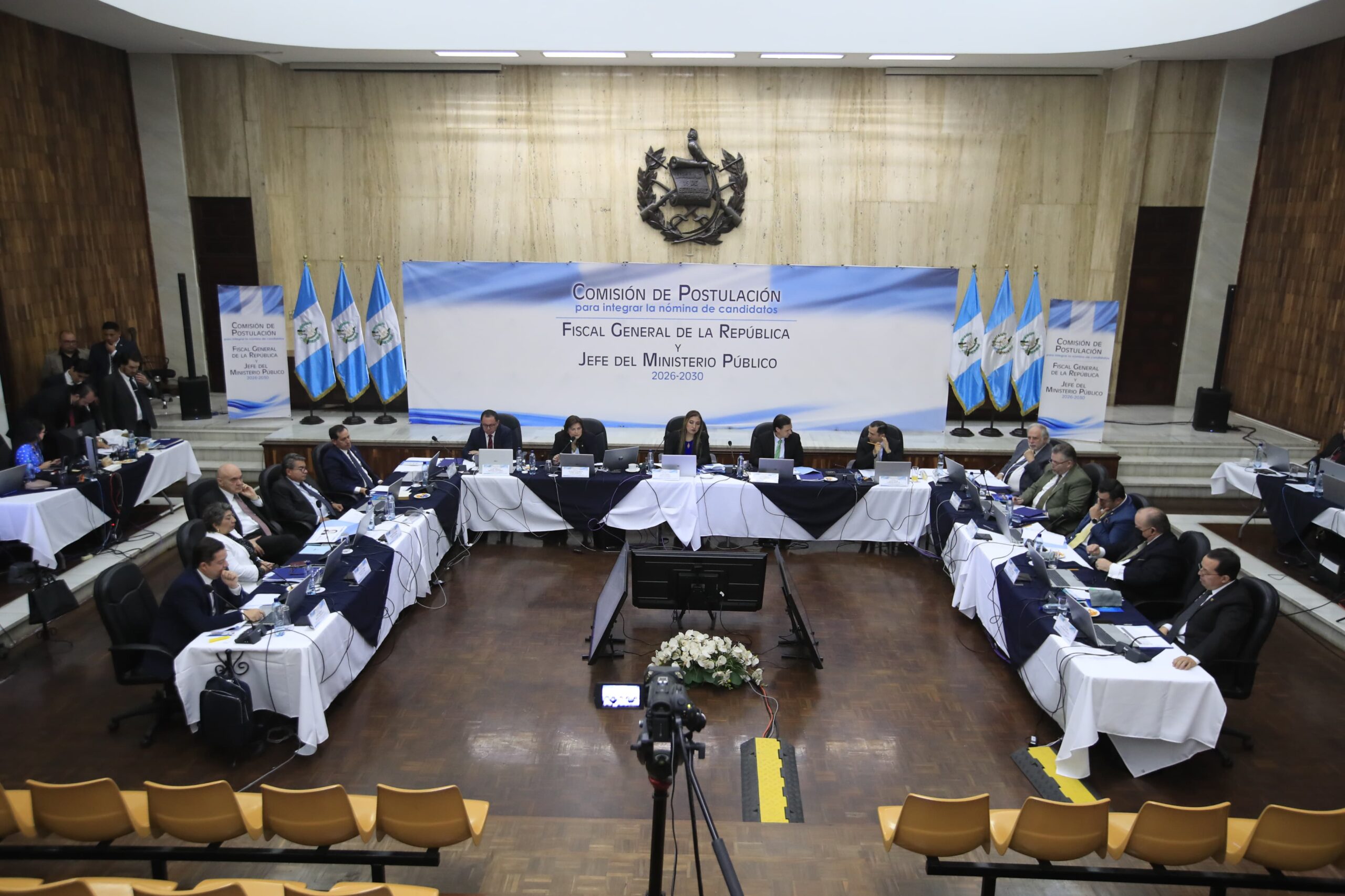
The candidate who nominates six candidates for attorney general had to lower her standards because only nine candidates reached the minimum score of 75 points in the assessment of academic, professional and human projection merits. The applicant chose to include the three professionals who obtained the scores closest to that grade, in order to have 12 eligible professionals.
This Monday, April 20, the nominating commission plans to form the list of the six candidates for attorney general, payroll that will be sent to President Bernardo Arévalo who has to make the appointment.
The new attorney general and head of the Public Ministry (MP) who is appointed by Arévalo will remain in office for 2026-2030. Beginning that constitutional period on May 17.
In its first meetings, the commission agreed that the list of candidates would be made up of at least 12 applicants who reached the cut-off line.
Each of the attorney general candidates who reached the minimum grade must be put to a vote, so that each of the commissioners can rule in favor or against their appointment as a possible candidate for attorney general.
For an applicant to be part of the list of candidates, at least the vote in favor of 10 of the 15 commissioners is required, an amount that has not been easy to achieve in the last votes.
Those eligible
Among the 12 candidates who are eligible as possible candidates for attorney general, the current head of the MP, María Consuelo Porras Argueta, stands out, who obtained the highest score.
The current attorney general obtained an evaluation of 92.33 out of 100, being the best evaluated of the 48 lawyers who reached this stage of the MP renewal process.
Although the applicant can make the list from the number of eligible lawyers who, if they reached the cut-off line, an amparo action seeks that the commissioners make up the list with the six best qualified.
This is according to a legal action promoted by lawyer Raúl Falla, a member of the Foundation Against Terrorism. This amparo action entered the Constitutional Court (CC) and it has already been admitted for processing.
The applicants
- María Consuelo Porras – 92.33 points
- César Augusto Ávila Aparicio – 92.13 points
- Brenda Dery Muñoz Sánchez – 90.86 points
- Julio Rivera Clavería – 88.93 points
- Walter Paulino Jiménez Tejax – 86.73 points
- Gabriel Estuardo García Luna – 86.21 points
- Néctor Guilebaldo de León Ramírez – 79.69 points
- José Manuel Quinto Martínez – 79 points
- Henry Alejandro Elías Wilson – 76.85 points
Eligible applicants who came closest to 75 points:
- Raúl Estuardo López Rodríguez – 74.26 points
- Beyla Adaly Xiomara Estrada Barrientos – 73.73 points
- Zoila Tatiana Morales Baldizón – 70.28 points
Balance of forces
The candidate is made up of 15 commissioners, who need to have the consensus of at least 10 of them to make decisions, including the integration of each of the six professionals on the payroll.
This commission is chaired by Judge Claudia Paredes, president of the Supreme Court of Justice (CSJ), who came to the nomination when she was already installed to be elected until February 16 as president of the Judiciary.
They are also members of the commission Patricia Gámez, president of the Board of Directors of the College of Lawyers and Notaries of Guatemala (Cang); together with Alicia Franco, president of the Court of Honor of the Cang.
To them are added 12 deans of the law schools, being Luis Lepe, from Regional University; Arturo Saravia, from Francisco Marroquín University (UFM); Luis Aragón Solé, from San Pablo University; Henry Arriaga, from USAC; Luis Ruano, from Mariano Gálvez University (UMG); Mario García, from Rural University; Enrique Sánchez Usera from Universidad Panamericana; José Andrés Reyes, from Da Vinci University.
They are added José González, from University of the West; Nery Anleu, from Mesoamerican University; Pablo Maldonado from Universidad del Istmo (UNIS); and Julio Cordón, from Rafael Landívar University (URL).
These last four deans made their debut in this nomination commission, after their respective universities changed the previous deans, some of them who had been denounced in the 2022 attorney general election process.
Of those 15 commissioners, 10 managed to pass a qualification that left out the official candidate, Marco Antonio Villeda. Current Minister of the Interior and career judge.
Villeda registered as a lawyer before the CSJ only on February 19, for which the candidate decided not to accept his decades of experience as a career judge.
Those who supported that vote are the following commissioners: president of CSJ; Court of Honor of the Cang; Regional University; University of the West; UFM; San Pablo University; USAC; Rural University; Pan American University; and Da Vinci University.
On the opposite side, in the session on April 17, those who did not agree with that vote were a minority of five: president of the Cang; Mesoamerican University; UNIS; URL; and UMG.