
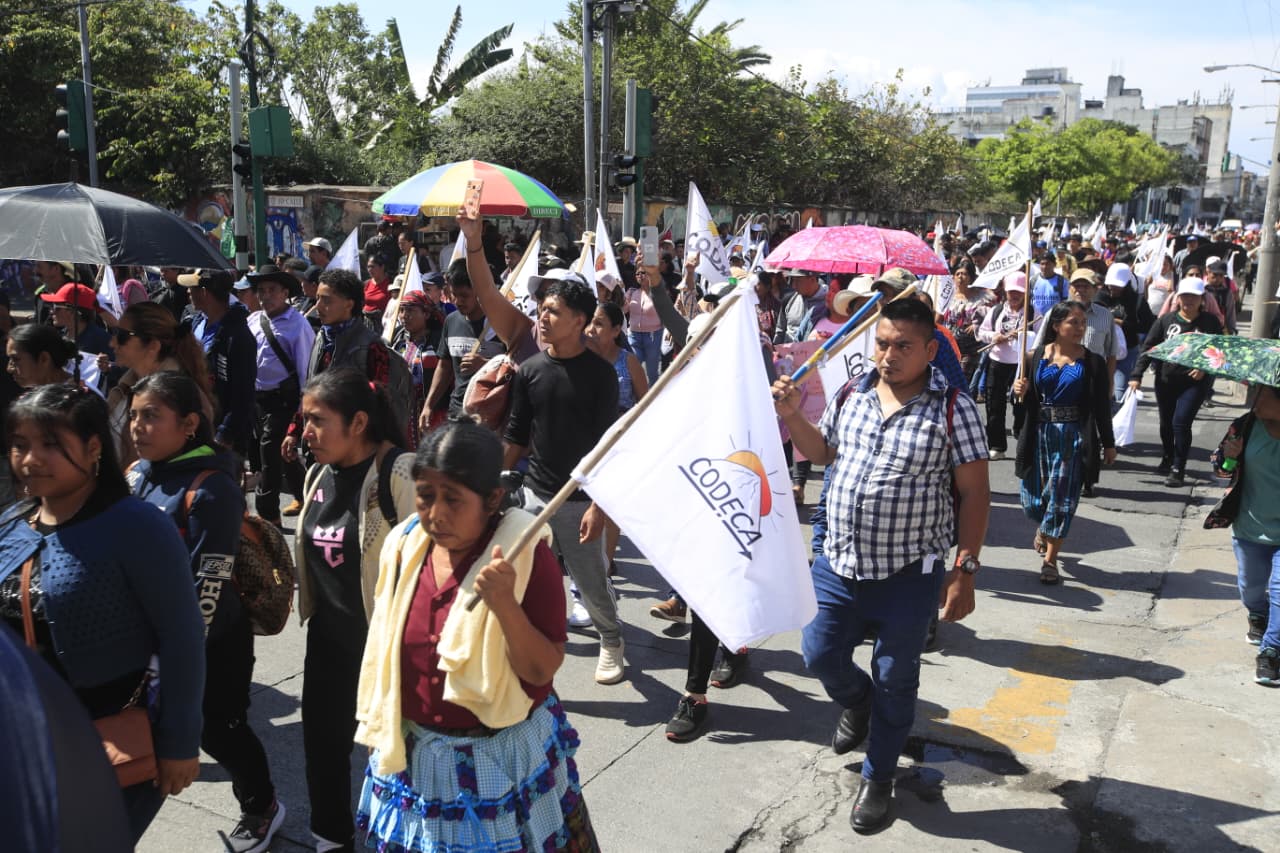
This Wednesday, April 22, in Guatemala City, Demonstrations are taking place by the Peasant Development Committee (Codeca) and other organizations.
In the mobilizations they speak out against the high cost of fuel and against the re-election of Walter Mazariegos as rector of the Usac, among other demands.
Traffic is complicated in strategic points of the capital, according to reports from the Municipal Traffic Police.
The department of Guatemala, along with four other departments, remains under a state of prevention for 15 days, as decreed by the Executive.
In that sense, in an interview in Free Press Radiothe general director of the National Civil Police (PNC), David Boteo, referred to the recent marches and blockades registered.
Boteo stressed that it is under a state of prevention and that “at no time will the National Civil Police allow there to be any type of illegal blockades, because the blockade is not a legal issue, nor will it be allowing alterations to public order.”
He remarked: “as long as a demonstration is peaceful and leaves movement free in at least one lane, we have no problem, rather we provide support to the demonstrations because it is an issue authorized by law.”
He said that they have summoned the Human Rights Ombudsman’s Office, the Departmental Government and other actors to prioritize dialogue and intervene in blockades and free the roads.
Furthermore, the PNC issued a statement in which, given the validity of the state of prevention duly ratified and published in the Diario de Centro América, it points out that it is the constitutional duty of this institution to guarantee public order, free movement and the safety of all citizens.
He clarified that, although the Political Constitution of the Republic guarantees the right to peaceful demonstration, this right is not absolute and finds its limits in respect for the rights of third parties and compliance with current regulations under exceptional regimes.
Given the recent acts of violence that have altered social peace, the PNC reported that it will not allow blockades of routes, main arteries or acts that threaten the physical integrity of people or public and private assets.
He assured that he has issued precise instructions to his operational units to act with strict adherence to human rights protocols, but with the firmness necessary to keep communication channels open.
“Any person who participates in acts of vandalism or illegal blockades will be brought to the disposal of the corresponding jurisdictional bodies,” he warned.
He urged social groups and the population in general to abandon confrontational attitudes and channel their requests through legal channels and dialogue, avoiding exposure to legal consequences derived from non-compliance with the state of prevention.
Martí Street is free of demonstration.
Group of farmers, from zone 6, now gathered at 6 avenue 1 street zone 1 in front of the facilities of the Supreme Electoral Tribunal.#22Apr26PMT pic.twitter.com/sS0IfrE9cK
— Amilcar Montejo (@amilcarmontejo) April 22, 2026
Measures during the state of prevention
- The state of prevention contemplates limiting the holding of outdoor meetings, public demonstrations or other spectacles and, where appropriate, preventing them from taking place.
- Dissolve by force, without the need for any summons, any group, meeting or public demonstration in which weapons are used or acts of violence are resorted to.
- Prohibit the circulation or parking of vehicles in certain places, areas and times, prevent them from leaving certain towns or subject them to registration