
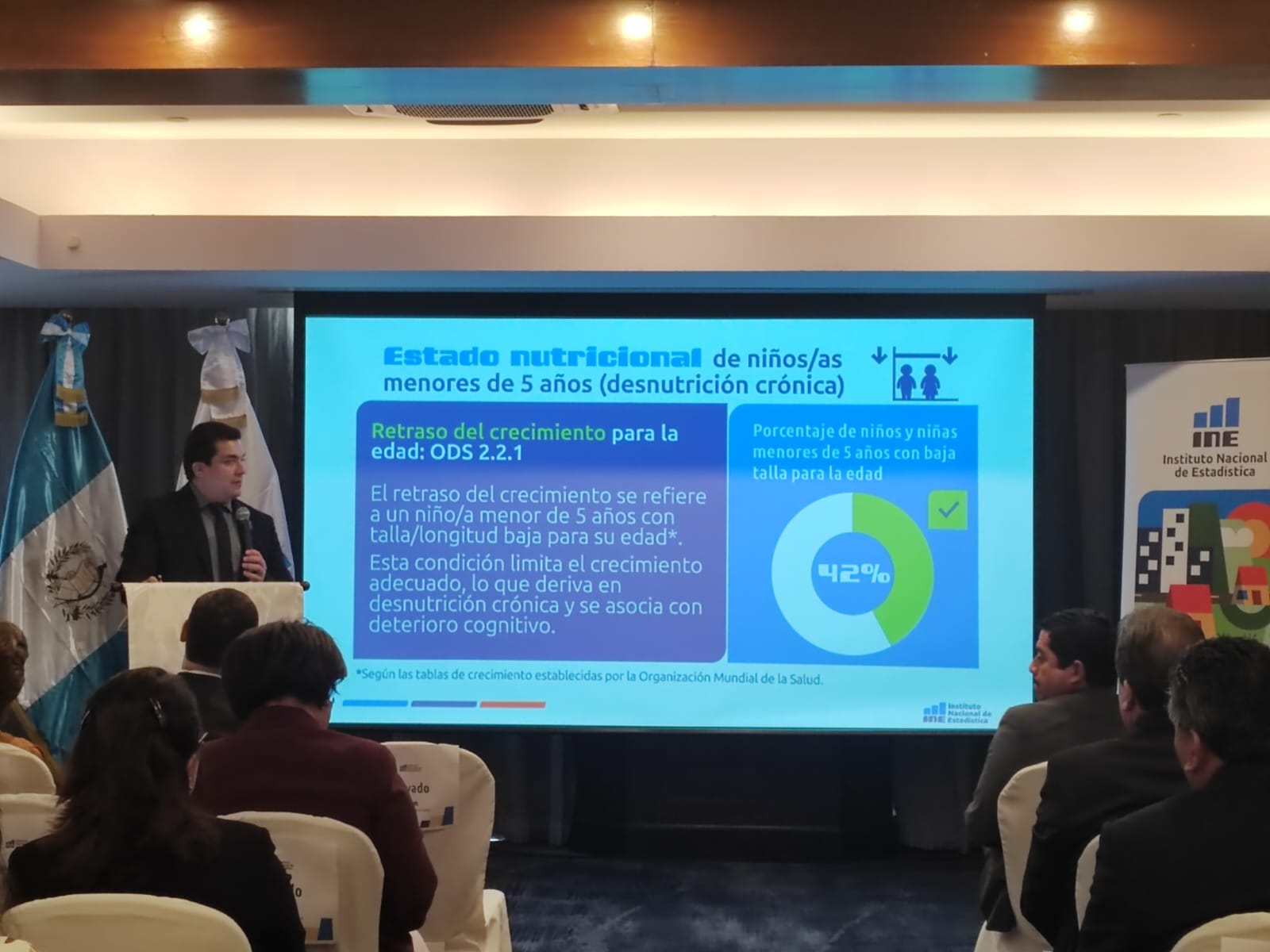
After a decade without data on the health situation in children under five years of age and in women of childbearing age, the National Institute of Statistics (INE) presented this April 27 the National Development and Health Survey (Endesa) 2025, which updates indicators such as chronic malnutrition. The data shows a decrease of 4.5 percentage points in the population under five years of age, compared to the last available survey.
At Endesa, the topics that were measured in the National Maternal and Child Health Survey (Ensmi), whose last publication covered the period 2014-2015. For this new measurement, information is collected on the health situation and its social determinants, the sample was 14,928 households, and several questionnaires were used to obtain data from women from 15 to 49 years old, children under five years old, children from 5 to 17 years old and men from 15 to 49 years old.
César Chávez, manager of the INE, mentioned that Endesa presents results for different indicators, but the most anticipated is the one related to growth retardation—chronic malnutrition—in children under five years of age: 42% of children has this condition, while in the last Ensmi the figure was 46.5%.
According to Mireya Palmieri, head of the Secretariat of Food and Nutrition Security (Sesán), it is a decrease of 4.5 percentage points in 10 years, which means a annual reduction of 0.4 percentage points, which is low and insufficient to end chronic malnutrition in the country.
When disaggregating the Endesa data, children between 18 and 23 months are the most affected group, since one in two has chronic malnutrition; while in Totonicapán seven out of 10 children have growth retardation. Rural, indigenous or Afro-descendant households, and where the mother has low schooling, have the highest prevalence.
The results of the survey will allow government institutions to have a more real photograph of the conditions of Guatemalan families, to more accurately guide public policies, indicated Vincenzo Placco, of the United Nations Children’s Fund (Unicef), which provided technical and financial support to carry it out.
Palmieri said that Sesán will analyze Endesa’s data and establish whether it is necessary to prioritize other departments in the Hand in Hand strategy.
More results
For the first time, Endesa includes the water qualitywhich showed that seven out of 10 homes have water availability and a similar proportion uses improved water sources in or around the home.
However, half of the population has access to a resource that It is not suitable for consumption. The most critical situation is faced by households in Huehuetenango, where eight out of every 10 people consume water contaminated with E. coli.
“We hope that with this photograph the different State institutions can work with comprehensive responses and simultaneous interventions that allow addressing these problems,” said Chávez.
The Ensmi was scheduled for the period 2022-2023, according to Ministerial Agreement 12-2022, published on January 14, 2022. It had a cost of US$7 million: 75% would be provided by the United States Agency for International Development (USAID) and the remaining 25% by the Ministry of Health.
Due to the closure of USAID by the United StatesEnsmi was cancelled, so the INE worked on Endesa, which evaluates around 40 indicators related to the Sustainable Development Goals in terms of health.
The intention of the INE is to develop Endesa with a periodicity of between three and five years, to monitor the indicators and have updated data for the country, which is comparable over time. A complete report of the 2025 edition will be presented by June 2026.