
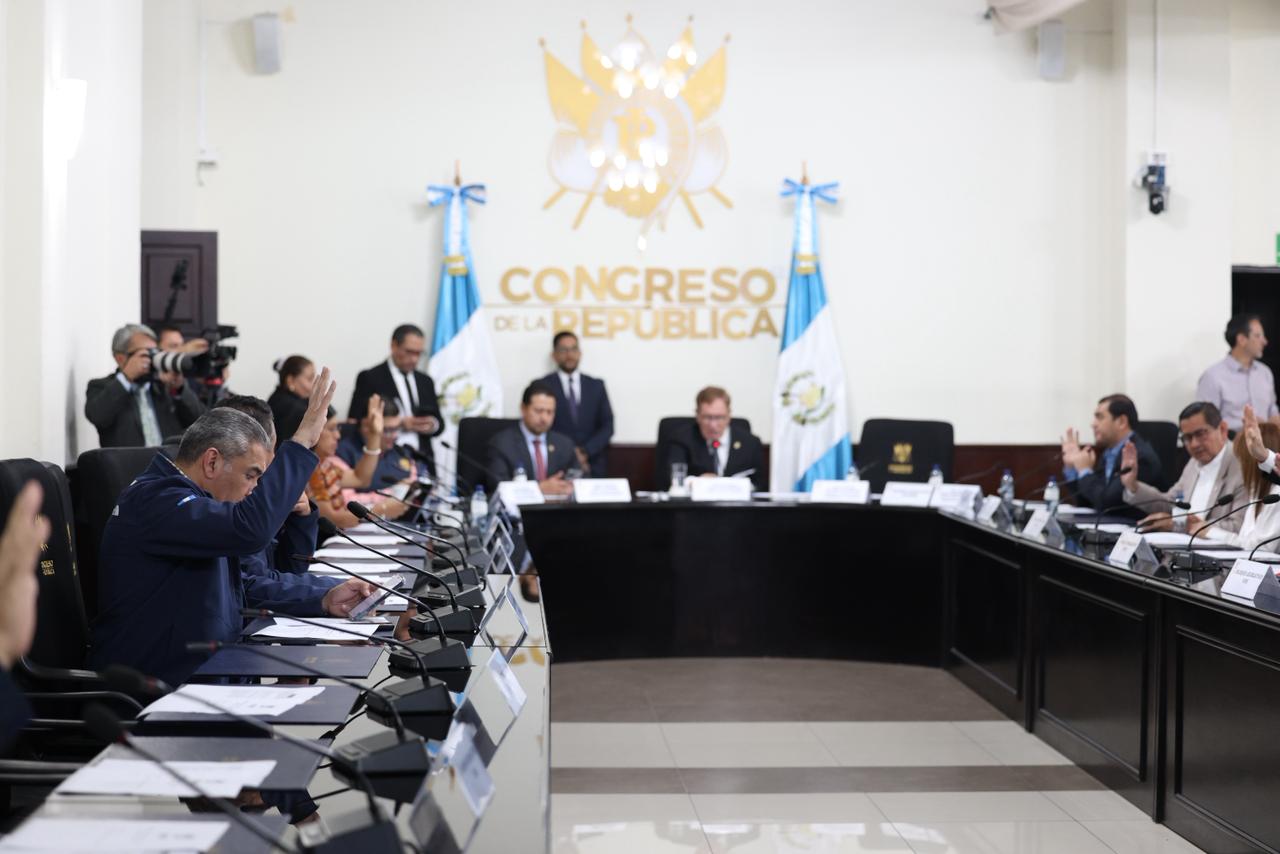
The approval of the anti-money laundering law will be a priority in the penultimate week of the first period of ordinary sessions of Congressaccording to the proposed agenda for the plenary session scheduled for this Tuesday.
The approval of initiative 6593 for the Comprehensive Law against Money Laundering or Other Assets and the Financing of Terrorism appears in the fourth point of the agenda.
Luis Contreras, president of Congress, said in the last session of Block Chiefs that a short agenda was proposed, because he predicts that the approval of the final wording of the anti-money laundering law could take about four hours.
Law initiative 6593, presented by President Bernardo Arévalo, entered the Legislative Directorate on July 28 of last year and was approved in first reading on March 24.
The second and third readings occurred on April 7 and 14, respectively, and then the issue was sidelined.
This week, the deputies decided to reactivate the law which, according to its promoters, if not approved could have negative implications for the country.
Amendment package
The bill that is about to be approved in its final articles has a package of amendments that will be discussed in this Tuesday’s session and that have already been shared with the different benches, according to representative Sonia Gutiérrez, from the Winaq bloc, in the session of block heads this Monday.
The document details 14 amendments, 12 that propose changes to the articles that already have an opinion and two that seek to add new articles. Deputies from different groups have said, outside of microphones, that they are analyzing the proposals.
Article 2, which defines elements of law enforcement, is one of the first articles to be amended. They expand the field of capital tracking when a suspicious person invests in a certain business if they are the one who contributes 15 percent or more of the project.
Professionals can also report if they identify irregular movements, which reinforces the support that the Superintendency of Banks already provides through the Special Verification Intendancy (IVE).
But there are other aspects that could hinder the field of action of the law, such as the suggestion of amendment to article 52 that would prevent the Public Ministry (MP) from using the financial analyzes of the Superintendency of Banks or the IVE for the exercise of criminal action.
Furthermore, through reforms to article 89, the MP would have three days to validate precautionary measures before a judge such as immobilization, freezing of assets, money, accounts or economic assets.
If the MP does not act, the measures would be without effect, which would benefit the person investigated in recovering control over resources or assets of alleged illicit origin.
The amendments incorporate guidelines for money laundering convictions: the possibility of converting the fine into prison when it is not possible to pay itbut also introduces the option of early release if the person has already served two years in prison for not being able to pay that fine.
Possible unconstitutionalities
Analysts after observing the package of amendments believe that there are elements that, far from improving the law, could weaken it, to the point that some articles could be considered unconstitutional.
“We have seen in the latest IVE reports that there are thousands of complaints, suspicious transactions, but in practice the MP does not even have the will to act on many of these suspicious transactions,” comments Manfredo Marroquín, director of Acción Ciudadana.
He adds that, in addition to there being certain complex conditions for the MP to carry out his work, the reforms that are sought to be carried out this Tuesday could fall into legal contradictions.
“If it is approved as it is, it could rather be subject to unconstitutionality or other types of actions; as well as international entities that set the standards saying that the law is a setback rather than progress, and that as a country we will be worse off, the truth is there is a lot of risk, I hope that Congress is not behind such a dark agenda,” said.
For his part, Francisco Quezada, an analyst at the National Economic Research Center (Cien), criticized the time it has taken Congress to reach this point of approval of a law that he considers vital for the country.
“If we talk about the least worst, the worst was the initiative of the Executive; then the commission made amendments for improvement; and I would hope that, in the amendments, with such a difficult discussion, there is a risk that the seat amendments are not to improve the wording but to get more lost,” commented the analyst.
Quezada considers that the way the law is drafted could lead to constitutional problems, because there is no certainty on some points which could lead to confusion and poor application.
“It is notoriously unconstitutional, for example, in that they give the MP the role of taking precautionary measures without the authorization of a judge, that was already in the previous law and it replicates it; there is no clarity in the obligated subjects, they launch a very large task and the Guatemalan will not know how to fulfill those obligations,” he concluded.
Two sessions
The session in which the deputies will hear the final articles of the anti-money laundering law will be this Tuesday at 2 p.m., but the deputies will have to arrive at Congress an hour before to hold a first solemn session.
The plenary session will have a solemn session at 1:00 p.m. for the imposition of the Order of the Sovereign National Congress on the athletes, Lester Martiez and Joshua Antón, for their achievements and performance at the international level.