
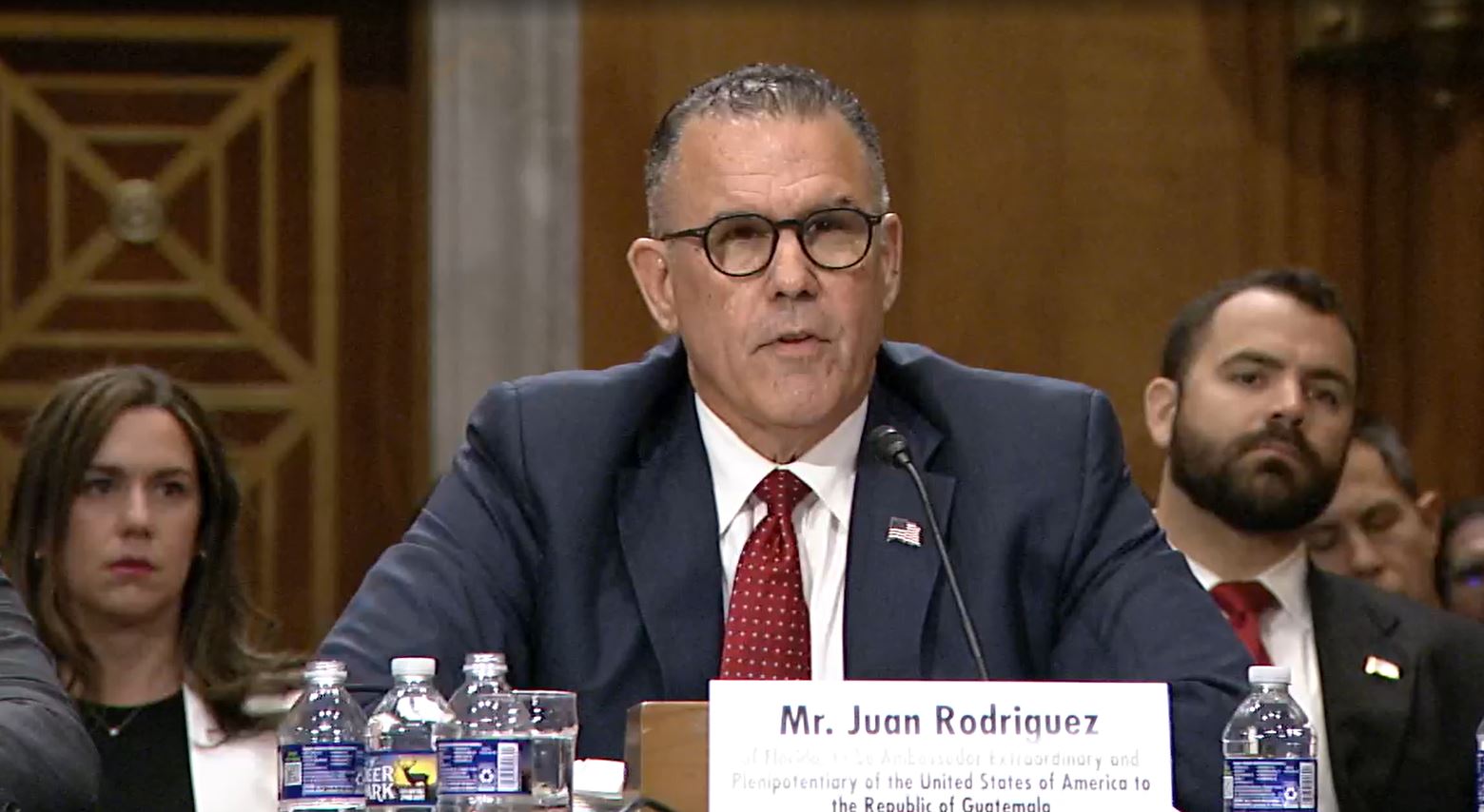
The appearance of United States ambassador-designate to Guatemala, Juan Rodríguez, before the Senate On April 28, he outlined a policy towards the country focused on results to Washingtonmainly from immigration control, security cooperation and containment of external influences.
More than a rethinking, according to the analysis of Roberto Wagner, internationalist and university professor, the diplomat’s presentation confirmed that Guatemalan institutional stability is seen as a US strategic interest, and does not represent a shift in Washington’s strategy, but rather the continuity of a line focused on its priority interests.
Migration: strategic priority
In this context, he explained that migration will continue to be the main axis of the bilateral relationship. “The interest of the United States is that we stop irregular migration. But it is up to Guatemala to make changes in the structural conditions to resolve it”he pointed out.
He added that the migration phenomenon is recurrent, since a significant part of the returnees try to leave the country again. “Of ten returnees, six try again and three succeed,” he cited as a reference to the phenomenon that, even with variations, is persistent.
According to the expert, this shows that US authorities will insist that solutions must focus on generating internal conditions that reduce migration.
The central axis of the ambassador-designate’s approach to migration was addressed not as a social phenomenon but as a security issue.
Rodríguez proposed strengthen cooperation to stop irregular migration, dismantle trafficking networks and accelerate returns, in line with a policy that moves border control to countries of origin and transit. Under this logic, Guatemala is configured as a functional actor in migration containment.
China, Taiwan and the strategic value of Guatemala
Regarding Rodríguez’s warning regarding China, the analyst stated that Guatemala already occupies a key position in the regional geopolitical dispute to maintain diplomatic relations with Taiwan, in a context in which several Central American countries have changed their recognition towards Beijing in recent years.
In this scenario, the country has become one of Taiwan’s most relevant allies in the hemisphere, both due to its demographic and economic weight, which gives it additional strategic value in the foreign policy of the United States.
“We are already the bulwark against China. We are one of the few countries that recognize Taiwan and, in terms of demographics and Gross Domestic Product, the largest. […] but we have not known how to take advantage of that relationship,” said Wagner.
The analyst maintains that this position has not been fully translated into tangible benefits, such as greater investment or access to markets or technology transfer, neither from Taiwan nor from the United States.
The geopolitical pressure is no less, since China has increased its presence in the region through investment, infrastructure and cooperation, which has led several countries to rethink their alliances.
In this context, the challenge for Guatemala according to Wagner is not only to maintain its alignment, but to capitalize on it.
“It is time for the country to really take advantage of these relationships and evaluate what benefits it can obtain from maintaining its ties with Taiwan in relation to the United States”he added.
According to the analysis, this implies a more active negotiation strategy that allows it to convert its geopolitical position into concrete advantages for its economic development and its international insertion.
Trade: tensions under “America First”
In trade matters, the analyst pointed out that the policy promoted by President Donald Trump has modified the rules of the international economic scheme, with a more protectionist approach aimed at favoring US interests.
In this context, he explained that the aim is to maintain a favorable trade balance for the United States and limit competition in sensitive sectors, especially agriculture.
“The aim is for Guatemala to continue importing more American products than it exports to that country, and to protect sectors such as agriculture”he explained.
He warned that this will be one of the most complex points in the bilateral relationship, which is why it will require constant negotiation.
“Agriculture is going to be a difficult relationship […] It is a situation that under the America First policy, Trump has been promoting as a doctrine […] “We have to continue negotiating,” he explained.
The analyst also considered that the future ambassador could act aligned with that vision. “Rodríguez is going to be like a spokesperson for that line — a little Trump in Guatemala — so we will have to learn to negotiate in that context,” he noted.
Guatemala’s room for action
Finally, the analyst stressed that the direction of the relationship will depend on the country’s decisions regarding the United States. “Guatemala has to decide whether to align completely or negotiate.”
He added that the current relationship also reflects accumulated decisions in the management of that policy. “The pressure is strong, but it is also a result of what has been allowed,” he concluded.
Also read: US allies look to Europe to build a post-Trump world order