
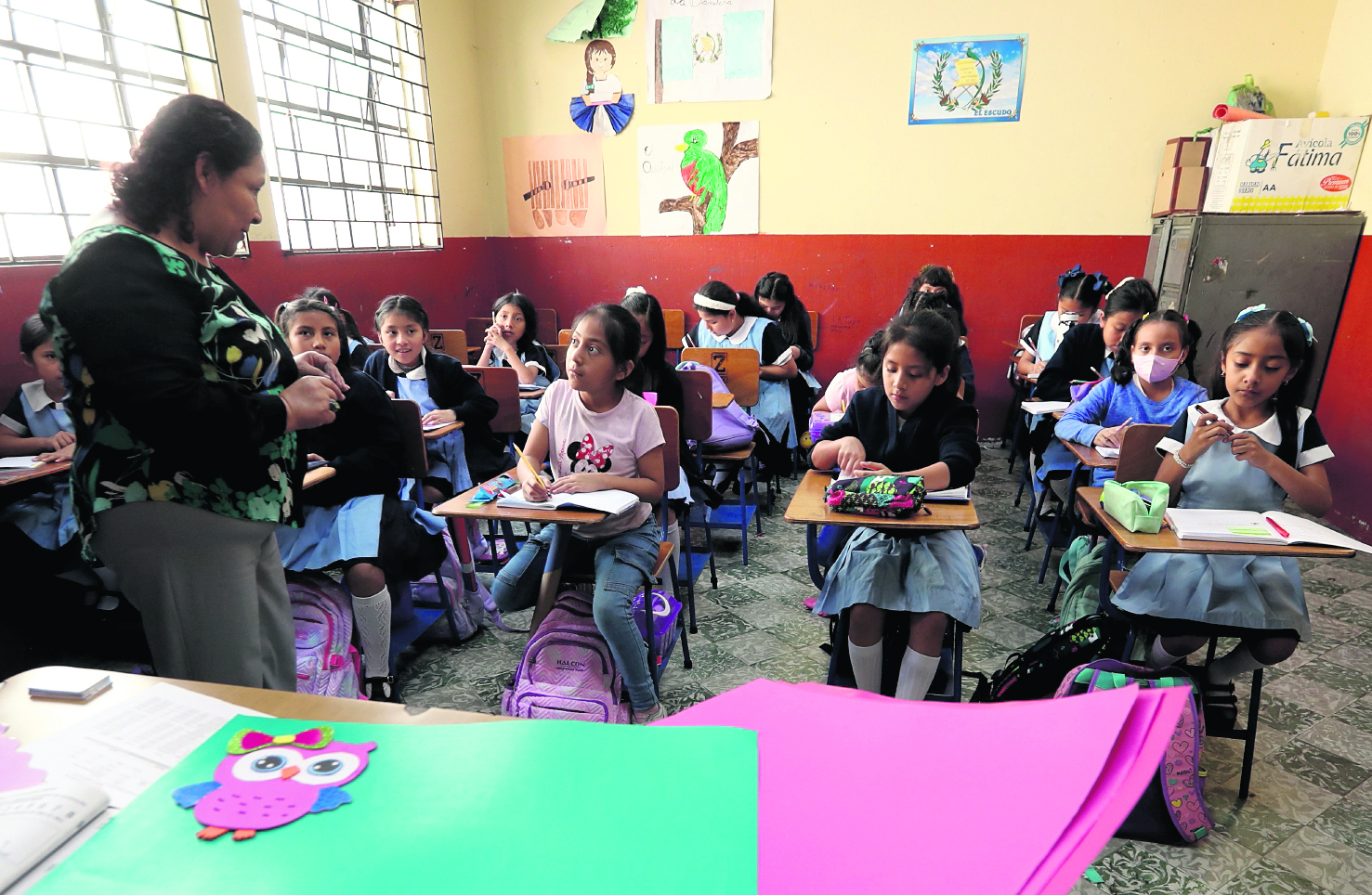
During 2025 and until April of this year, the Ministry of Education (Mineduc) has retired more than 4 thousand teachers who taught classes at different educational levels. The number of dismissals exceeds the average of one thousand teachers who used to cease work activities in the portfolio annually, this before the reforms to the State Passive Classes Law (Decree 18-2024), approved in 2024, came into force.
The Ministry of Education record indicates that Last year 2,453 teachers retired and that, in the first four months of this year, there are 1 thousand 668. 25.3% of these personnel worked in classrooms of public establishments in the department of Guatemala; 12% was assigned to Escuintla; 11.6%, to Quetzaltenango; 11.4%, to Huehuetenango, and 10.5%, to establishments in Chimaltenango. These are the five departments with the most teachers who have stopped working for the Ministry.
According to Francisco Cabrera, technical vice minister of Education, with the modifications to decree 18-2024 the rate of retirements increased, and it is expected that This year it closes with 3 thousand retired teachers.
Cabrera sees this phenomenon as healthy for the educational system, since it allows teachers with 25 or more years of experience to leave the classrooms and allow young staff to pass.
“This does not guarantee any change by itself, but a young teacher, here and anywhere in the world, is associated with a person more willing to learn, to implement new things, with more capabilities, and with greater familiarity with technology. It has a positive impact,” recognizes Cabrera.
But this also represents a challenge in administrative terms for the Mineduc, since demands greater agility in the processes to assign new teachers to vacant positions, which must occur within a maximum of two months so as not to harm the teaching process.
The data banks that have been created with each call that the Ministry has launched for the hiring of teachers in new positions allow candidates to be selected in a short time to appoint replacements for retirees. The advantage is that this file stores information by municipality, that is, you can locate candidates who reside in the same area where it is needed.
Cabrera points out that teachers have access to the data bank, which allows them to verify what position they are in and, if they are among the first places, prepare their paperwork so that when they are called to fill the vacant positions, they are ready for incorporation.
Process
There is no set date for teachers to retire, although in previous years, by “tradition,” they did so at the end of January. However, due to changes in the law, the process can be started at any time.
Vice Minister Cabrera explains that retiring is a right of public workers, and that it is usual for teachers to wait until they reach class F (the highest rank) to do so, since this allows them to obtain a higher pension. To reach this rank, it is necessary to have worked for a minimum of 24 years for the Mineduc.
“A teacher who has been working in the system for 20 years or more is very likely to feel very comfortable with the practices that he has done all the time. If he reaches old age and continues to practice, it is very likely that he will have limitations that affect his performance, associated with his state of health, mobility or the energy to endure the entire work day,” says Cabrera.
At this point the discussion opens on the experience and mastery that the teacher has in the subjects that he has taught for years, despite having reached retirement age, compared to the new practices and performance that younger teachers may have. What weighs more?
“It is not a problem in itself for a teacher with 20 or 25 years of service to continue working, but several factors are associated – suffering from age-related illnesses – that can become a negative burden for the system and directly affect their performance, and, therefore, harm students. Young people may have more flexibility and greater willingness to apply different – pedagogical – practices, but they must gain experience like any other professional,” explains the vice minister.
Ester Ortega, education analyst and former vice minister of Educational Quality, considers it positive that teachers who have completed their time of service retire, since there are cases in which the educator does not update himself and continues with teaching-learning methods used in past decades, now outdated.
That young teachers come to occupy these vacant positions represents an opportunity to renew strategies and techniques in the classroom. In addition, new generations are more familiar with the use of technology, knowledge that they can transfer to students to face the challenges of the 21st century, reflects Ortega.
Changes in pensions
From the modifications to Decree 18-2024the monthly pension of retirees cannot be less than the non-agricultural minimum wage established in 2024, which is Q3 thousand 634.59, nor greater than Q7 thousand.
In the reforms to the standard, a periodic review was approved every four years – in January – which will consist of an actuarial study to analyze the allocations corresponding to retirements and pensions.