
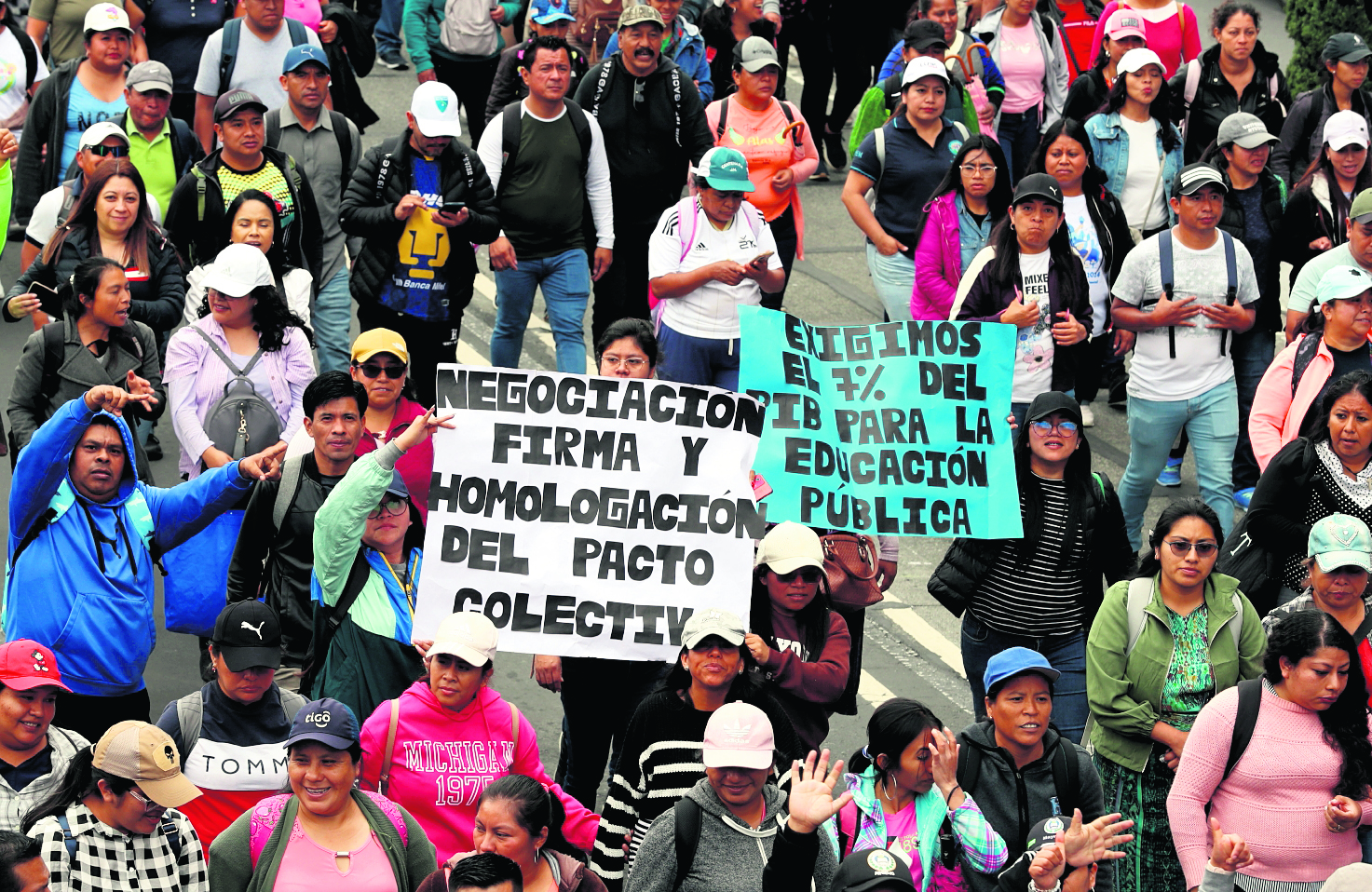
The sentences of three articles of the Collective Agreement on Education Working Conditions that the Constitutional Court (CC) ruled as unconstitutional must be eliminated from the agreement in force from 2022 and cannot be included in future negotiations.
On May 3, the High Court issued a ruling on an unconstitutionality appeal presented in May 2025 by the Attorney General’s Office (PGN), at the request of the Ministry of Education (Mineduc), considering that seven articles of the pact granted the Guatemalan Education Workers Union (STEG) power over decisions that are solely the responsibility of the ministerial authority.
Phrases were questioned in the sections 1, subsection c); 20; 21, subsection b); and in articles 45, 46, 47 and 62; but the favorable ruling was only for three: 20, 21 and 62, related to support programs, educational quality processes and human resource training. The other four, referring to the mixed boards, continue without changes.
According to Vice Minister Francisco Cabrera, the CC’s resolution is positive, as it establishes “with complete clarity” that The leadership of the educational system corresponds to the Ministry of Education.
“We are very satisfied with the Court’s resolution, because it rescues what is most important and resolves several aspects that we believed needed to be clarified,” said the official, referring to the role of the joint boards.
The phrases on which the unconstitutionality was declared are without effect. “If there were a future collective agreement, it can no longer include everything that the Court’s ruling already defined,” Cabrera said.
Among what was resolved in favor of Mineduc is that it can operate support programs and training for human resources without the restrictions previously established by the collective agreement, such as have the endorsement of the union.
“The STEG does not have the power to supervise; it is not its responsibility, and the Court made it very clear. The training processes are important and have to be carried out with technical criteria, not on political consensus, as occurs in the spaces of a collective agreement,” indicated the vice minister.
With respect to the articles that the CC did not declare unconstitutional, these are maintained in the current collective agreement and can be included in future agreements; However, the sentence clarifies that they should not contravene the Ministry of Education, the official added.
Such is the case of mixed boards, which, according to Cabrera, it was never the ministry’s intention to eliminate them, as they are a recognized figure in labor law, but rather to delimit their actions so that they do not exceed the functions that are solely the responsibility of the authorities.
He STEG spoke on their social networks about the CC ruling and, according to their interpretation, “none of the seven articles challenged are illegal or unconstitutional.”“, and that only some phrases from three articles should be eliminated, but this does not “alter the content of the collective agreement.”
He adds that what was resolved by the High Court demonstrates that what is established in the pact “does not conflict with the Constitution, national laws and international legislation,” and that The negotiation “was carried out in accordance with the rule of law.”
What does the sentence say?
The section focuses on the adherent unions, that is, the groups that join the collective agreement. The PGN indicates that the STEG is granted administrative powers that correspond to the ministry, by including in the article that, to adhere to the pact, the groups must have a certified copy issued by the majority union, through the phrase: “the resolution issued by the corresponding Congress of the STEG”.
However, among the CC’s arguments is that this phrase “must be understood as an adjuvant mechanism, not as a delegation of public power,” and that it maintains the division between state powers and freedom of association. Furthermore, it considers that “it harmonizes the public function with collective labor rights.” Therefore, declared the complaint of unconstitutionality inadmissible.
Addresses the quality of services provided by the ministry, such as training, training and evaluation processes of human resources. The phrases questioned by the Mineduc are several, considering that they delegate functions of the portfolio to the STEG.
One of the statements is: “and unions will encourage such participation“, in reference to the training and training processes.
In this regard, the High Court ruled that the content of the phrase “does not entail delegation or interference” in ministerial functions; rather, it constitutes a “participatory promotion mechanism” that strengthens educational policy.
From the same article, the PGN questions the phrase “known, discussed and approved by the national ministry through its representative organization”, for ceding the ministry’s own powers to the union.
The CC argued that the statement grants the union power of knowledge, deliberation and approval over the teacher training and evaluation programs implemented by the ministry, which constitutes “undue interference” in the educational leadership and “denaturalizes” the public function. Furthermore, he indicated that the union’s participation should be limited to dialogue, consultation or recommendation. For this reason, declared it unconstitutional.
In article 20, the phrase “and the proposing union and adherents“, related to the promotion of parents. In the Court’s opinion, this exceeds the limits of collective bargaining, exclusive of working conditions, and violates the principle of “non-delegability of the public function.” Therefore, declared it unconstitutional.
The section addresses the training of Mineduc personnel through different programs, but here the phrase is questioned: “prior consensus with the proposing unionAccording to the CC’s analysis, this violates the functions of the ministry, which is responsible for directing, processing, resolving and inspecting everything related to the portfolio.
Therefore, it indicates that the statement is unconstitutionall, since it “subordinates” the ministerial power to train personnel by requiring prior consensus with the union. It adds that union participation in these processes must be redirected to consultation and support, “without their consent being a binding condition for the exercise of ministerial power.”
Said articles address the issue of mixed boards, who comprises them and the validity of the agreements and resolutions reached by them. In this regard, the Mineduc has indicated that their role in the collective agreement escalated to deciding on the hiring or relocation of teachers, publication of calls and other matters of the ministry, and that the public function is not delegable.
In the opinion of the CC, the function of the mixed boards, within the framework of a collective agreement, is that of instances of conciliation and social agreement, and they strengthen the dialogue between employers and workers, without replacing the powers of the competent administrative body, in this case the Mineduc. “Its role is limited to facilitating the consensual solution of labor disputes,” he indicates.
The high court declared the complaint of unconstitutionality of these three articles without merit.
This refers to educational benefits, such as the provision of materials, furniture and equipment necessary for teachers by the Mineduc. However, the PGN questioned two phrases, considering that they contravene the stewardship and functions that are the responsibility of the ministers of State.
The phrases are: “and the STEG” and “The Guatemalan Education Workers Union, STEG, will ensure proper compliance with the programs and will carry out monitoring and evaluations of the services it deems appropriate.”.
At this point, The CC declared unconstitutionality valid and pointed out in the ruling that transferring to the union the power to ensure compliance and evaluate educational programs and services constitutes an interference in the functions of Mineduc and “introduces a parallel control power in the hands of an entity that lacks public investiture.”