
Before the development of the election processes in the Supreme Electoral Tribunal (TSE), the Constitutional Court (CC) and the Public Ministry (MP), a scenario of “distrust and uncertainty” was perceivedbecause there were certain doubts on the part of different sectors of the country about whether these processes could be carried out adequately. However, That panorama changed with the replacement of the new authorities in these entities, that are “of utmost importance for democracy in Guatemala”, sAccording to the assessment of the observation mission of the Institute for Climate, Democracy and Inclusion (CDI).
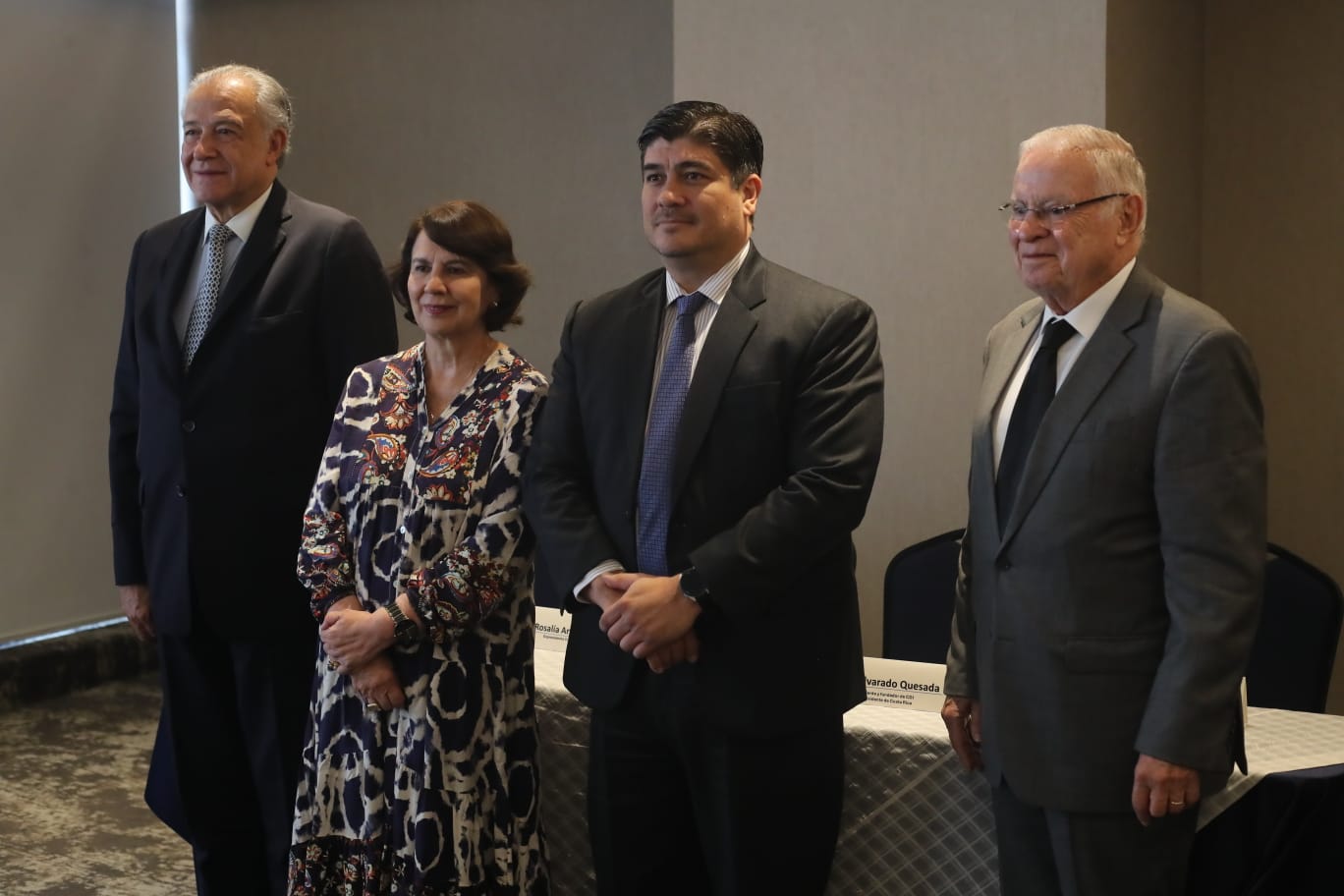
This is the second visit that the mission headed by Carlos Alvarado Quesada, former president of Costa Rica, and made up of Rosalía Arteaga Serrano, former president of Ecuador; Miguel Ángel Rodríguez, former president of Costa Rica, and Óscar Naranjo Trujillo, former vice president of Colombia, perform in Guatemala, since The first was carried out in February of this year, prior to the appointment of the new authorities in the three bodies.
According to Alvarado Quesada, during this new visit the mission focused mainly on “monitoring the second-level election processes and strengthening the legitimacy of the institutions that are key within the State,” since the result of these is a reflection that the rule of law and democracy still prevail in the country.
“The mission takes place at a time of special relevance for Guatemala, after the recent election of the new attorney general of the Republic for the period 2026-2030 and within the framework of other institutional processes that will take place during the year, among them the appointment of the comptroller general of accounts and the election of the presidency of the Supreme Court of Justice”, which are considered fundamental for the consolidation of the rule of law, the separation of powers and citizen trust in the institutions,” he stated.
He also indicated that The processes for appointing authorities carried out throughout 2026 are fundamental for the consolidation of state institutions, the separation of powers and the recovery of citizen trust in these institutions, since the direction of the country depends on them.
Institutional strengthening
In this second visit, which the mission carried out from June 8 to 10the progress recorded in carrying out the second degree election processes stands out mainly, which especially reflects the strengthening of these institutions and makes Guatemala in an example for democracy on the continent, stated the leader of the mission.
“We want to highlight this because although there is a global, even regional, trend in some countries of democratic erosion and regression, what exists today in Guatemala is an advance towards democratic strengthening. And that is worth highlighting because Guatemala becomes an example for this process, an example for the region of strengthening democratic institutions,” he assured.
Alvarado commented that During this visit to the country they have held conversations with representatives of the Guatemala Forum, indigenous leaders and communities, who pointed out some aspects that could have been improved in these election processes, but they are issues that “are present, as in any democracy.”
Monitoring of the appointment of the comptroller general
The members of the CDI observation mission commented that they will follow up on the appointment process of the new comptroller general of accounts, since it is also a position of great relevance in Guatemala. The Comptroller’s Office has a fundamental role in next year’s electoral process, mainly due to the issuance of the temporary certificate of non-existence of claim of charges, known as “settlement”.
“It is a process that we know that citizens and civil society follow. In particular, one of the things that we have heard the most is about the figure of the settlement. It is a figure that the Comptroller’s Office issues; this settlement is what allows authorities or people to participate in election processes. This seems to be a very central element, because it is required that it be done with the greatest transparency and justice, and not as a discretionary blocking tool. That is what we have heard about the importance of this process,” said the head of the mission.
About the University of San Carlos
The members of the mission also indicated that, within the conversations held with different sectors of the country, they have been aware of the fundamental role that the University of San Carlos of Guatemala (Usac) has in the designation of authorities in these institutions. They also pointed out that they have heard the accusations made against the authorities and that this is precisely due to the constitutional model that exists in Guatemala, where that power is granted to the house of higher education, which constitutes an issue worthy of analysis, as indicated Rosalía Arteaga Serrano, former president of Ecuador and member of the mission.
“From the conversations we have had regarding the role of the University of San Carlos, we determined that it is a unique situation. In our countries there is no such representative and important figure of a university when it comes to nominating possible authorities. So, it is a topic worthy of analysis, worthy of study, which has been very repetitive in all the spaces where we have talked. The role that the university is having and the concern about how it appoints its own authorities,” said Arteaga.
The role of the media
Regarding the role that the media have played, Arévalo Celada assured that this has been “very important”, since they have been fundamental throughout the election processes carried out in the Supreme Electoral Tribunal, the Constitutional Court and the Public Ministry. It is through them that citizens “have been able to learn about its development and who the elected authorities have been,” as well as to help ensure that there is no “polarization” over the processes.
Therefore, His work has been and continues to be fundamental for democracy in the country, and will continue to be so in the pending appointment processes, such as those of the Comptroller General of Accounts and the presidency of the Supreme Court of Justice, which is why the elected authorities in each of the elected institutions are urged to respect and guarantee their work without bias, indicated the members of the observation mission.