
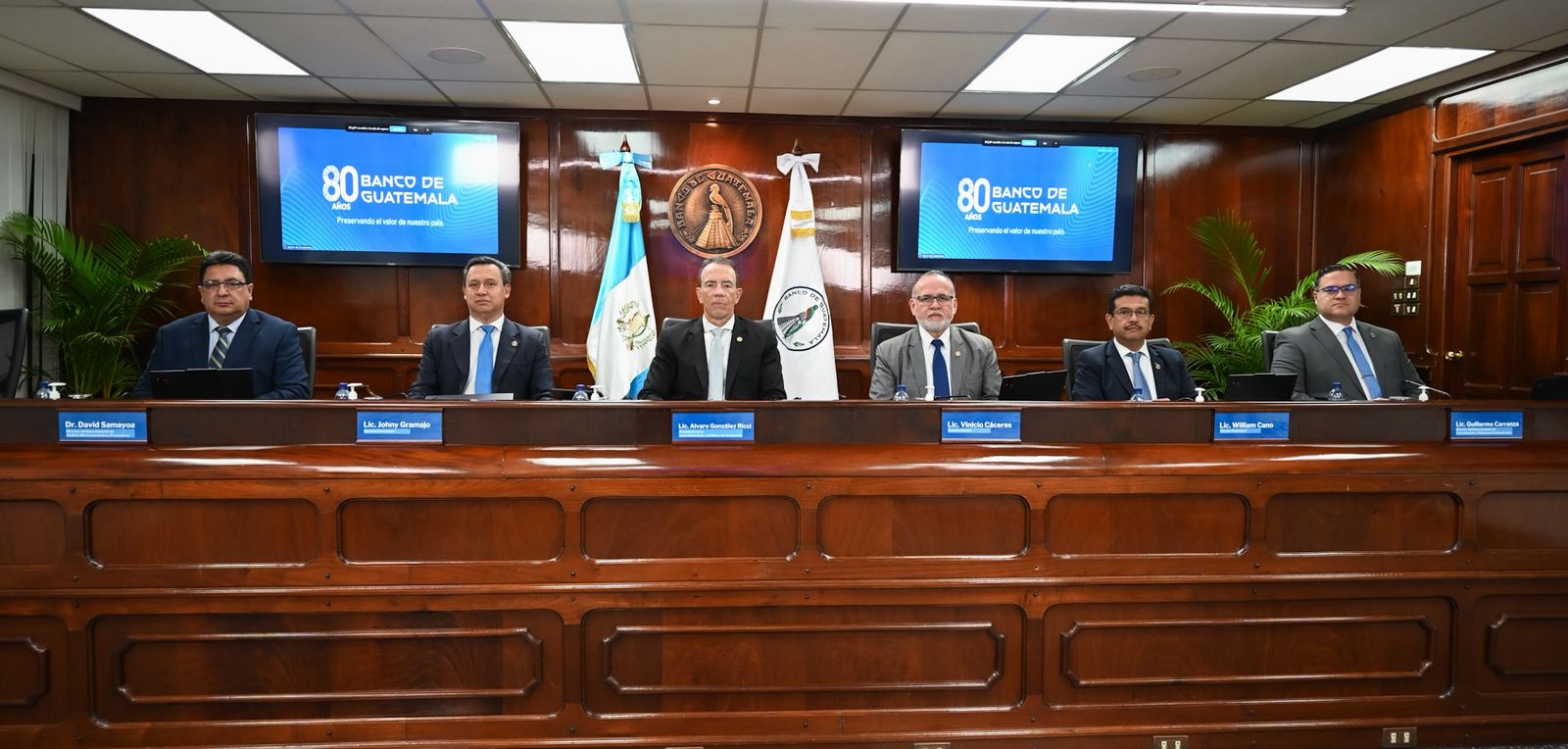
Guatemala closed the first half of 2026 with a leading monetary policy interest rate of 3.50%, in a context of global pressure and uncertainty due to the international geopolitical conflict, the authorities of the Monetary Board (JM) stated when announcing the decision.
The announcements released last week about an understanding agreement between the United States and Iran reduced pressure on international prices for a barrel of oil, and that trend is already reflected in the crude oil market.
Álvaro González Ricci, president of the JM, explained at a press conference that the decision was unanimous. However, the outlook for global economic growth remains positive, driven by the resilience of private consumption and by still favorable international financial conditions, although in an environment of greater uncertainty and downside risks due to the geopolitical conflict.
He explained that have registered significant decreases in the international price of oil and its derivatives, whose effects are already observed in international inflation.
González Ricci highlighted that progress in negotiations to end hostilities has recently led to significant decreases in the international price of oil, which would tend to moderate pressures on international inflation.
At the domestic level, he highlighted that the behavior of short-term economic indicators continues to be positive, in congruence with the estimate of economic growth expected for 2026. However, he clarified that, if a definitive peace agreement is not reached, the external supply shock in the internal prices of fuels and energy would persist and could affect the economic outlook of Guatemala during this year.
Monthly inflation in May in Guatemala was -0.12%, and the inflation rate reached 2.86%, lower than the 3.24% registered in April, but higher than the 2.50% in March, when the international geopolitical conflict began and the level of uncertainty increased.
The transportation division influenced the Consumer Price Index in May.
The scenario for closing inflation in 2026 is 3.75% and 4% for 2027, as explained at the conference.
Oil falls after agreement
In an interview granted to Free press On Monday, June 22, Jonhy Gramajo Marroquín, economic manager of the Bank of Guatemala, explained that the memorandum of understanding basically establishes a more formal ceasefire and allows the Strait of Hormuz to be reopened for the transit of oil through that sea route.
With the announcement that an agreement would be reached, The price of oil decreased last week to around US$76 per barrell.
“If we compare it with the prices we had, for example, a month ago, close to US$100 per barrel, it is basically a 25% drop in the price of oil,” he exemplified.
In July there will be a pause in the decisions of the Monetary Board (JM) on this indicator, and the next session was scheduled for August 24.
Record
Since May 2022, the leading rate has risen from 1.75% to 5% but then dropped to 3.50%:
- From January to April 2022: 1.75%
- May 2022: 2%
- June 2022: 2.25%
- August 2022: 2.75%
- September 2022: 3%
- November 2022:3.75
- January 2023: 4.25%
- February 2023: 4.50%
- March 2023: 4.75%
- April 2023: 5%
- May 2023: 5%
- June 2023: 5%
- August 2023: 5%
- September 2023: 5%
- November 2023: 5%
- February 2024: 5%
- March 2024: 5%
- April 2024: 5%
- May 2024: 5%
- June 2024: 5%
- August 2024: 5%
- September 2024: 4.75%
- November 2024: 4.50%
- February 2025: 4.50%
- March 2025: 4.50%
- April 2025: 4.50%
- May 2025: 4.50%
- June 2025: 4.50%
- August 2025: 4.25%
- September 2025: 4%
- November 2025: 3.75%
- February 2026: 3.50%
- March 2026: 3.50%
- April 2026: 3.50%
- May 2026: 3.50%
- June 2026: 3.50%