
On August 12, 2026, the strip of totality of the solar eclipse will cross the Arctic Ocean, Greenland, Iceland, the Atlantic Ocean, northern Spain and the extreme northwest of Portugal. Millions of people in the rest of Europe, parts of North America and northwest Africa will be able to observe a partial phase of the phenomenon.
The expectation is considerable. Spain will be the only populated place in the world where the total eclipse can be observed, the first of its kind in that country since 1912.
However, the magnitude of the event carries a health risk about which medical authorities have already begun to warn.
Irreversible damage
Although during an eclipse the light from the Sun appears dim, the star continues to emit harmful radiation—ultraviolet, infrared, and intense visible light—that can concentrate on the retina.
The eye does not feel pain or notice that it is being damaged. The result can be solar retinopathy, that is, a burn on the retina, with loss of central vision or permanent dark spots.
This is confirmed by the American Academy of Ophthalmology, which warns that looking directly at the Sun, even for a short period and without adequate protection, can permanently damage the retina and even cause total loss of vision.
The General Council of Colleges of Opticians-Optometrists of Spain (CGCOO) warns in the same sense. The optician-optometrist Rafael Pérez Cambrodí, president of the Valencian Community college, warns that observing the Sun directly can cause burns in the macula, the central area of the retina that allows us to distinguish details.
He adds that improvised solutions – x-rays, old film reels or conventional sunglasses – do not offer protection and, on the contrary, can enhance the damage by allowing the Sun to be observed for longer than would be possible with the naked eye, as he told the EFE agency.
How to protect yourself
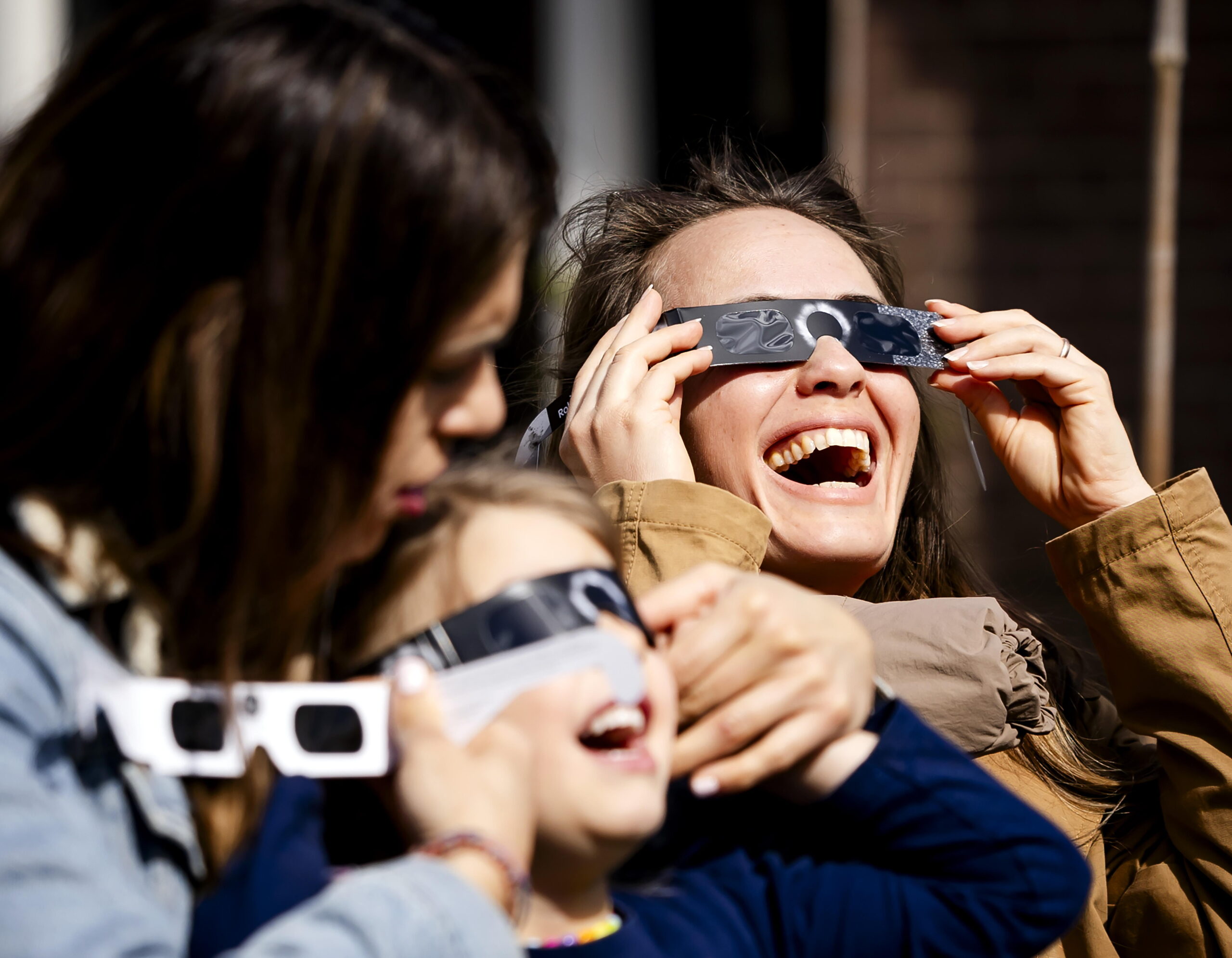
The only safe way to view a solar eclipse, except during the brief seconds of totality, is with certified solar filters. Only during that period, when the Moon completely blocks the Sun’s bright surface, can viewers remove eye protection, NASA explains. Outside of that phase, and during any partial eclipse, protection is essential at all times.
Experts indicate that glasses must carry the ISO 12312-2 seal, which certifies their ability to block solar radiation. They also recommend not using them if they have scratches, perforations or any other visible damage. Those who use telescopes or cameras should place the filters on the objectives and not on the eyepieces, since these instruments concentrate the radiation even more.
Prevention as a priority
Looking at the Sun without adequate protection can damage the retina in just a few moments. Since the process does not cause pain, minors do not realize that their eyes are being injured. For this reason, specialists make a special call to parents and educators to reinforce the warning among children and young people.
A study published in January 2026, on the April 2024 eclipse in the United States, concluded that public education campaigns on safe viewing appear to have been effective in reducing emergency department visits for eye injuries. However, he points out that awareness efforts must be maintained in the face of future eclipses.