
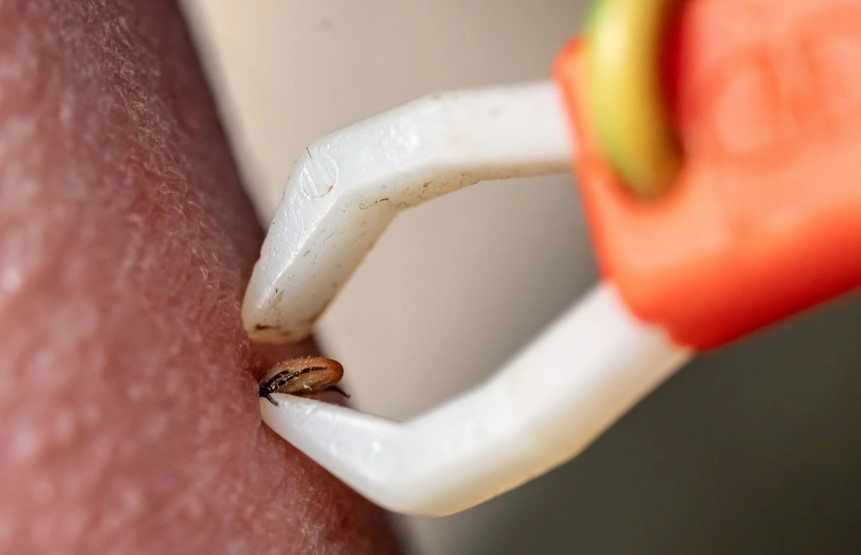
If a tick attaches itself to your skin—something that’s becoming more common, especially in the United States this time of year—the first concern could be Lyme disease, the most common tick-borne disease. But the same ticks that transmit Lyme disease, deer ticks, are also vectors for other pathogens, one of which may pose an even more serious threat: the Powassan virus.
In recent months, cases of Powassan virus disease in New Jersey and New Hampshire have garnered national attention due to the possible severity of symptoms, which can include neurological problems such as memory loss, slurred speech and seizures.
This is because the Powassan virus can enter the central nervous system and cause encephalitis (inflammation of the brain) or meningitis (inflammation of the tissues surrounding the brain), explained Saravanan Thangamani, professor of microbiology and immunology at SUNY Upstate Medical University and director of the SUNY Center for Vector-Borne Diseases.
Although Powassan virus disease is quite rare, an increase in cases has been seen in recent years. Data from the Centers for Disease Control and Prevention (CDC) show that in 2015, seven cases were recorded in the United States; in 2025, that number rose to 76.
Here’s everything you need to know about the disease, including why experts think it’s becoming more common and how to protect yourself.
How and where the Powassan virus spreads
Powassan virus is named after the Ontario city where it was discovered in 1958. In the United States, it has been detected primarily in the Northeast and Upper Midwest. The deer tick (also known as the blacklegged tick) most frequently transmits the virus to humans.
Groundhog and squirrel ticks are also known to spread it, but they live in densely forested areas where people have less access, Thangamani said.
The virus can be transmitted from tick to human quite quickly. “Unlike Lyme disease, where the tick typically needs to feed on blood for 16 to 24 hours to transmit the disease, with Powassan virus, it appears that the tick does not need to be attached to the person for much longer than 15 minutes,” said Catherine Valentine, an assistant clinical professor in the division of infectious diseases at New York University Grossman School of Medicine.
According to Thangamani, the longer a tick carrying the Powassan virus spends feeding on you, the more virus will be transmitted to you and the more seriously ill you could become.
Symptoms and possible complications of Powassan virus
According to Valentine, experts hypothesize that most people infected with the virus do not show symptoms. Those who do have them usually have a fever first and may feel like they have the flu. This could manifest as muscle aches, fatigue or general malaise, Valentine explained. For some, that’s where Powassan’s story ends.
But in other cases, the virus enters the central nervous system, infecting the spinal cord and brain, usually within a few weeks. This is when symptoms become neurological and can include confusion or cognitive problems, slurred speech, loss of coordination, and even seizures or paralysis.
“It wouldn’t be unreasonable for someone to think they were having a stroke,” Valentine said. A key difference is that, during a stroke, neurological deficits appear very quickly; Symptoms of a brain infection appear over the course of a few days, he explained.
Among symptomatic patients, the mortality rate is as high as 15 percent, and half of survivors suffer long-term neurological sequelae, which can range from “I always forget my car keys” to difficulties speaking, walking and sometimes even eating, Valentine said.
There is no treatment for this condition or vaccine to prevent it. Management of severe cases usually involves supportive care, such as intravenous fluid therapy and respiratory or nutritional assistance if necessary, Thangamani explained. Some doctors may prescribe steroids to reduce brain inflammation, Valentine said. Survivors with long-term neurological problems can also benefit greatly from rehabilitation services, such as physical therapy, cognitive therapy, and occupational therapy.
Why is Powassan booming?
Climate change is the main factor: Ticks thrive in warm, humid climates, so rising average temperatures have dramatically extended their active season, Valentine explained. “We are seeing cases [de enfermedades transmitidas por garrapatas] “Now in March and even as late as November.” Additionally, when it is warmer, people spend more time outdoors, which increases the likelihood of tick bites and, therefore, contracting tick-borne diseases.
Milder winters may also contribute to increased rodent and deer populations. Ticks feed on these animals, which then transport them to new geographic areas, Thangamani explained. A greater presence of ticks in different regions could also facilitate the spread of Powassan.
Better surveillance and reporting of Powassan virus disease could also play a role in the increase in cases, but Thangamani suspects it is more underdiagnosed than overdiagnosed cases. Asymptomatic cases and those with only flu-like symptoms can easily go undetected. Even cases involving meningitis or encephalitis are not always correctly diagnosed, especially if the patient does not mention a tick bite (or does not even know he had one), or if the doctor does not relate the symptoms and orders blood or cerebrospinal fluid tests, Valentine explained.
How to avoid tick-borne diseases
The best way to avoid Powassan is to prevent tick bites. So, forget about fashion and tuck your pants into your socks when hiking or spending time in wooded areas, Valentine advises.
When you get home, put your clothes in the dryer on high heat for 10 minutes, Thangamani said. The dry environment will kill any ticks that may have attached themselves to clothing.
Also check for ticks immediately after any outdoor activity, not just at the end of the day or before bed.
“You go for a walk, you come back and check yourself; you go out to work in the yard, you come back in and check yourself again,” Valentine said.
If you find a tick, remove it, ideally by holding it by the head near its mouthparts with tweezers. Then, watch for symptoms of an infection, mainly fever, for 30 days, Thangamani said.
CONTENT FOR SUBSCRIBERS
If you feel unwell, see a healthcare professional as it could be Powassan disease or another tick-borne illness; Additionally, ticks can transmit multiple pathogens in a single bite, Thangamani added.
Their hope is that more people will become aware of the threat posed by tick-borne diseases, such as Powassan disease, and take it seriously. “It’s rare,” Thangamani said, “but it has serious consequences for human health.”