
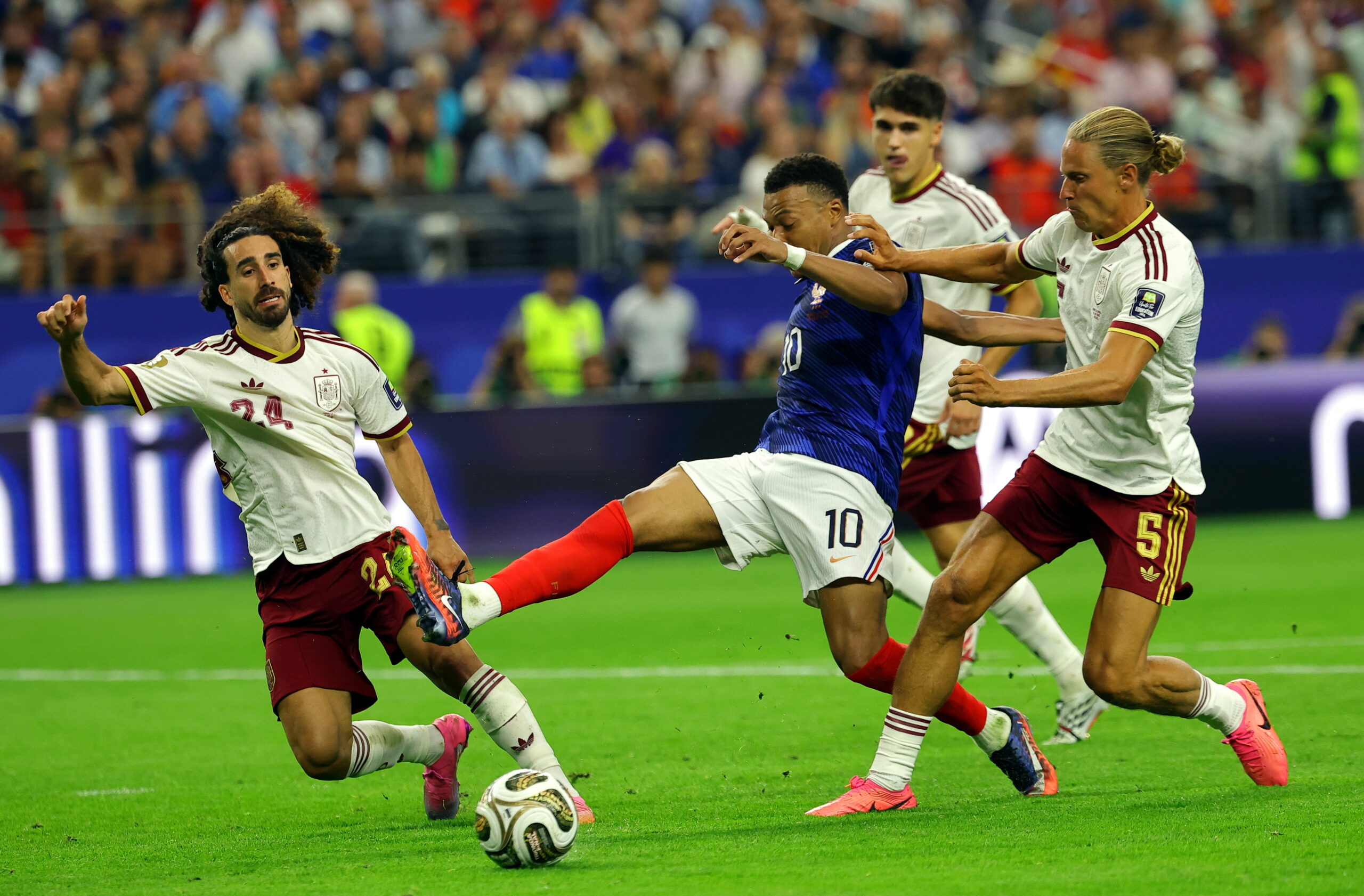
Spain did not need to monopolize possession of the ball or shoot more times than France to qualify for the final of the 2026 World Cup. The team led by Luis de la Fuente won because it managed the moments of the match better, reduced the French team’s main avenues of attack and converted its clearest opportunities.
The following analysis was prepared by Free press based on official match statistics published by the FIFA and in the records of DataFactorysports data provider used by this medium for coverage of the 2026 World Cup.
From these data, the sports editors interpret the main tactical aspects that explain the development of the match.
Mikel Oyarzabal opened the scoring from a penalty in the 22nd minute, after an individual action by Lamine Yamal, while Pedro Porro extended the lead at 58 after combining with Dani Olmo. France finished without a response, despite featuring Kylian Mbappé, Ousmane Dembélé, Bradley Barcola and Michael Olise from the start.
The figures reflect a much more balanced match than the score suggests. Spain ended with the 50.9% possessionin front of the 49.1% of France, and both teams performed 10 finishes. The difference was in the way in which each team managed the spaces and resolved the decisive actions.
1. Spain controlled the pace without monopolizing possession
The explanation for the victory is not in how long Spain had the ball, but in how they managed it.
Although possession was practically divided, La Roja lost fewer balls, recovered the ball faster and prevented the game from becoming a constant exchange of attacks.
Spain did not need dominant possession; Safer and more orderly circulation was enough.
2. Rodri gave balance to the midfield
The statistics reflect a high volume of interventions by the Spanish midfielder and the development of the match showed that he was the main organizer of the game.
In addition to distributing the ball, he protected the space in front of the centre-backs, helped with pressure after loss and limited French attempts to accelerate through the central lane.
His influence allowed the match to be played at the pace that best suited Spain.
3. Cubarsí and Laporte limited the deep unchecking
Spain advanced its defensive line to keep the team compact.
Pau Cubarsí and Aymeric Laporte alternated anticipation, coverage and retreats to prevent Mbappé, Dembélé and Barcola from finding spaces behind the defense.
France finished ten times, but only three shots were between the three posts and few actions allowed their attackers to receive with an advantage.
4. Mbappé received far from the most dangerous areas
Mbappé arrived as France’s main offensive reference.
The match sequences show that he received the advantage less frequently than in previous matches of the tournament.
Spain did not resort to an individual brand. He closed passing lines and forced the French striker to intervene far from the area or with his back to the goal.
5. Olise found few spaces between lines
Michael Olise needed to receive between the midfield and the Spanish defense to connect with the forwards.
That space practically disappeared.
Rodri protected the central lane, Fabián Ruiz reinforced the coverage and Dani Olmo constantly collaborated in the pressure.
France had possession, but few clean connections in the area where they usually generated the greatest danger.
6. The French forward never managed to attack as a block
Dembélé and Barcola are especially dangerous when they receive with meters to run.
Spain forced them to start many actions from delayed positions or close to the wings.
The pressure after losing reduced his time to decide and made partnerships with Mbappé and Olise difficult.
The French offensive never managed to link actions in a sustained manner.
7. Pedro Porro attacked to force France to defend
The right back was decisive long before scoring the second goal.
His constant additions forced France to delay several players and reduced the options of quickly coming out on the counterattack.
In the 58th minute he appeared again in attack to combine with Dani Olmo and seal the semi-final.
8. Lamine Yamal broke the balance
For more than twenty minutes France had managed to maintain the tie.
Everything changed when Lamine Yamal faced from the right and caused the penalty that Oyarzabal converted.
That goal forced France to abandon the plan they had developed for much of the tournament and take greater risks.
9. Spain was more effective
The two teams finished ten times.
Spain directed only two shots between the three sticksbut both ended in goals.
France generated a similar volume of approaches, although they lacked the precision to overcome Unai Simón.
In such a balanced semi-final, efficiency ended up making the difference.
10. Spain defended and attacked as a block
The classification cannot be explained solely by the performance of Rodri or the defense.
Fabián Ruiz supported the midfield; Dani Olmo connected the circulation with the attack and participated in the second goal; Oyarzabal converted the penalty; Cucurella balanced the left sector; Laporte coordinated the last line and Unai Simón responded when required.
Spain defended with their lines together and attacked by incorporating players from different areas of the field.
The key to the semi-final
Although the score was 2-0, the development of the match was much more balanced than the result reflects.
The difference was in the way Spain managed the spaces, controlled the timing of the match and took advantage of its opportunities.
France never found the scenario that most favors Mbappé, Dembélé, Olise and Barcola: receiving with meters to accelerate and attack a disorganized defense.
La Roja did not need to master all the statistical indicators.
It was enough for him to prevent France from playing the game they wanted. That was the main reason why he will compete in a new World Cup final.