
International Soccer
Thomas Tuchel admitted that he is analyzing a personal record over Lionel Messi. However, an analysis of Free pressbased on statistics shows that the biggest challenge for England will be to contain the collective functioning of Argentina.

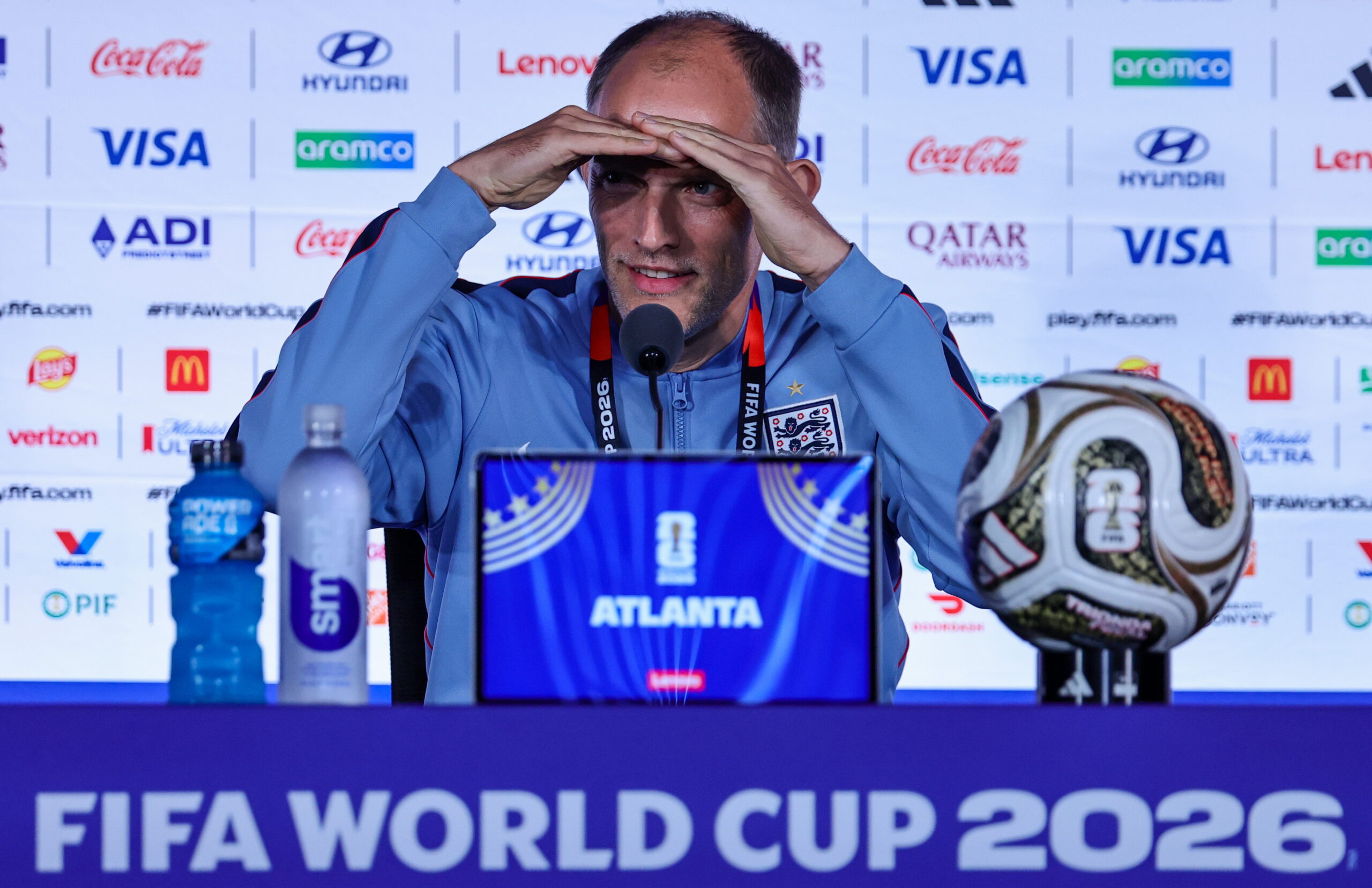
The England coach, Thomas Tuchel, participates in a press conference prior to the 2026 World Cup semi-final against Argentina, where he admitted that he is analyzing the possibility of applying a personal mark on Lionel Messi. Free Press Photo: EFE.
Thomas Tuchel admitted this Tuesday that he even considered a man-to-man mark on Lionel Messi before the semi-final between England and Argentina, a possibility that reflects the influence that the Argentine captain continues to exert on the elite of world football.
“It crossed my mind to do man defense, I don’t know if we will do it or not,” declared the England coach. Then he explained the reason for that reflection. “When Messi has the ball, the movement begins.”
The German coach’s statements raise an inevitable question: Do the statistics support that concern?
To answer it, Free press analyzed the official records of the FIFA Data Centercomplemented with the statistics of DataFactoryused during coverage of the 2026 World Cup.
The conclusion confirms Tuchel’s insight, but also reveals a broader finding: England will not only have to stop Messi; will have to find a way to deactivate the most complete offensive system in the championship.
Messi explains the concern
The individual numbers justify why the English coach thought of a special plan.
Messi reaches the semi-final with eight goals and two assiststied with Kylian Mbappé as the tournament’s top scorer. Furthermore, he has participated directly in 10 of the 17 goals scored by Argentina.
Its influence, however, goes beyond definition.
FIFA movement statistics show that he constantly intervenes between the lines, retreats to initiate construction and forces opposing defenses to modify their references. He does not remain stationary as a forward or wait for the ball; He goes out to look for him to activate the Argentine attack.
This behavior explains why an individual mark is much more complex than assigning a defender throughout the game.
The fact that changes the analysis: Argentina does not depend only on Messi
Here appears the main finding of the analysis. Statistics show that Argentina does not build its attacks solely around Messi.
The captain initiates many actions, but the team maintains a high offensive production thanks to the mobility of its midfielders and forwards, who generate new passing lines and occupy the spaces left by the attention on the number 10.
Official FIFA records reflect that reality.
Argentina leads the World Cup in:
- 17 goals
- 98 shots
- 4,162 passes completed
- 91% passing accuracyequal with Spain
In addition, it is among the teams with the best records in unmarking to receive, movements between the lines, offensive circulation and line breaks through the pass.
The data describes a team whose offensive production does not depend exclusively on individual inspiration.
The collective movement is the greatest strength
Statistics help to understand the functioning of Lionel Scaloni’s team.
When Messi receives the ball, Julián Álvarez, Lautaro Martínez, Alexis Mac Allister, Enzo Fernández and Rodrigo De Paul They multiply passing options with constant movements that generate new spaces between rival lines.
It is precisely this dynamic that Tuchel summarized by stating that “when Messi has the ball, the movement begins.”
The figures support that interpretation. Rather than monopolizing the game, Messi acts as the starting point of an offensive mechanism that permanently involves several teammates.
England will also have to solve its own challenge
The English team does not arrive without arguments either. Harry Kane and Jude Bellingham They accumulate six goals each and concentrate a good part of the team’s offensive production. In addition, Bellingham leads FIFA’s individual statistics in openings to receive, an indicator that reflects his ability to appear from different areas of the field.
Argentina will also have to control this mobility if it intends to return to another World Cup final.
What England should really stop
Statistics support Thomas Tuchel’s concern for Lionel Messi.
However, the same analysis shows that the main challenge for England transcends the Argentine captain.
The success of the English team will depend on preventing Argentina from maintaining the circulation of the ball, reducing receptions between the lines and finding the connections that have made the Albiceleste the most productive attack in the World Cup.
Tuchel’s statements find support in the numbers: Messi continues to be the most influential footballer in Argentina. But the analysis of Free pressprepared with official data from FIFA and DataFactory, reveals a broader conclusion: When the rivals focus their attention on the captain, Julián Álvarez, Lautaro Martínez, Alexis Mac Allister, Enzo Fernández and Rodrigo De Paul appear to keep the collective functioning alive.
That is the real challenge for England. Not only contain the best player in the world, but find a way to deactivate the offensive mechanism that has made Argentina the most productive team in the 2026 World Cup.