
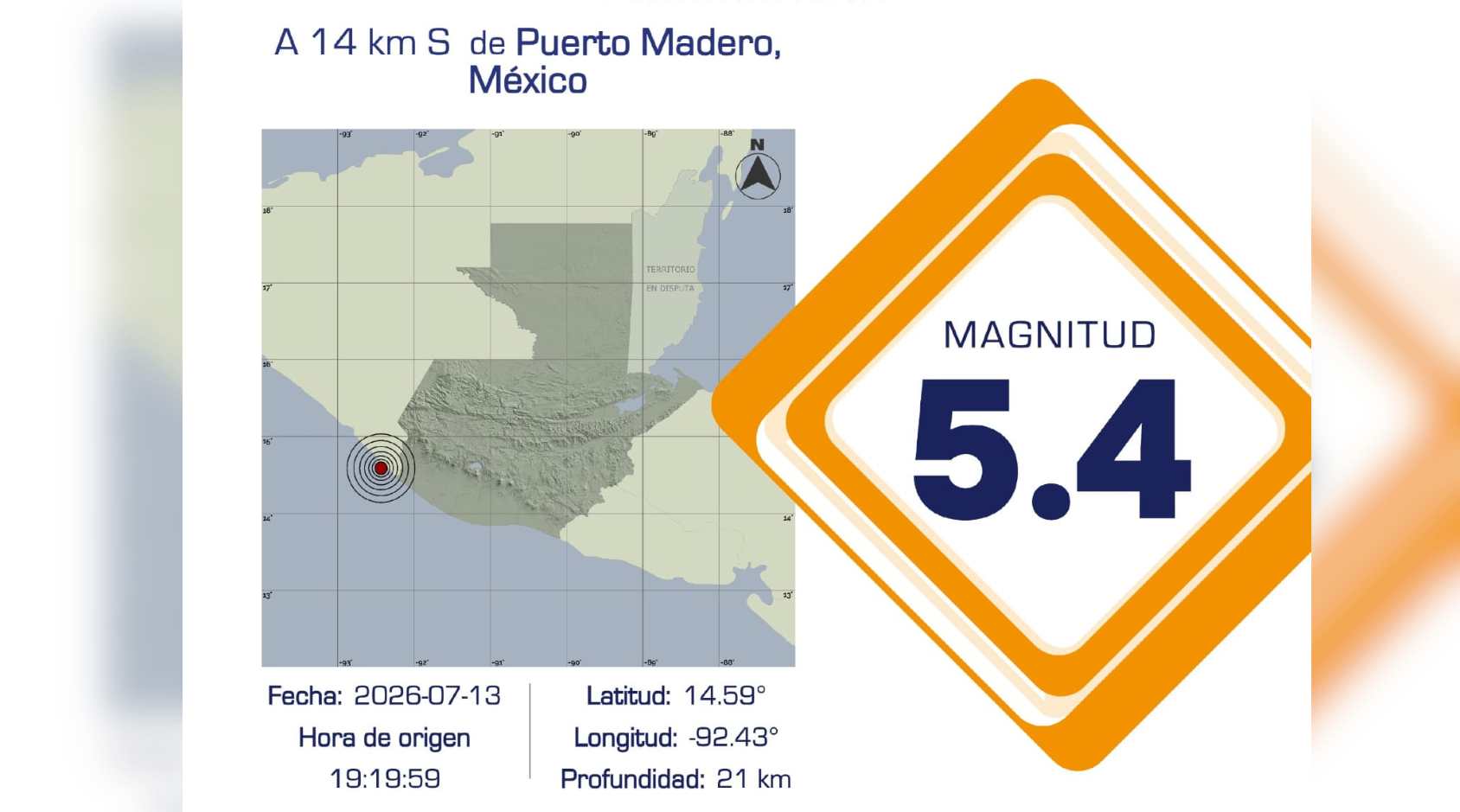
He magnitude earthquake 5.4 recorded off the Pacific coast of Mexico left more than just a perceptible tremor in western Guatemala.
He also left an explanation about how terrain features can change the way an earthquake feels.
Although Ocos was the Guatemalan municipality closest to the epicenter, the movement was more intense in Malacatán and the departmental capital of San Marcos. The explanation could lie in a phenomenon known as siege effect.
In the west of the country, inhabitants of San Marcos, Quetzaltenango, Retalhuleu and Suchitepéquez They reported feeling the movement.
Víctor Tzorin, from the Guatemala Seismological Service (SSG) of the Mariano Galvez Universityexplained that the site effect is a phenomenon through which the geological characteristics of the terrain influence the propagation of seismic waves.
“Although the epicenter was off the coast of the Mexican Pacific, the waves of an earthquake extend in all directions and can be felt even hundreds of kilometers away”explained the researcher.
According to the specialist, some types of soil can amplify the movement of the ground, causing an earthquake to be perceived with greater intensity than in other areas based on firm rock.
“It is striking that Ocós, located about 63 kilometers from the epicenter, registered an intensity IV, which is lower, while Malacatán and San Marcos, although they were further away, reached intensities close to V”indicated Tzorin, that is, a moderate and clearly perceptible movement.
“The possible explanation is the so-called site effect. This means that certain types of soil can cause movement to be felt more strongly, similar to how a soft surface can vibrate more than a firm surface,” he added.
The literature specialized in seismology agrees that subsoil conditions can modify the intensity, amplitude and even duration of seismic waves. Therefore, proximity to the epicenter does not always determine where an earthquake will be perceived most strongly.
Although the difference between an intensity IV and V On the Mercalli scale it may seem small, it is not a linear scale.
While an intensity IV is usually perceived mainly inside buildings and causes a slight shaking, an intensity V represents a moderate movement, clearly perceptible to most people, capable of swinging hanging objects and moving small objects.
Tzorin recalled that this behavior had already been documented in Saint Mark after the 2012 earthquake, when studies carried out in that region identified the influence of the type of soil on the amplification of seismic movement.
“The fact that the movement was recorded with greater intensity in that area coincides with what was observed in previous studies,” he stated.
In the following hours, other seismic movements were also recorded in the region, including one of magnitude 4.5 facing Puerto Madero, Chiapas (Mexico). However, the SSG clarified that this occurred in a different area and relatively far from the epicenter of the 5.4 magnitude earthquake.