
International Soccer
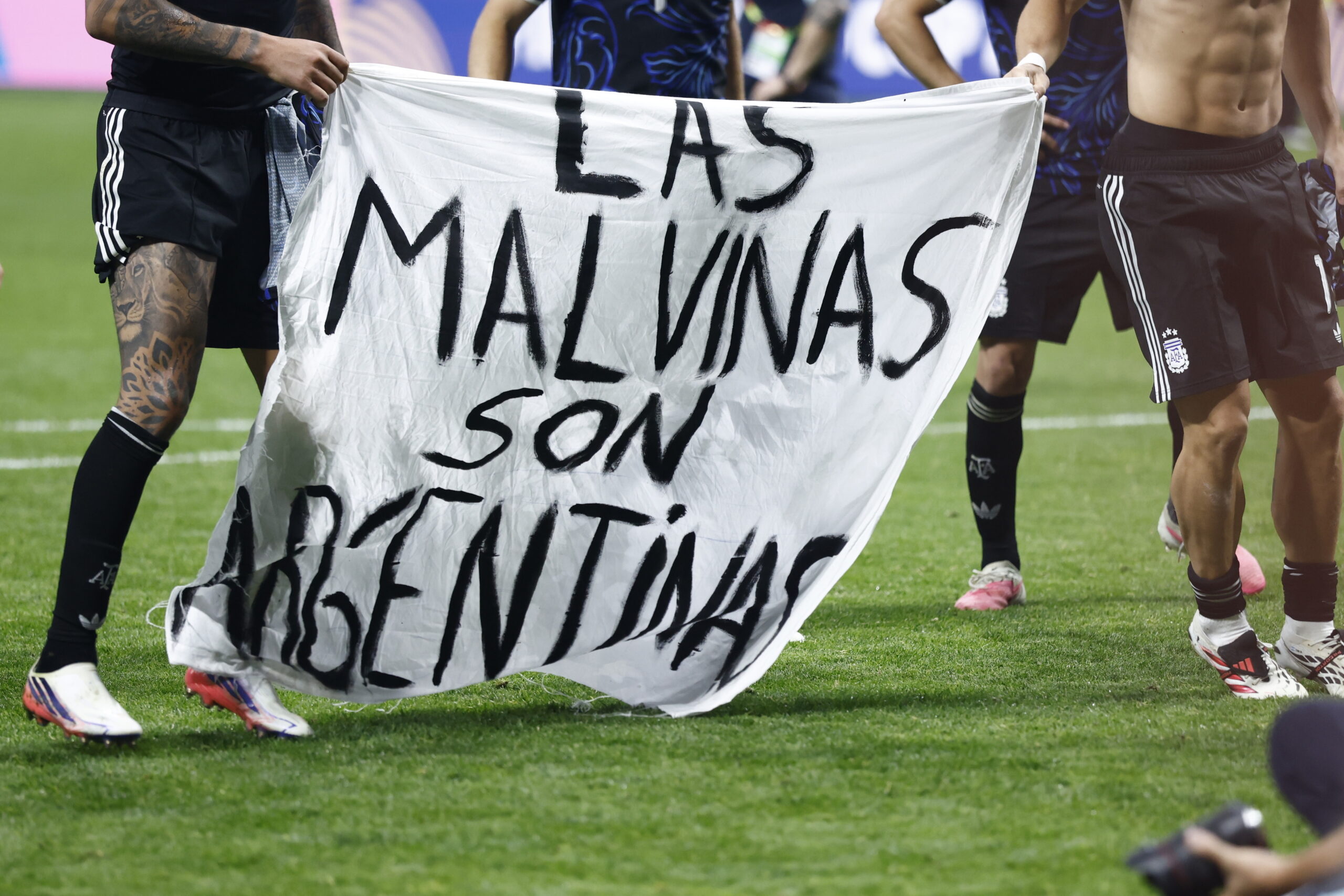
Argentina’s celebration after eliminating England included a flag with the legend “Las Malvinas son Argentinas.” Can that image lead to disciplinary action? This is established by FIFA rules and the most recent precedents.

Players from Argentina hold a flag with the legend “Las Malvinas son Argentinas” during the celebration of the 2-1 victory over England in the semifinal of the 2026 World Cup, played at the Mercedes-Benz Stadium in Atlanta, United States. (Free Press Photo: EFE).
Argentina secured its qualification for the 2026 World Cup final with a 2-1 victory over England, but an image captured after the match opened a discussion other than sports.
During the celebration at the Mercedes-Benz Stadium, several Argentine footballers held a flag with the inscription “The Malvinas are Argentine”. Giovani Lo Celso was one of the players who displayed it on the pitch, according to the images released after the semifinal.
The episode occurred after the security operation announced restrictions on the entry of flags, t-shirts and other objects with political references. World Cup rules allow FIFA, stadium authorities and government agencies to decide what materials can enter venues; Larger flags also require prior authorization.
The subsequent presence of the message in the hands of the footballers raises a question: Can FIFA intervene?
What do the rules say?
The Laws of the Game prohibit footballers’ equipment from including slogans, statements or images of a political, religious or personal nature. They also establish that a player or a team can be sanctioned by the competition organizer, the corresponding national association or FIFA when they fail to comply with this provision.
That article refers specifically to the equipment and clothing displayed by the players. The flag displayed by Argentina was not part of the clothing, so the application of this rule cannot be considered automatic.
The eventual evaluation would have to consider the Disciplinary Code, the competition regulations, the context of the celebration and the official match reports. FIFA publishes the decisions of its Disciplinary Commission, the body in charge of resolving the files submitted to it.
Until the closing of this publication, the organization had not publicly announced the opening of a procedure for the flag displayed after the semifinal.
The opening of a file is not equivalent to a sanction
FIFA could request reports or open a procedure if it considers that what happened warrants a disciplinary review. However, this openness would not, by itself, mean that there is a violation or that a sanction will be imposed.
The Disciplinary Commission must analyze the circumstances of each case, identify the participants and determine what provisions are applicable before issuing a resolution.
Measures provided for in disciplinary regulations may include warnings, fines and other sanctions. It is not appropriate to anticipate which would be applicable as long as FIFA does not even confirm that it is studying the episode.
The background of Xhaka and Shaqiri
One of the most cited cases occurred in the 2018 World Cup in Russia, during the match between Switzerland and Serbia.
Granit Xhaka and Xherdan Shaqiri celebrated their goals by forming a double-headed eagle with their hands, a symbol associated with Albania and the historical tension between Serbia and Kosovo.
The FIFA Disciplinary Committee considered the conduct unsportsmanlike. Both received a warning and a fine of 10 thousand Swiss francsbut they were not suspended and continued participating in the tournament.
The precedent shows that FIFA has imposed financial sanctions for celebrations with political connotations. It does not determine, however, what the decision would be in the Argentine case: the circumstances, the type of message and the moment in which the exhibition occurred are different.
The symbolic load was present before the game
The semifinal came preceded by references to the Malvinas, Diego Armando Maradona and the historic confrontations between Argentina and England.
Hours before the match, Argentine fans sang around the stadium: “For Malvinas, for Diego, for Leo’s last”according to EFE coverage.
Lionel Scaloni had asked to separate the party from the 1982 conflict.
“It’s a football match, I can’t mix things up, especially out of respect for what happened so many years ago,” declared the Argentine coach before the semifinal.
The match took place without political incidents that interrupted the game. The flag appeared after the final whistle, during the classification celebrations.
The players defended the message
Leandro Paredes was consulted after the game about the claim shown on the field.
“And they will always be Argentine,” replied the midfielder.
Lautaro Martínez acknowledged that the team tried to keep the load accumulated during the previous off the field, although he admitted that the confrontation had a special meaning.
“We tried to leave aside everything that was generated off the field. But for us it was not a match like the others,” declared the scorer of the winning goal, according to EFE.
These responses confirm that the players knew the symbolic dimension of the message, but do not allow us to anticipate how the Disciplinary Commission would interpret it.
A decision that does not yet exist
Argentina’s classification to the final against Spain was defined on the field of play. The disciplinary dimension will now depend on whether FIFA considers that the display of the flag should be analyzed in accordance with its regulations.
The history of Russia 2018 shows that the organization can act against demonstrations with political content, but it does not guarantee that it will open a file or apply a sporting or economic sanction.
For now, there is only one documented fact: Argentine soccer players showed the flag after beating England. As of press time, FIFA had not publicly announced an investigation.