
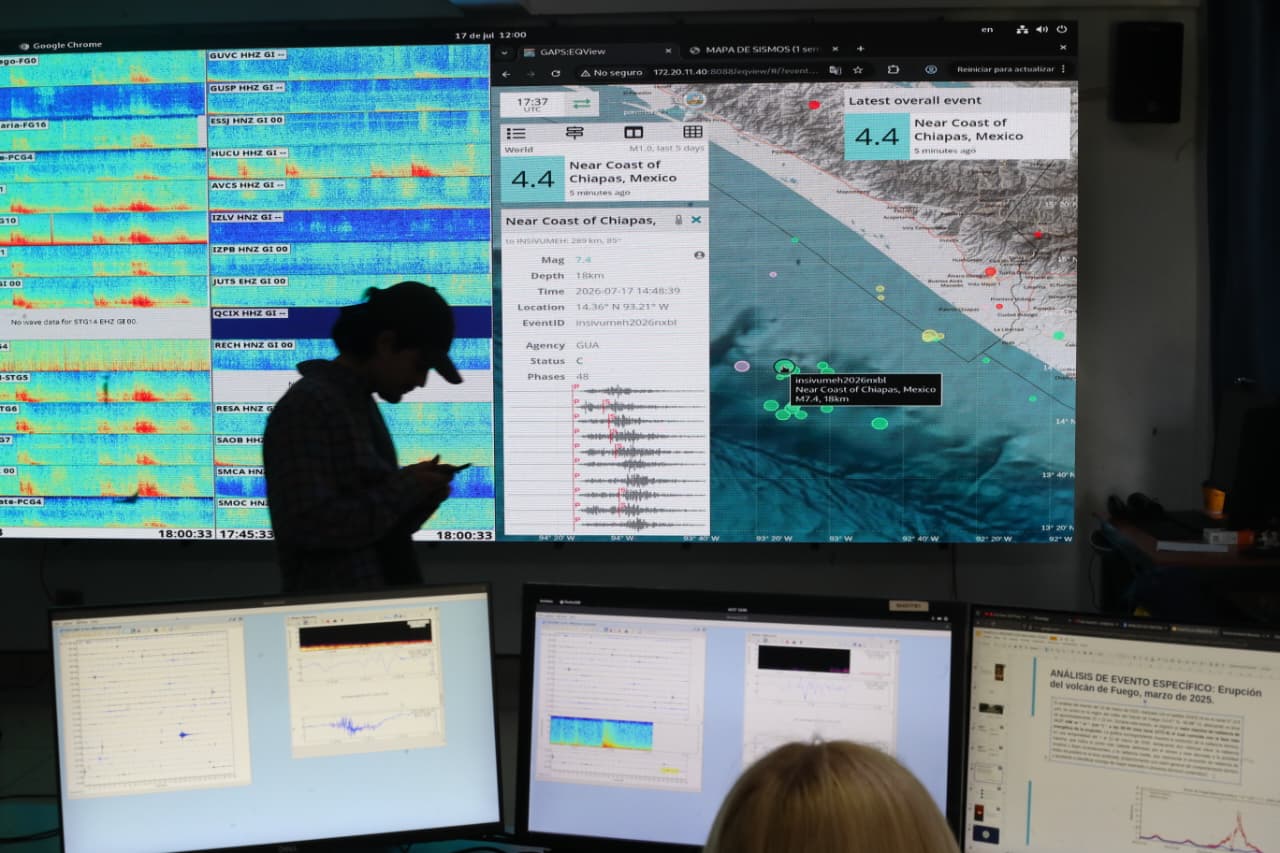
During the afternoon of this July 17, the director of the National Institute of Seismology, Volcanology, Meteorology and Hydrology (Insivumeh), Edwin Rojas, reported that the main earthquake, of magnitude 7.4, was recorded off the coast of Chiapas, Mexico. However, before this there was a premonitory earthquake with a depth of 3 kilometers.
Given this scenario, up to now, 42 replicaswith magnitudes between 3.4 and 6.1. For that reason, the Tsunami Warning Center issued a warning for the Pacific Ocean, after registering an increase in waves of almost 34 centimeters in the department of Saint Mark. However, the alert has already been canceled in the nation.
Likewise, given the reports of failures On social networks, the director of Insivumeh, Edwin Rojas, clarified that the application of the National Institute of Seismology, Volcanology, Meteorology and Hydrology worked and alerted the 15% of his 500 thousand users. He added that the problems were due to the saturation of connectivity and signal in the country.
Despite this, during the press conference the doubt arose as to whether in Guatemala it was a seismic swarmthat is, the occurrence of a set of seismic events in a specific area for a relatively long period of time shortgiven that so far 42 replicas have been counted, with magnitudes between 3 and 6.
Was it a seismic swarm in Guatemala?
The director of Insivumeh, Edwin Rojas, discarded that it is a seismic swarm in Guatemala, since, although initially the concern due to a possible seismic swarm in the border area, the National Institute of Seismology clarified that the current phenomenon corresponds to a mainshock followed by multiple aftershocks.
The concern of the Guatemalan population about a “seismic swarm” arises from the memory of the historic seismic swarm of July 2025. On that occasion, seismic activity generated more than 230 earthquakes in areas such as Amatitlán, Escuintla and Sacatepéquezcaused damage to more than a hundred homes and left five dead.
Read more: How is the air quality in New York and New Jersey? The venue of the World Cup final
Given the circumstances, the authorities emphasized that the event on July 17 is due to a dynamic of plate subduction different from the one that caused the seismic swarm of 2025. Therefore, they insisted that the important thing is keep calm and do not run or use elevators during an aftershock, such as the magnitude 6.1 one.
Other official recommendations from Insivumeh are the following:
- Follow official channels to avoid confusion.
- Prepare the 72 hour backpack with bottled water, canned food, flashlightkeys and important documents.
- Review the structures and verify if the home presents cracks new or damage minors before re-entry.
What is a seismic swarm?
According to the Insivumeh, a seismic swarm is the occurrence of numerous earthquakes of similar magnitude in a specific geographic area and for a very short period. Therefore, unlike traditional earthquakes, there is no single mainshock followed by aftershocks. and They are usually caused by the fracture of geological faults.
This situation did occur this July 17 in Mexico, where the series included a 7.4 magnitude earthquake in Chiapas and several subsequent events of magnitude greater than 5.8which generated an alert tsunami and the activation of civil protection protocols, as detailed by Mexican authorities and various media outlets.