
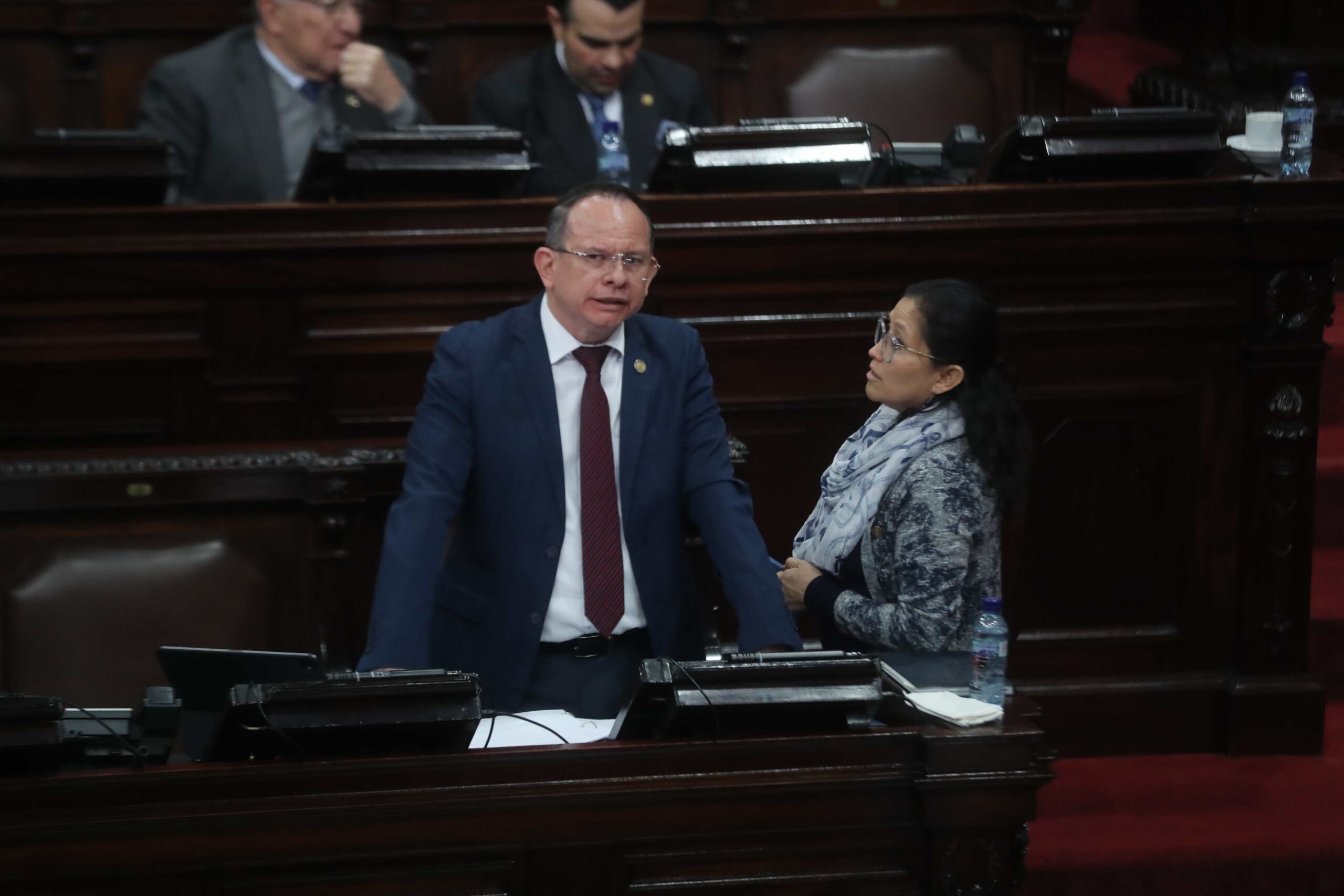
As a measure to “harass and hinder” the functioning of the Government, President Bernardo Arévalo described the interpellation processes promoted by opposition blocs in Congress to supervise the work of several ministers who make up his Government Cabinet.
The president referred to the issue during the press conference this Monday, July 20 at the National Palace of Culture and there are based on requests from deputies of the National Unity of Hope (UNE) bloc to question 14 ministers who make up the Executive Body.
“We have a situation where interpellations, which are a legally established resource to affirm controls in a democratic system, the system of cross controls that is the basis of a democratic system, is being abused and perverted, in an attempt to use it to harass the Government and hinder its operation,” he indicated.
Arévalo stated that given the situation, the Attorney General’s Office (PGN) presented before the Constitutional Court (CC) an action for protection to urge the Board of Directors of Congress that these interpellations, which are a constitutional right enjoyed by deputies, do not represent an “interference” in the public function.
“Last week, the Government of the Republic presented an amparo before the Constitutional Court asking the Court to indicate to the Board of Directors of the Congress of the Republic that the interpellations that are being requested by the different members of Congress be carried out in a way that does not constitute an interference in the functioning and management of the Executive Body,” stated the president.
Arévalo assured that with this action the Executive does not intend to impede the right of interpellation of the deputies, but rather that this be carried out in a coordinated and organized manner, with the aim of preventing it from becoming a tool that paralyzes the work of the Executive Body.
PGN, in charge of the legal action
The amparo was presented by the Attorney General’s Office (PGN) on July 16 before the Constitutional Court, in compliance with the instructions of the president with the objective of prevent the requested interpellations from being carried out “simultaneously”.
Within the legal action, the “certain, imminent and determined threat” is denounced that the Board of Directors of Congress will simultaneously schedule the interpellations of the 14 ministers of State, requested by the UNE on July 9.
In this sense, the action cites several aspects that would put the work of the Executive at risk:
- It would paralyze the administrative activities and functions of each ministry.
- It would seriously affect essential public services, such as health, security, education and infrastructure.
- The figure of interpellation is used as a means to hinder the functioning of the Executive Body, which affects the governability of the country.
- It violates the principle of “non-subordination” between State agencies – Article 141 of the Constitution – since Congress would be “de facto” subordinating the Executive by controlling its agenda.
- It prevents the president from acting in the Council of Ministers – article 182 of the Constitution – if all ministers are subject to the interpellation process.
Given this situation, The Executive requests the CC to grant provisional protection “urgently”, as a precautionary measure to prevent the interpellations from being carried out “simultaneously” while the case is resolved and, subsequently, the protection is finally granted.
Also that “exhort or urge the Board of Directors of Congress to schedule, schedule and plan the interpellations in an orderly manner and not simultaneously”to guarantee the continuity of public services.
According to the provisions of article 141 of the Organic Law of the Legislative Body, after the interpellation by the deputies is raised, the president of Congress must announce the date and time of the session in which it will take place. This must be carried out, at the latest, within the five immediately following sessions, and the Congress Secretariat must make the corresponding notification to the minister who will be questioned. It also indicates that basic questions must be communicated to the minister no less than 48 hours in advance of the interpellation.
At the discretion of former mayor and former deputy Selvin Garcíainterpellation is a constitutional right of all deputies. As indicated, in 2016 changes were made to the Organic Law of the Legislative Body, in which a specific day was stipulated to carry out this procedure, since before these modifications, interpellations were included in the agenda of the day of Congress, which made them an “uninterruptible” process that delayed the legislative agenda.
Also consider that Some deputies have fallen into “abuse” of this right, turning it into a tool of pressure and political benefit, distorting its original purpose.
“The problem is the abuse of the right to interpellation. Any right can also become an abuse… When there is an abuse of the use of interpellation, it must be considered whether, in fact, the intention of interpellation is to evaluate or seek a form of political pressure and obtain an additional benefit,” says García.
Regarding the request made by the UNE to question the entire Government Cabinet, he assures that “historically” something similar had never happened.
“Historically it has never happened, nor is there any history or precedent for the same party to question, in its order, all the members of a Government cabinet at the same time.”
Executive, without a strong bench
The former congressman also assures that, given this request to question the entire Government Cabinet, The Executive is “vulnerable” compared to the Legislative, due to the lack of a strong official bench, as well as allies in Congress.
“The fact that the Executive does not have a good relationship with Congress, does not have a strongly representative bench… makes it more vulnerable to any action that Congress can carry out individually or jointly. It means that the interests of the agenda that the Executive could have are slow or simply not known or approved,” he says.
They can continue with their work
As to whether it represents any delay in the work of the ministers to go to Congress every Thursday waiting to be questioned, García indicates that in previous legislatures “spaces have been enabled” for officials to continue carrying out their work while they wait to enter the chamber.
“Spaces have been made available for them to continue their work… they almost have an office in Congress. But the intention is that they do not interrupt their activities if they have to sign or make high-level decisions. The ideal is to have and facilitate everything they do so that they can continue with their functions,” García concludes.
Interpellations without results
For his part, deputy Juan Carlos Rivera, member of the Permanent Commission of Congress, He indicated that effectively the interpellations have been carried out with the idea of ”stopping” the administrative function of the ministries. Furthermore, he assured that the latest interpellations have been “mediocre” and with the aim of hindering the functions of the ministers.
“The people who have seen the social networks and who have followed the Congress of the Republic, see that the interpellations have really been mediocre interpellations, without foundations. They have not managed to conclude the one of the Minister of Social Development, they have not been able to identify the shortcomings of that ministry. What this institution only intends is to keep the ministers detained here every Thursday from 8 in the morning to noon that the interpellations last and they are political interpellations to hinder the work of the ministries,” Rivera assured.
The congressman also stated that none of the interpellations that have been carried out so far in the current legislative period “have complied with the constitutional mandate of supervising, denouncing or verifying the shortcomings that the ministries have and this has not been seen in the interpellations that have been carried out in the last three years.”
They reject the president’s statements
After hearing the statements of President Bernardo Arévalo, The UNE issued a statement in which it rejects the president’s statements and indicates that Interpellation is a right granted to deputies in the Organic Law of the Legislative Body and in the Constitution.
“The Government intends to divert the attention of Guatemalans from the low execution of investments by State ministries,” the statement indicates.
He also assures that during the three years of the current Government the country “maintains a large debt and with deficiencies in roads, medicines and hospitals, security, schools and with greater poverty and malnutrition.”
The interpellation requests were made by the representative Teresita de León of said legislative bloc, who directs the interpellation to the Minister of Social Development, Abelardo Pinto, which began on November 13, 2025. The ministers who will be interpelled at the request of the congresswoman are:
- María Fernanda Rivera, Minister of Agriculture.
- Gabriela García, Minister of Economy.
- Miriam Roquel, Minister of Labor.
- Anabella Giracca, Minister of Education.
- Jonathan Menkos, Minister of Finance.
- Carlos Ramiros Martínez, Minister of Foreign Affairs.
- Marco Antonio Villeda, Minister of the Interior.
- Henry Sáenz, Minister of Defense.
- Luis Méndez Salinas, Minister of Culture.
- Patricia Orantes, Minister of Environment and Natural Resources.
- Norma Zea, Minister of Communications, Infrastructure and Housing.
- Joaquín Barnoya, Minister of Health and Social Assistance.
De León also requested that the Minister of Energy and Mines be questioned. However, it is still under analysis because he took office on July 2. Erwin Rolando Barrios, who served as vice minister of Mining and Hydrocarbons, replacing Víctor Hugo Ventura.
Additionally, deputy Inés Castillo, head of said legislative block, also requested an interpellation against the Minister of the Environment, Patricia Orantes. In all interpellation processes, Congress has not yet defined the date and time in which they will be carried out.