
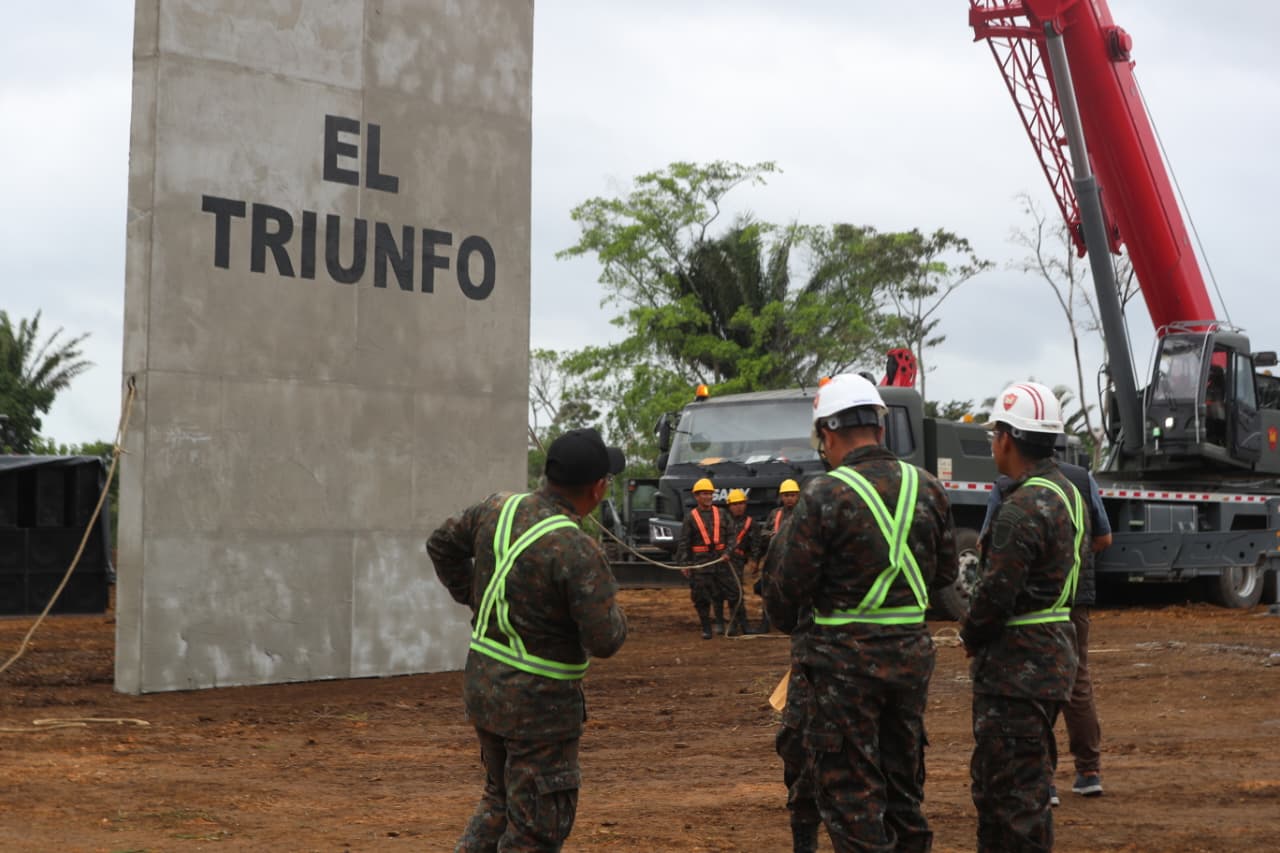
On June 26, the Ministry of Environment and Natural Resources (Marn) published a ministerial agreement through which it declared under reservation all information, documentation and administrative acts of both the ministry and the Ministry of Defense, related to the development and construction of the maximum security prison project in El Triunfo, Izabal.
This provision was signed and authorized by the head of the Environment portfolio, Patricia Orantes, on June 23. The official based her decision on article 21 of the Law on Access to Public Information, which establishes the limits of the right of access to information, since, according to Marn, this information is considered classified because it is related to military and national security matters.
Regarding this aspect, the Secretariat of Access to Public Information (Secai) of the Human Rights Ombudsman’s Office (PDH) He spoke about the disposition of the Ministry of the Environment, since said ministry is only responsible for preparing the environmental impact studies necessary for the construction of this maximum security prison.
Environmental impact studies constitute a fundamental tool to evaluate the risks of contamination, deforestation and impact on water and natural resources. By shielding them under the cloak of secrecy, Marn not only violates the principle of transparency, but also limits the possibility of citizens actively participating in the monitoring of the project, indicated the PDH.
Ana Lucía Oliva Rojas, head of the Secai, described the Marn measure as “very premature,” At the same time, he questioned whether the ministry had used national security arguments to restrict access to documents that, by technical nature, should be public. He also stated that “information reserves must be specific and not general,” as can be seen in the provision of the Environment portfolio.
The official explained that the subjects obliged to provide information cannot declare reservation in a broad and abstract manner, but they are obliged to point out specific files or documents that prove probable damage to request the reservation.
“The objective is to maintain the balance between the protection of the legitimate interest of the State and the right of citizens to know public action. So, it is certainly very premature to establish information as a reserve, which is not even held in the institution in the first place, and not be specific as to what specific document is being reserved,” Oliva stated.
In that sense, he described it as inappropriate for Marn to reserve a “complete file” or refer generically to an “environmental impact study”, since this prevents the exercise of the fundamental right of access to information.
The main axis, as indicated, revolves around the absence of “proof of damage” to justify the reservation of information by the Ministry of the Environment.
Oliva explained that This test requires demonstrating that the restriction of a specific document will cause actual harm.l, effective and current to a legitimate interest protected by law.
“The reservation of information must be carried out on documents, files or concrete and specific information. Right? That complies with a test of damage. Because what is that test of damage? To demonstrate that what is being restricted could definitely cause real and specific damage to a legitimate interest protected by law,” he assured.
The mere mention of national security, Without a technical analysis that proves the direct damage, it turns the reservation into an arbitrary act, commented the head of Secai, who insisted that the reservation cannot be based on assumptions or hypothetical scenarios, since the damage must be “real and specific”, which implies that Marn would have to precisely identify what specific data, if disclosed, would put national security at risk.
In the case of environmental impact studies, the preparation of which is the responsibility of Marn, these usually contain technical data on flora, fauna, soil and water, the disclosure of which could hardly compromise the country’s defense strategy. This mismatch between the means—environmental studies—and the end—national security—evidence, in the opinion of the PDH, a disproportionate application of the law.
Marn does not have the powers
Regarding institutional competence, The PDH considers that the Ministry of the Environment lacks the powers to determine what affects national defense.
“Since this is an issue of national defense, and given that the Ministry of the Environment is an entity that is not responsible for the issue of State security, the PDH would consider that this ministerial agreement could at a certain moment be inadmissible due to lack of competence,” warned Oliva, who believes that, if the reserve seeks to protect the country’s security, “the entities called upon to qualify said information are the Ministry of National Defense or the National Security Council” and not a portfolio whose mandate is the protection of natural resources.
However, the official acknowledged that the Law on Access to Public Information, specifically in its article 23, It does not establish a closed list of institutions competent to classify information, but rather grants that power to each entity.
“It is the faculty and responsibility of the institution to analyze the information it already has and verify if that information falls within any of the numerals and precepts established in that article,” he explained.
However, He emphasized that the Access to Public Information Law requires that secrecy be the exception, not the rule, and that any doubt be resolved in favor of its advertising.
Article 30 of the Political Constitution of the Republic establishes the publicity of the acts of the public administration. Oliva recalled that this constitutional precept is the cornerstone of the transparency system in Guatemala. In this regard, he indicated that “any exception to this rule must be interpreted restrictively, since access to information is a fundamental human right that allows social control and accountability.”
Although the PDH carries out preventive support, the secretary clarified that the institution cannot intervene without a specific case.
“Any analysis must be carried out on specific facts and within the framework of the powers that the law grants to the institution,” he stated.
If any person, organization or journalist formally requests the studies and the Ministry of the Environment denies access invoking this agreement, the PDH is authorized to receive the corresponding complaint.
“When it is established that a right is being violated, we will gladly process and investigate the case,” said the representative of the PDH.