
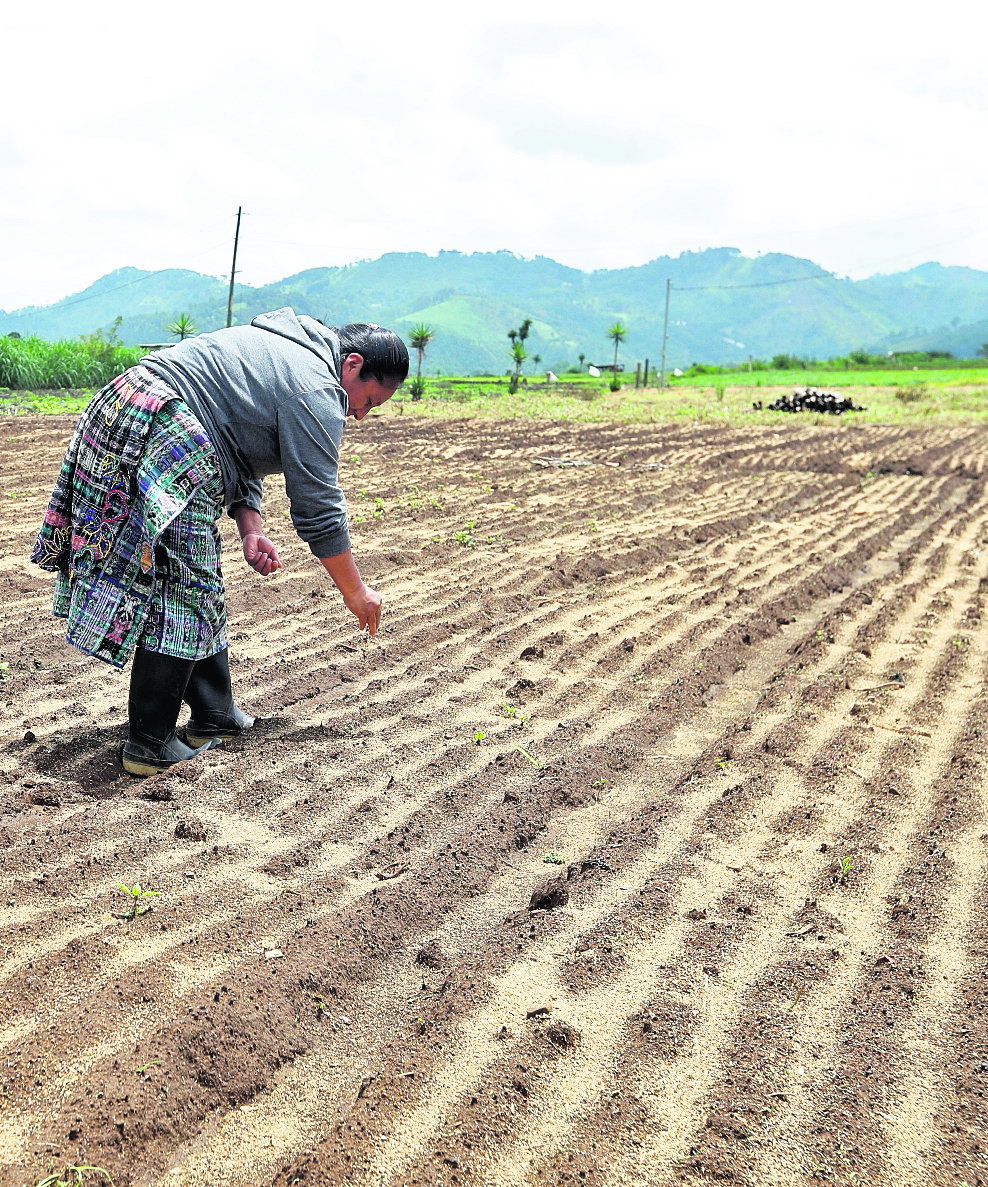
This year, the agricultural drought has affected more than 143 hectares of crops and, given the decrease in rains, the Ministry of Agriculture, Livestock and Food (MAGA) launched the Keyline system as a measure to promote moisture retention in soils.
The system is part of the Soil and Water for the Future intervention, according to Minister María Fernanda Rivera, it consists of a sustainable management practice to increase water availability for the benefit of agricultural production, through a design of ditches that allow rainwater to be captured and promote its infiltration into the soil.
At the moment, MAGA trains producers and extension agents to implement the system in the 340 municipalities of the country. For this activity they have a budget of Q300 million.
What is the impact of the water deficit due to the lack of rain due to the prolonged dog days?
We have a combination of conditions. On the one hand, there have been climatic anomalies since May, which began with a late onset of winter and then irregular rains.
There is a type of rain called convective, which is short-term — 45 minutes to 1 hour and 30 minutes, more or less — but very strong and, sometimes, accompanied by hail and thunderstorms. But the agricultural sector needs rain from time to time; The ideal is every five days and not so strong, so that the soil has time to infiltrate and retain them.
When there are convective rains, the water continues: up to 149 million tons per year. If we retained it, it could help in those dry periods—some years in Guatemala there are up to 60 days without rain—that affect crops.
Now we have climate anomalies that are not yet associated with the El Niño phenomenonand there is a high probability of the effects of the phenomenon at the end of this year and the beginning of the next.
The Ministry of Agriculture has an institutionalized emergency committee and is preparing to respond in the months in which there will be a peak – the end of July and August -, which is also when the driest season is marked, and the calculation is that there will be between 170 thousand and 200 thousand people with damage to their crops.
In response to this, the ministry designed a food assistance plan so that no one falls into food insecurity or malnutrition, but work is also being done for the medium and long term, in the Soils and Water for the Future program, which includes the Keyline design, but also soil management.
Who are among those 200 thousand people who could see their crops affected by these climatic conditions?
We have sub-subsistence producers, also the small surplus ones, the medium ones and the large ones; everyone could have some influence from such events, and you have to work with them in different ways.
In order for water to be maintained and not wasted through runoff, organic matter is needed, which basically consists of the waste not being burned, but rather remaining in place or incorporating, for example, organic fertilizers. The other thing is to have micro and macro organisms, which take this organic matter and convert it into humus, which gives the structure to the soil and which becomes a kind of sponge that stores moisture. In addition, the soil has minerals that help fertility, and microorganisms convert them into nutrients that the plant can use.
It is important to know the soil we have, and the Ministry uses all the strategic soil information it already has, which allows us to make decisions at the farm or land level to, depending on the type of soil, make the best possible management.
Once we have an idea of how to manage the soil and that farmers and producers already know how to do it, we have to design the plantation, but based on how water moves within a piece of land. That is a hydrological design, since the most limited resource is water. It is important to retain it in the ground. We have to learn to use the rainwater.
The great advantage is that this knowledge remains with the people, so as not to create a dependency on the ministry or on any actor in the territory, but rather they learn this logic so that they continue producing and applying it on their plots or other lands.
How does the Keyline system work?
This hydrological design causes water to pass more slowly through a terrain and we do not have emergencies and those conditions in which the rains carry the soil into the rivers. All construction and land management work is done.
It can be used on large or small plots, and what will change is the way it is designed, the way the water passes and where the plantation will be.
The idea is that we can have water or humidity available throughout the land for longer. Relief irrigation can also be used, which are ways to make the use of the water we may have more efficient, for example, in reservoirs, such as drip irrigation.
Keyline works without the need for fuel. By doing a good design, water moves on the ground on its own, with each rain that falls.
Can this be implemented on all types of soil and who would make that design?
Yes, it can be in any territory of the country.
With some farmers a promotion strategy is used and with others a training strategy is used.
What do I mean? With the most vulnerable, those with the smallest plots of land, subsistence and medium-sized ones—cooperatives, associations, etc.—the Ministry can support them, and this is being done with the design and also by training them, since the idea is that the knowledge remains with the people.
On larger plots of land, training can be provided so that they can also train their technicians and advisors.
The system can be adapted to the terrain and type of soil. The design will be very different for Petén, which has karst soils, than for Totonicapán or Quiché, which have different conditions. What adapts is the design.
Is MAGA working on a pilot plan for the Keyline system?
What we are doing are demonstration plots. That’s where they see how it’s done; We show you how the design was made, the type of soil we found and how it is being managed now, in a very different way than it was until the beginning of this year.
How long will it take to see the results when implementing said system?
If the design is well done, the water begins to distribute from the first rains.
In the first year there will be an effect, but, as one manages the soil better, the efficiency of the system will improve, because it traps more water. The healthier the soil is, the more alive it is, with microorganisms, organic matter, etc., the better it will hold that water and retain it for longer.
What is the deadline to replicate the system throughout the country?
This will be replicated in the 340 municipalities, depending on the type and size of the producer. The Ministry has many ways of serving the population and it starts with the most vulnerable, with design. Then we have the small surpluses; then, the medium and large ones.
In the following months you will see a deployment of the Ministry of Agriculture in the 340 municipalities to be able to serve all types of farmers. This is a country and state strategy.
This really is adaptation to climate change; We cannot reverse this trend nor can we determine when it will rain, but we can design and do this work so that the rainwater remains longer on each of the plots and thus avoid damage from now and for the future.
Is the system already being applied on land outside of this demonstration farm?
The Ministry, for a long time, had the National Rural Extension System almost obsolete, but it really is a training tool. From January to May, 100 technicians were trained and the 40 best were chosen for another phase of preparation so that they could be the trainers. At the end of July they will give regional workshops.
The other trainers will train their promoters and these will train the participants of the Learning Centers for Development (CADER), which are groups of 20 to 25 people. There are 8 thousand CADER in the country. In addition, VISAN will come out, which is the Ministry of Food and Nutritional Security, which will attend to the food assistance part. VIDER will be deployed with associations, cooperatives and the private sector.
It is a cascade methodology, in which the same 40 technicians do not go to the 340 municipalities, but rather this system is used in which trainers, extension agents, promoters and CADER participants participate.
Are the trainings currently happening and what budget does MAGA have to implement the system?
It’s right. For this campaign or for this intervention of Soils and Water for the Future, within the framework of the 2026 agroclimatic conditions, it is Q300 million. If there is a need for more funds, different funding sources have been identified. Even the Ministry of Finance would be supporting us.