
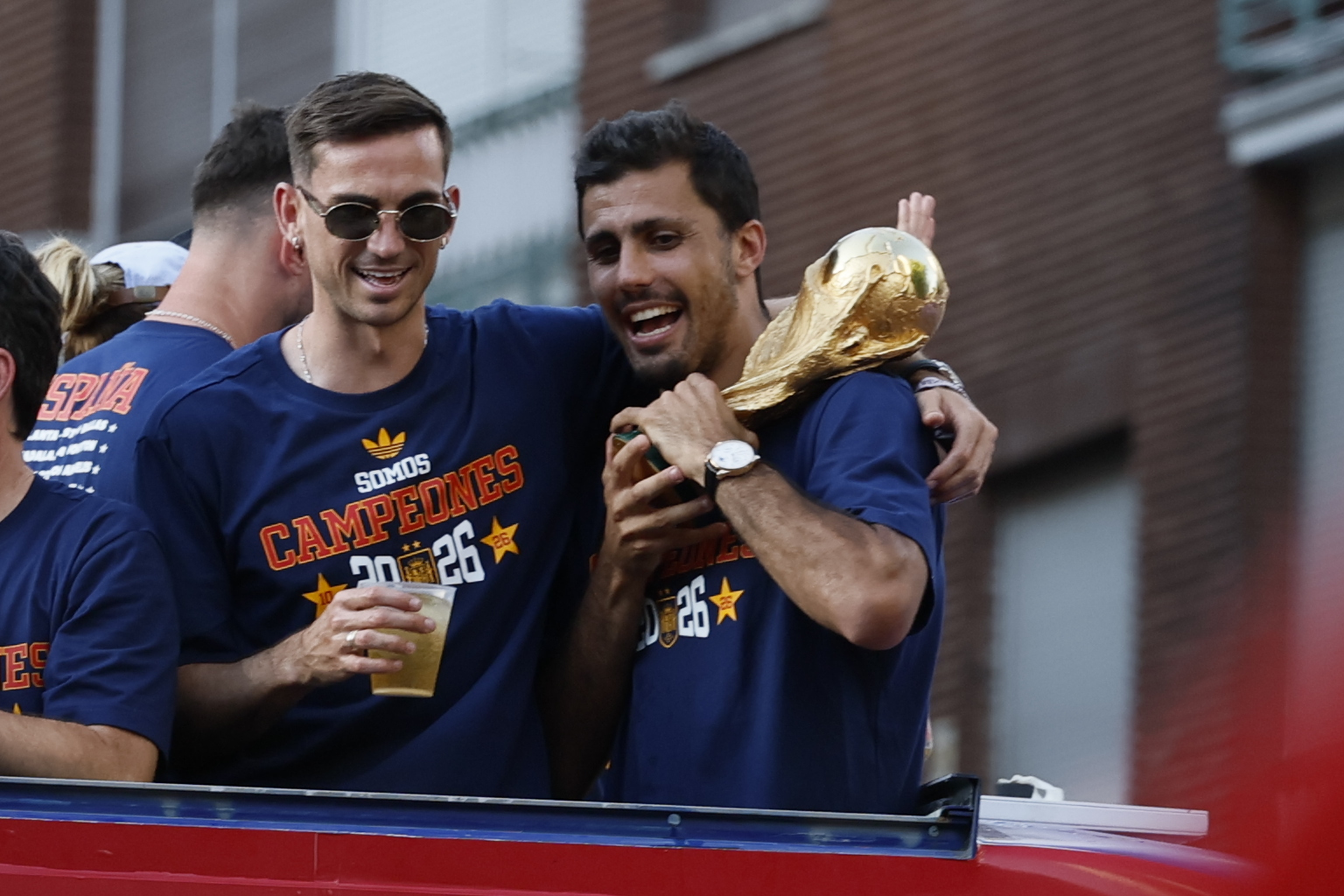
Rodrigo Hernández reached the highest point of his career, but his next move may define the last great chapter of his career.
After winning the Champions League with Manchester City, winning the Ballon d’Or and lifting the 2026 World Cup with Spain, the midfielder appears again at the center of the European market. His name is once again associated with Real Madrid, while the English club tries to ensure its continuity.
The Rodri case is not only a negotiation between clubs. It is the story of a footballer who left Spain to become a world reference and who now appears as a possible piece of the new Madrid project.
From Madrid to Manchester: the path of an elite midfielder
Rodri knows Spanish football from his first steps in the top category.
The midfielder trained in the lower divisions of Atlético de Madrid before moving to Villarreal, where he began to establish himself as one of the most promising young midfielders in LaLiga.
His return to Atlético in 2018 meant the leap towards a highly demanding stage. A year later, Manchester City opted to sign him and paid close to €70 million for a player who still had to prove that he could dominate the midfield of a European giant.
He did it.
Under Pep Guardiola, Rodri evolved into one of the most important pieces of City’s system. His ability to recover, distribute, control the timing of the game and appear in decisive moments transformed him into a differential midfielder.
The culmination came with the collective titles and individual recognitions that placed him among the best footballers in the world.
Manchester City tries to shield its key piece
Rodri has a contract with Manchester City until June 2027. The English board seeks to expand that bond to prevent the player from reaching the last stage of his contract with greater margin to decide his future.
The importance of the Spanish within Guardiola’s project explains the club’s insistence.
He is not just a quality midfielder. Rodri represents the balance of a team that for years built its identity around controlling the game.
However, the passage of time adds a different variable.
At 30 years old, the footballer is faced with a decision that combines sporting, family and career planning aspects.
The attraction of returning to Spain
Rodri has never hidden his connection with Spain. His return to LaLiga appears as a natural possibility after having spent most of his football maturity outside his country.
Real Madrid represents a different opportunity.
It would not be the signing of an undiscovered talent, but rather the incorporation of an already established footballer, champion of everything and with experience in the most demanding stages of European football.
The question for the white club is not whether Rodri has the level to play at the Santiago Bernabéu.
The question is whether an investment of that magnitude fits into the sports policy that has marked the team’s recent years.
Mourinho and the search for balance
The arrival of José Mourinho to the Madrid project adds another element to the conversation.
The Portuguese coach has historically given special value to midfielders capable of organizing a team, regaining balance and controlling games from the central zone.
From that perspective, Rodri represents a profile that is difficult to find: a footballer with leadership, international experience and the ability to modify the structure of a team.
The coach’s interest, however, does not mean that the operation is closed. The decision also depends on the economic and sporting assessment made by the Madrid board.
The cost of the transfer, the salary and the duration of the contract will be determining factors for a negotiation that is still in the analysis phase.
A movement that defines a stage
Rodri’s future brings together three different interests.
Manchester City wants to keep the footballer who became the lynchpin of its most successful era. The player contemplates the possibility of returning to Spain after having reached the international peak. And Real Madrid analyzes whether incorporating a 30-year-old world champion represents an exception within its model.
More than a simple signing, the Rodri case represents a career decision.
The midfielder who left Spain to become a world figure could return as one of the most influential footballers of his generation.
Now the market must answer a question: whether Rodri’s next chapter will be written again in Madrid or will continue in Manchester.