
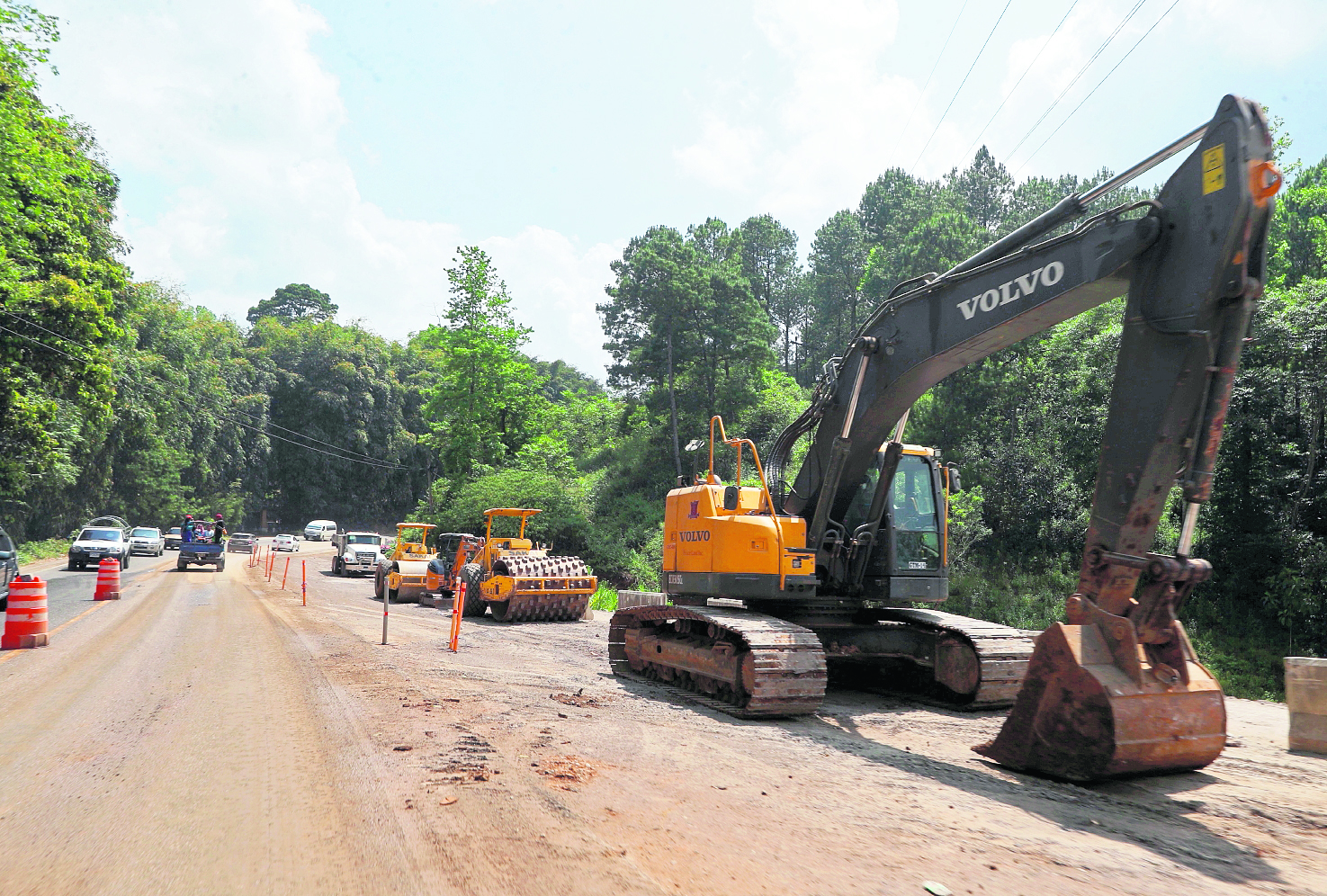
The recovery of the road network and the reactivation of several road projects, as well as infrastructure, has been prioritized by the Executive Body during the current year, after almost two and a half years in which the Government had not developed projects or plans for the improvement of roads, a situation that has been questioned by different productive sectors, as well as by deputies in Congress who monitor the progress.
During 2026, the Ministry of Communications, Infrastructure and Housing (CIV) has contracted several road recovery projects in different parts of the country, which, according to the latest portfolio report for July, show progress in their execution.
According to the information provided by the Communications portfolio, 14 strategic projects are currently being executed, which were contracted mainly on Central American routes, under the special emergency bidding modality provided for in the Priority Road Infrastructure Law.
According to the CIV, of those 14 projects that are currently being executed, 10 are in charge of the Road Conservation Execution Unit (Covial) and they focus on the rehabilitation of sections that, together, add up to 271 kilometers of intervention, equivalent to 12.6% of the Central American routes in the national territory.
The CIV also explained that The remaining four projects are in charge of the General Directorate of Roads (DGC) and consist, mainly, of the design, construction and rehabilitation of bridges in different parts of the country.
Projects in progress
The projects carried out by Covial are about rehabilitation at different points considered “strategic” by the portfolio on Central American routes.
The work is carried out on the CA-01 Oriente, detour to Fraijanes-Pueblo Nuevo Viñas; CA-02 Oriente, Chiquimulilla detour-Las Lisas detour; CA-01 Oeste, Pologuá, Totonicapán-Quiquival, Quetzaltenango; CA-02 Oriente, El Jobo bridge, Taxisco-Chiquimulilla detour; CA-01 West, Estancia de la Virgen, El Progreso-RN-09 North fork; CA-14, Chagüite-Niño Perdido detour, Baja Verapaz; CA-02 West, Escuintla-Siquinalá detour; CA-10, Chiquimula-Quezaltepeque bifurcation; and CA-09 North, Río Hondo-Gualán, Zacapa.
According to the Ministry of Communications, the work that has been carried out until July 20 They are patching, milling, placement of geosynthetic material, modified asphalt mixture and placement of asphalt concrete pavement. Regarding the progress of the works, it is estimated that they have reached between 40% and 50%, and it is expected that they can be completed before the end of this year, according to CIV projections.
Regarding the projects carried out by the DGC, they are mainly aimed at four bridges: rehabilitation of the Río Dulce bridge, at kilometer 274 of route CA-13; construction of the Moca bridge, kilometer 132 of the CA-02 West route; construction of the Santa Bárbara bridge, kilometer 139.91 of route CA-14; and construction of the Las Pericas bridge, kilometer 95.15, also on the CA-14.
With the 10 projects carried out by Covial, 271.39 kilometers of the country’s road network will be rehabilitated. While With the construction and rehabilitation of these four bridges, a length of 1,045 meters will be covered, specified the Ministry of Communications.
Slow progress and no further scope
According to Delfino Mendoza, infrastructure expert at the Foundation for the Development of Guatemala (Fundesa)it is positive that the CIV makes the necessary efforts to recover the country’s road network. However, he considers that progress is slow, mainly due to the delay in hiring, both emergency and maintenance.
Mendoza highlighted that the “key” to accelerate the works lies in streamlining the bureaucratic contracting processes, keeping payments up to date and hoping that the Directorate of Priority Road Projects (DIPP) can assume control of the projects contracted under the Priority Road Infrastructure Law in the medium term, in order to plan and execute projects more efficiently.
According to the expert, although the projects are already being implemented, There is no certainty about his physical progress, since the Communications portfolio has not provided reliable information. Therefore, an estimate can only be made based on the time elapsed.
“The contracts were actually in force as of May and would take in real terms two months of execution. All contracts were made on average nine months in duration, although the majority are longer than eight months. This would mean, if we do it linearly, a 25% advance of the contractual term,” he commented.
One aspect that stood out is that the 271.39 kilometers that will be rehabilitated through these projects carried out by Covial represent a very low percentage of the total road network that needs attention at the national level.
“There are 271 kilometers of highway that include these 10 contracts. The Central American road network is 2,148 kilometers; we would be talking about the percentage that is being served is relatively low, on the order of 12.6% of the entire Central American road network,” said Mendoza.
Regarding the bridges, he considered that The rehabilitation and construction of four bridges, which total 1,045 meters, is insufficient facing the identified need that, at least, 30 bridges throughout the country require immediate attention so they can continue to operate effectively.
For 2026, the Road Conservation Execution Unit (Covial) has a budget of more than Q2,210 million, allocated to the maintenance of the national road network, of which only 24.22% had been executed as of June 30, according to the latest Fundesa report, said Delfino Mendoza.