
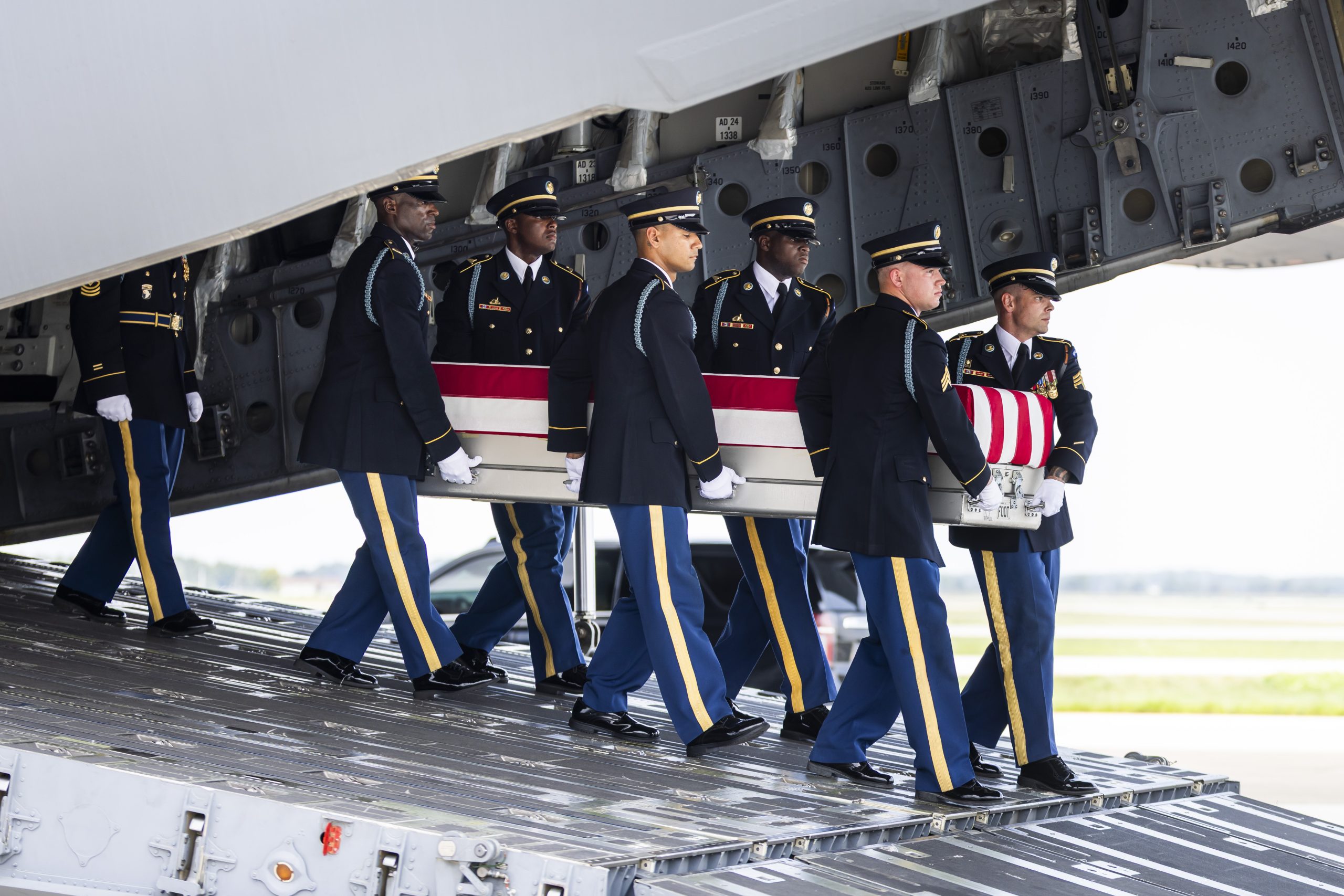
The four American soldiers who died in recent days during the resumption of hostilities with Iran They were stationed in air defense units, taking the risk of remaining in vulnerable bases to protect others from ballistic missile and drone attacks. Unlike the last two decades of war in Afghanistan and Iraq, where soldiers patrolling on foot and traveling in convoys accounted for the majority of combat deaths, in this conflict such deaths are occurring among troops who have never set foot on Iranian soil, dying instead in targeted attacks on bases sometimes hundreds of miles away.
In addition to those killed, more than 100 soldiers have been injured since fighting resumed about a week ago. Last Wednesday, President Donald Trump flew to Dover Air Force Base in Delaware to meet with families of the fallen and witness the arrival of soldiers’ flag-draped coffins. “It’s one of the hardest things a president can do. But it has to be done,” Trump told reporters before boarding Air Force One for the flight. “The only thing I’m going to say is that we love them, we love their son. There are no games, there’s nothing like that. He’s their son.”
Since the war began in late February, Iran has launched about 8,500 missileses and drones against targets throughout the Middle Eastand nearly 100 of these attacks have managed to bypass the defenses of the United States and its allies, according to what he told Washington Post a military officer familiar with interception figures. Like others interviewed for this report, the officer spoke on condition of anonymity to discuss sensitive military matters. That shift has put extreme pressure on the U.S. military — and specifically, Army air defense units — to adapt quickly, said Brad Bowman, an Army veteran and senior director of the Foundation for Defense of Democracies. The soldiers who lost their lives in recent days are some of the most frequently deployed in the Army due to the changing nature of war, he added.
“These units have had to take on new responsibilities,” Bowman said, noting Iran’s proliferation of short-range drones and the challenge of detecting and shooting them down. “Autonomy, artificial intelligence and mass production are making the already very difficult job of US Army air and missile defense personnel even more complex.” In Jordan, Private Isabella Gonzales, 19, of Carrollton, Texas, and First Lieutenant Tyler James Feehan, 25, of Ewa Beach, Hawaii, were killed by an Iranian missile at the Muwaffaq Salti Air Base on Friday of last week, according to authorities.
Sergeant Angel S. Rampersad, 28, a resident of Ozone Park, a neighborhood in Queens, also reportedly died in the attack, according to a statement issued Tuesday night by the Pentagon. Rampersad was listed as missing. In the last few days, Iran has intensified its attacks on Jordanaccording to a US official, because the United States was moving additional aircraft to that country. Tyler Feehan followed in the footsteps of his father, Stephen Feehan, and enlisted in the Army, becoming a platoon leader. Feehan’s unit is responsible for operating air defense systems, including the Patriot system and the lesser-known Avenger, truck-mounted weapons that fire Stinger missiles and a heavy machine gun.
The Avenger was designed 40 years ago as a last line of defense against helicopters, fighter jets or short-range missiles, but in the last 10 years, the Army has adapted it to also fire against drones, due to increased demand. On Tuesday, his father arrived in Delaware from his residence in Italy to witness the arrival of Feehan’s casket. “Our purpose now is to preserve your legacy,” Stephen and Shari Feehan wrote in a post about their son, who was engaged to be married. “We only ask this: that when remembering Tyler, people stop to appreciate what is good this country still has, rather than what divides it.”
Gonzales was responsible for operating and maintaining short-range air defense systems. “Their bravery and sacrifice represent the best of Texas,” he declared.Governor Greg Abbott on Facebook. In Iraq, Sergeant Michael Emmanuel Swinton, 30, of Fayetteville, North Carolina, was killed Sunday at Erbil Air Base during the controlled detonation of an Iranian one-way attack drone, authorities said. Swinton, who was serving with an independent air defense unit at Fort Bragg, North Carolina, died “during an operation to protect his fellow Soldiers,” his commander, Lt. Gen. John L. Rafferty, said in a statement about Swinton’s death.
“My husband, my best friend, the father of my daughter, is gone and right now I have no words,” Mia González-Swinton wrote on her Facebook page along with a montage of photos. In a statement, Swinton’s mother, Christel Swinton Andujar, said her son “wasn’t a hero just because he wore the uniform, but he was a hero because of the way he loved, protected, encouraged and inspired everyone around him.” In remarks Tuesday, Trump appeared to suggest that U.S. forces in Jordan had turned to another country’s air defense weapons to intercept the missiles, although he did not specify which one. “If we had had other operators, you know, this wouldn’t have happened,” he told reporters.
“But when you let others do your job… sometimes things don’t turn out so well.” The White House did not immediately respond to a request for comment, as did el United States Central Command, which oversees the war. The Jordanian Embassy also did not immediately respond to a request for comment. The recent deaths of American soldiers have revived questions about the security of American forces at bases in the Middle East, since those facilities were generally not designed to withstand retaliatory attacks, since during the previous wars in Iraq and Afghanistan, fighting took place within those two countries and not in regional installations that supported combat operations.
Before the war with Iran began, the Pentagon moved many of its forces outside the largest bases, anticipating that Tehran would retaliate against those facilities. However, Iran’s response has been broader, attacking facilities large and small and civilian infrastructure, and threatening to attack any country that supports US war operations.
A soldier who had previously been deployed at the Muwaffaq Salti air base in Jordan told ThePost that many of the buildings there were metal trailers and thin-framed tents, unable to withstand rocket, mortar or drone attacks. However, even the most recent construction at some bases in the region, which now include layers of thick walls, cannot protect against a direct hit from a ballistic missile, the soldier said. “These bases are not expected to be attacked,” the soldier said. “The stage is not set for a prolonged conflict. And that is why we see the impacts we are receiving.”