
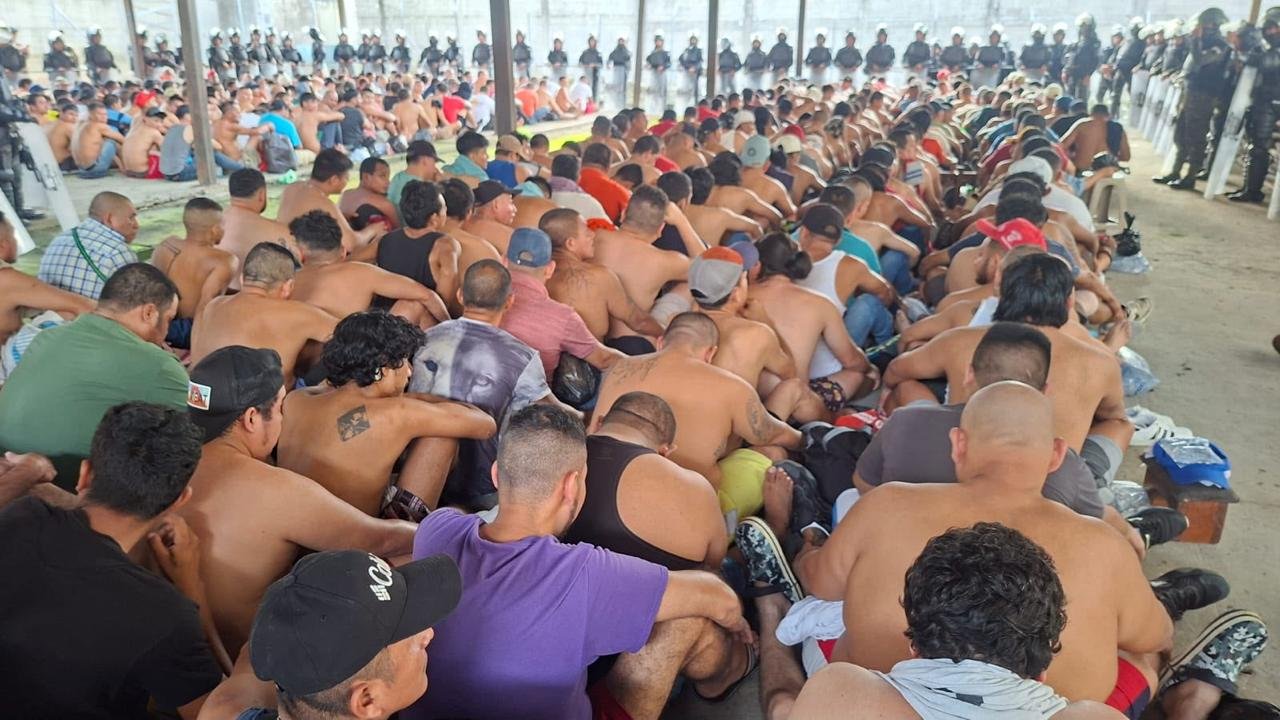
The Ministry of the Interior identified that a criminal network led by an inmate known as the Mingawho coordinated extortion, hitmen, drug dealing and human trafficking from the Izabal prison. The transfer of 56 inmates sparked a dispute over control of the prison that left three prisoners murdered and later charred.
For years, a criminal structure headed by Roberto Gordillo Coronado, the Mingaconverted the Puerto Barrios prison, Izabal, into an operations center from where, according to the authorities, extortion, hitmen, drug dealing and human trafficking that transcended the prison walls and they reached municipalities of Izabal, the route to the Atlantic and even zone 18 of the capital.
The organization lost control of the penitentiary center after a series of operations that They started last Thursday, July 23, executed by the Ministry of the Interior (Mingob) and the Penitentiary System (SP), which culminated in the transfer of 56 prisoners identified as members or leaders of that criminal structure.
According to the Minister of the Interior, Marco Antonio Villeda, the intervention caused a dispute between inmates who remained in prison for assuming control of the prison. The confrontation left three prisoners dead, who were attacked with firearms and later burned by other inmates.
“The blow was so hard that the penitentiary center was practically headless and, from then on, there was a brawl between inmates to try to take control of the penitentiary center again,” commented the official.
Intelligence detected a structure that operated from prison
The person in charge of the Interior portfolio explained that the intervention in the Puerto Barrios prison responded to intelligence information that revealed that a group of inmates maintained control of the center and continued to direct criminal activities outside the prison.
“We found out that there was a group of inmates who not only maintained control of the center, but also had activities that went beyond the walls of the prison. They were involved and coordinated activities related to drug dealing, human trafficking and even hitmen,” commented Villeda.
He added that a requisition in the Puerto Barrios prison and that initially 34 prisoners who had been identified by the General Directorate of Civil Intelligence and the Specialized Criminal Investigation Division (DEIC) as responsible for controlling these illicit activities were transferred.
Subsequently, during a new intervention, other prisoners were transferred until 56 prisoners were mobilized to different prison centers in the country.
You might be interested in: They investigate links between a drug trafficking structure and a councilor from Los Amates, Izabal
La Minga directed the structure
The general director of the Penitentiary System, Jorge Guillermo López Dellachiessa, confirmed that the leader of the organization is Roberto Gordillo Coronado, the Mingawho was transferred more than a year ago from Puerto Barrios to the maximum security prison Renovación 1.
“The leader of that center was mobilized more than a year ago from Puerto Barrios to Renovación 1. For many years he governed the center of Puerto Barrios,” he assured.
Although he is currently held in Renovación 1, authorities maintain that the criminal structure continued to operate in the Izabal prison.
La Minga He is serving a 40-year prison sentence for a double homicide that occurred in Puerto Barrios in 2008 and has been classified by the Ministry of the Interior as a highly dangerous prisoner.
In April 2025 he tried to regain his freedom using an electronic bracelet, but the measure was challenged by the Public Ministry and the Penitentiary System.
Extortion, hitmen, drug dealing and trafficking
According to López Dellachiessa, the organization not only coordinated acts of violence and drug distribution from prison.
There was also a history of human trafficking within the prison itself.
The director explained that, approximately a year ago, a case was reported in which women deprived of liberty and some visitors were forced to have sexual relations with other inmates.
After the complaint, the SP made changes to the infrastructure to prevent contact between men and women held in the prison.
“The necessary measures were taken and buildings were built to prevent men and women from crossing each other,” he indicated.
Inmates were distributed in different prisons
Those deprived of liberty identified as members of the structure were sent to different penitentiary centers, López said.
According to the SP, the transfers were to the Pavón, Cantel, Canada and Zacapa prisons, while the women were sent to the Women’s Orientation Center (COF) and Los Jocotes, in Zacapa.
Minister Villeda added that overcrowding continues to be one of the main factors that hinder the control of prisons and said that it is necessary to build new penitentiary centers, including those planned in Morales, Izabal, and Masagua, Escuintla.