
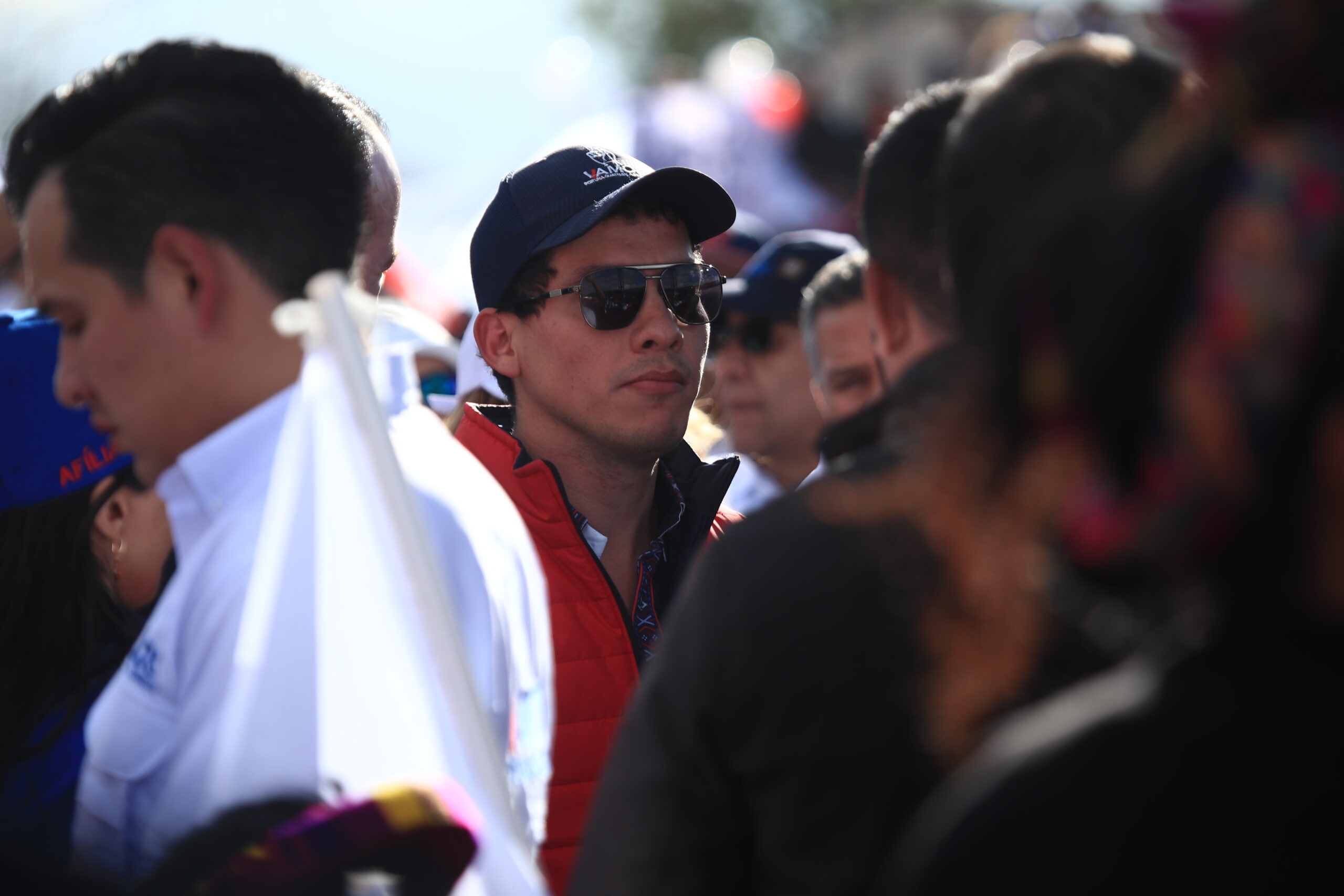
Although he maintained that he was never criminally charged and that the Special Prosecutor’s Office against Corruption of Guatemala archived the investigation related to the purchase of Sputnik V vaccinesthose arguments were not enough to convince a US federal court.
The judge Beryl A. Howellof the District Court of Columbia, rejected the lawsuit filed by Miguel Martinezformer director of the defunct Government Center and one of the most influential officials during the administration of Alejandro Giammattei, who sought to reverse the sanctions imposed by the Office of Foreign Assets Control (OFAC) of the US Treasury Department for alleged acts of corruption in Guatemala.
Throughout the ruling, Howell concluded that the former official’s arguments failed to undermine the reasons that supported his appointment.
The ruling adds that the file “it is full of classified and/or sensitive information for law enforcement” which, in OFAC’s opinion, supports the conclusion that Martínez “it has not been truthful” during the administrative process and “has participated in a pattern of public corruption in Guatemala.”
The judge noted that this information could only be examined by the court and that US law allows it to be kept out of the plaintiff’s reach.
After this analysis, he concluded that there was no evidence of “arbitrary or capricious” action on the part of OFAC and that the file, even in its public sections, already offered sufficient grounds to support the designation.
He even stated that Martínez’s interpretation of the scope of US sanctions was “frontally contradicted by the text of the Executive Order” which gave rise to the global corruption sanctions regime.
In a resolution issued on July 24the judge denied Martínez’s request to be removed from the List of Specially Designated Nationals and Blocked Persons (SDN List) and confirmed OFAC’s decision to maintain the sanctions against him.
The judge also upheld the U.S. government’s power to maintain the designation even if a person has not been criminally convicted. In that sense, he maintained that the decisions adopted by prosecutors or courts of Guatemala, the United States or any other country “they are not conclusive” regarding OFAC’s authority to impose sanctions under the Executive Order 13818.
The ruling recalls that the Treasury Department sanctioned Martínez he December 1, 2023 considering that he used his position in the Government to benefit private interests, by colluding to award contracts outside the official public procurement system, favoring companies with financial interests linked to him and soliciting bribes related to the acquisition of Russian Sputnik V vaccines by the Guatemalan State.
Regarding the purchase of the vaccines, Howell pointed out that OFAC evaluated the arguments presented by Martínez during the administrative process, but concluded that these “do not refute the available information” for the agency and that There was still grounds to maintain his designation due to his alleged participation in other acts of corruption in Guatemala.
Another of the central points of the ruling was the rejection of the argument that the former official should know all the evidence used by the US authorities.
Howell maintained that the Government has a legitimate interest in protecting classified, privileged or sensitive information for investigations and concluded that “due process requires no more”considering that Martínez received notification of the reasons for his sanction, had the opportunity to request his exclusion from the list and present evidence in his favor.
The judge also supported the evaluation carried out by OFAC during the reconsideration procedure and highlighted that the agency concluded that Martínez had not demonstrated a change in circumstances that justified removing him from the sanctioned list nor had he provided sufficient information to refute the allegations against him.
Read also: HRW asks the EU to extend its sanctions on Guatemala and act in favor of the rule of law