
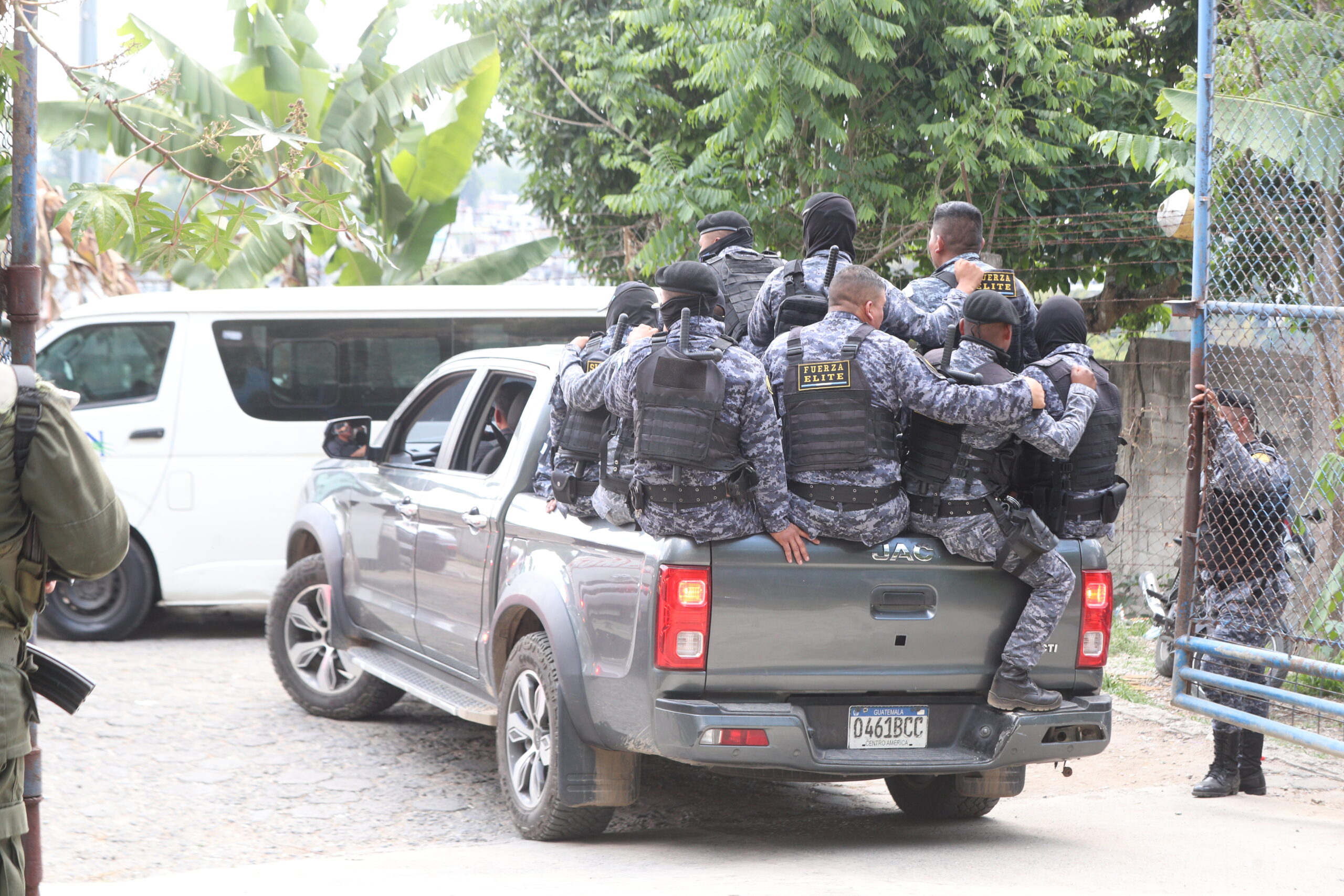
The lack of implementation of the penitentiary career keeps the Penitentiary System (SP) with difficulties in professionalizing its agents, limits promotion opportunities and makes it difficult to strengthen security in prisons, said researcher Corinne Dedik during the presentation of the monthly report of the Center for National Economic Research (CIEN).
Although the Penitentiary Regime Law ordered the creation of the penitentiary career in 2007, Dedik explained, it has not yet been implemented, which has an impact on the training, stability and motivation of the staff.
He added that the SP has about 4,000 prison officers who work in two shifts of eight days on duty and eight days off. In practice, about 2,000 remain on duty simultaneously, although that number usually decreases due to vacations, medical incapacity and other leaves.
According to Dedik, this task force must guard approximately 23 thousand inmates, that is, there is one agent for every 15 people deprived of liberty.
Working conditions for SP guards
Dedik explained that the agents remain inside the prisons all week and sleep in “blocks.”
He added that in the country’s prisons there is a shortage of space, mattresses, bunk beds and lockers, in addition to humidity problems and few conditions for preparing and eating food.
The agents are hired under line 011 and receive a remuneration of approximately Q6 thousand per month, according to the CIEN.
You might be interested in: Deputy questions that the SP buys supplies for prisoners while the guards lack boots and uniforms
Irregular formation in the SP
Dedik indicated that the recruitment and training of new agents does not follow a permanent plan.
According to CIEN data, the training of new agents has been irregular during the last decade. In 2017, more than 500 correctional officers graduated; However, between 2018 and 2020, no promotions graduated. Training was subsequently resumed, with around 260 graduates in 2023 and just 100 in 2024. By 2025, a promotion of almost 500 agents was again recorded.
In the researcher’s opinion, this shows that initial training depends on the priorities of each administration and budget availability.
You could also read: Extortion, hitmen and human trafficking: this is how the “La Minga” structure operated from the Puerto Barrios prison, Izabal
He explained that currently the training courses for new SP guards last three or six months, depending on institutional needs, but there is no continuous training or periodic specialization programs.
He commented that, when comparing the initial training of penitentiary agents in Latin America, Guatemala, along with El Salvador, registers the shortest courses, while countries such as the Dominican Republic, Chile and Peru maintain training processes close to one year.
He added that the Dominican Republic, Chile, Argentina and Colombia have more consolidated prison careers, where agents must complete between two and three years of studies to access certain specialized positions.
No promotions or incentives in the SP
Dedik explained that the prison career includes the rules that regulate the professional life of staff, from their entry to their retirement, and includes professionalization, promotions and remuneration.
He recalled that article 40 of the Penitentiary Regime Law establishes that personnel must be subject to a job and salary classification manual. However, he assured that this manual does not yet exist.
“All agents have the same grade and the same remuneration and cannot be promoted. In other words, they enter at level 1 and remain at level 1 throughout their professional life because there is no opportunity to advance to a higher level,” he added.
He explained that the lack of this career affects professionalization, favors constant staff turnover and causes the loss of knowledge acquired in specialized positions.
“Usually, agents are not assigned especially based on their criteria, due to their technical capabilities, but rather they are assigned by the head of security and can be rotated or assigned to other positions at any time. So, if someone has held a position where a certain specialty or certain specific knowledge is required, when rotated, that knowledge is lost,” he indicated.
He added that the absence of promotions and incentives reduces the motivation to develop a career within the institution.
Dedik added that constant turnover forces many agents to take on responsibilities for which they were not prepared.
Proposal to create the career
Dedik reported that currently an inter-institutional table made up of the Ministry of the Interior, the Penitentiary System and the School of Penitentiary Studies is working on a proposal to implement the penitentiary career.
Among the planned actions is the preparation of the positions and salaries manual, with the definition of functions, hierarchies, remunerations and requirements for promotions.
Work is also being done on an internal disciplinary regime and on the design of specialization and training programs for staff.
Given the Cien report, the Social Communication department of the SP said that as part of the process of modernization and institutional strengthening of the General Directorate of the Penitentiary System, during February 2026, actions aimed at the implementation of the Penitentiary Career began.
He added that it is a first stage where internal work meetings were held to prepare the “Post and Salary Classification Manual”, an essential technical instrument to establish an organizational structure based on functions, responsibilities and profiles.
In May 2026, an inter-institutional technical table was formed made up of representatives of the General Directorate of the Penitentiary System, the Ministry of the Interior and the National Civil Service Office -ONSEC, to unify technical and administrative criteria that allow the process to be developed and streamlined in accordance with current regulations.
Homicides increase, extortion decreases
The CIEN also noticed a change in crime behavior during June. Although complaints of extortion continued to decrease, homicides registered an increase compared to the same month of the previous year.
David Casasola, CIEN researcher, explained that June was the first month of 2026 in which more homicides were reported than in the same period of 2025.
“We have 10 more homicides and this begins to show the need to pay attention, because it is a phenomenon that could maintain that pace,” he added.
In addition, he said that in the cumulative total of the year there are still 162 fewer homicides than in the first half of 2025.
Casasola explained that complaints of extortion showed a reduction and the rate went from 151.4 to 112.7 complaints per 100 thousand inhabitants between June 2025 and June 2026, which represents 961 fewer complaints.
The Minister of the Interior, Marco Antonio Villedasaid on July 27 that, although this year there has been a reduction in homicides, the spike observed on some days in May and June forces us to rethink the security strategy to have more presence in the areas and times where violence is concentrated.