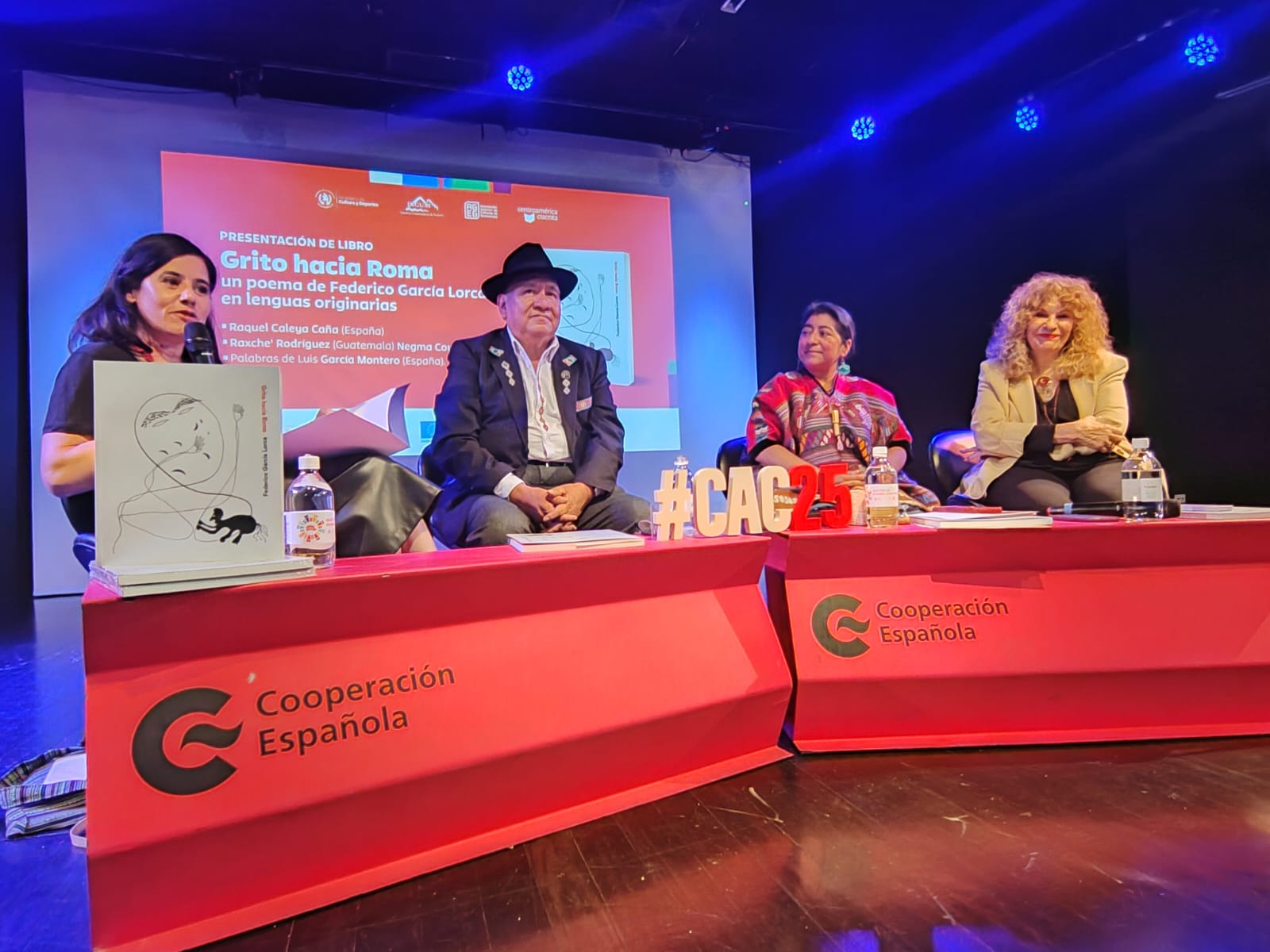
In the multiple activities of Central America (CAC 2025), On Tuesday, May 21, the presentation of the book inspired by the poem was held I shout towards Romeby Federico García Lorca. The poem is part of the book Poet in New York.
It was written in the late thirty years of the 20th century, in which the author expressed his outrage at the indifference of the Church against the suffering of the time, including the great economic depression, which began in the United States and extended to various nations. It was published posthumously in 1940, within the book Poet in New Yorkthanks to a collaboration between UNAM, through the General Directorate of Publications and Editorial Development, and the Cervantes Institute of Spain.
The activity was in charge of Raquel Caleya, a philologist and expert in cultural management, who is currently director of Culture, Libraries and Digital Culture of the Cervantes Institute. Raxché Rodríguez Guaján, self -taught in bilingual education, translation and individual and collective rights of indigenous peoples in Guatemala participated; The writer and artist Negma Coy, and writer Gioconda Belli.
I shout towards Rome It is considered one of the most translated and most desperate poems that have been written in Spanish. This edition is a job to read it in 27 native languages of Latin America, of which 12 are originally from Mexico and 15 from other countries, among which Guatemala stands out, with a Kaqchikel language version.
The translation process
Contributions from Bolivia, Colombia, Chile, Paraguay, Peru and Venezuela appear. It was consulted with experts in the field of translation and in these languages. Writers in their mother tongue, which allows them to name the world from a particular worldview that is not, of origin, the Castilian, describes Rosa Beltrán Álvarez, Cultural Diffusion Coordinator of the National Autonomous University of Mexico, who was part of this project and was in charge of the epilogue of the publication.
By Guatemala, he participated in the translation to Kaqchikel Rodríguez, who also coordinates the Maya Editorial ‘Wuj project, dedicated to the elaboration of texts for the learning of various Mayan languages (mam, k’iche’, q’anjobal’al ‘, tz’utujil, poqomam, poqomchi’ and q’eqchi ‘). He also participated in the creation of the 18 intercultural normal schools in Guatemala.
On page 53 of this special edition is the text of the translation entitled Raqomchi ‘K’a Rome. Rodríguez explains that it was not a simple project. He took months of work and recognizes that every translation is always perfectible.
For a moment he hesitated to translate it, but he has the conviction that the language can address any technological, philosophical or literary theme. Thus began with the first, the second, the third version, until reaching the last, which he shared with the attendees. Rodríguez, during the activity, read the poem in Kaqchikel, while Belli did it in Spanish.
During the presentation, the writer Negma Coy highlighted when reading a poem called Cholq’ijin which the energies of the Mayan Nawales are expressed. The sound poem, which includes mimicked birds through the sound of clay whistles, caught the attention of the attendees.
The poem is part of another project that was published in the book The will of the Earth. 22 poets in languages from different latitudes of Mexico and Latin America participate in these pages. Luis García Montero, director of the Cervantes Institute, describes in his prologue that the title asked Federico García Lorca, and corresponds to the final verses of his poem I shout towards Rome: “Because we want the will of the Earth to be fulfilled / that pays off for all.”
Coy explains that the poem has just 20 lines, like the 20 days of the Mayan calendar. He believes that, at present, it is said that the Maya are creating books, but “writing has always been; it has been invisible for hundreds and thousands of years … Perhaps not created books, but there is a writing in other spaces and messages in our way of living, of being, for example, in our huipiles,” concludes the poet.