

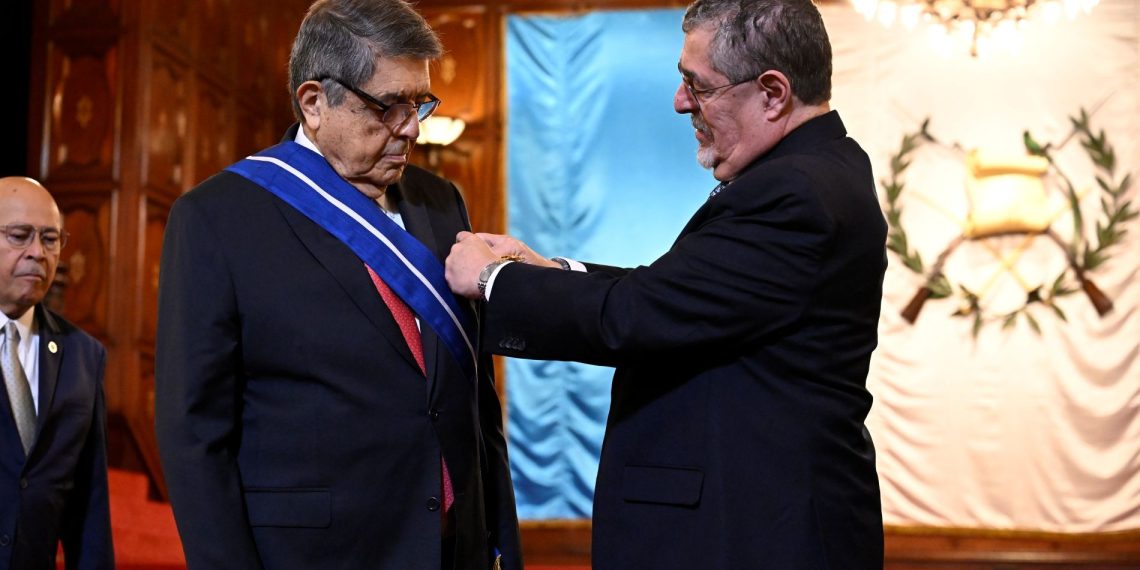
President Bernardo Arévalo delivered the decoration in Grand Cruz, Golden Plate, of the order of the five volcanoes, To the 82 -year -old novelist Sergio Ramírez, 2017 Cervantes Award, who is in Guatemala to preside over the Central America Festival (CAC 2025).
The order of the five volcanoes, in the degree of Gran Cruz, is an honorable distinction granted by the Government of Guatemala to people or entities that have made a significant contribution to regional or international integration.
This degree of the order is considered the highest and is usually granted to heads of state, ambassadors, plenipotentiary ministers and other national or high -ranking international officials.
This recognition is contained in the Government Agreement 81-2025, through which the order is granted to the writer. The agreement describes the work of Ramírez, a renowned writer, journalist, politician and lawyer Nicaraguan, who has been actively involved in the Central American integration process. He has written extensively about the history, culture and politics of the region, continuously promoting the integration between Central American artists, writers and intellectuals.
Sergio Ramírez’s trajectory
Ramírez is a benchmark for the contemporary Central American novel, recognized with several literature awards internationally and in different languages. He was vice president of Nicaragua from 1985 to 1990. He is currently exiled in Madrid, after in 2023 he was stripped of his By the government of Daniel Ortega.
In 2013, the Nicaraguan writer and Cervantes Prize created the Central America Festival (CAC)with the purpose of contributing to the projection and dissemination of Ibero -American literature from Central America. Currently, it has two editions: one in the first half, in a Central American or Caribbean country, and another in the second semester, in Madrid, Spain.
Until 2017, its headquarters was Nicaragua. Since 2019, he has made editions in Costa Rica, Guatemala, Madrid, Dominican Republic and Panama.
During the delivery, President Bernardo Arévalo mentioned that this recognition was a testimony of Ramírez’s struggle against all kinds of oppression and authoritarianism. From his first storybook to his most recent novels, Sergio Ramírez’s literary work has been the precise expression and testimony that the drama of individual and collective life tells us, said the president.
The author’s emblematic titles were remembered as Divine punishment, Margarita, the sea is pretty and Goodbye boys.
Sergio Ramírez talks about his roots
In his thanks speech, Sergio Ramírez shared with the attendees how he became aware of his Central American roots and his convictions in this regard.
He recalled with affection the date of his wedding with his wife, Gertrudis Guerrero, on July 26, 1964: that same day they moved to live in Costa Rica. “My teacher at the university told me: I have nothing to teach you here, you have to leave Nicaragua,” he said. He added that this professor wanted him to be assigned a position as head of Public Relations in the Central American University Council (CSUCA), which, he explained, was the first integration agency that came to operate in Central America.
He talked about this pioneering institution, formed by the five national universities of the Central American countries, when Panama had not yet been incorporated. In 1964, Ramírez was appointed General Secretary of the CSUCA. Before occupying that position, he had already begun to travel in the region, and considers that it was at that stage, at age 21, when he became Central American.
“I always like to say that I am first Nicaraguan. In the next circle I am Central American, then I am from the Caribbean and then I am Latin American. So, from these statements of these concentric circles, I define my own identity. And my Central American identity never lost it,” said the laureate, ensuring that he feels the same affection for each of the countries in the region as for his own homeland.
Ramírez stressed the need to have a regional integration scheme to be respected: “If there is no cultural integration or cultural identity, it seems to me that it will not be possible to achieve political, economic or social integrity.”
In addition, he recalled that since his youth he has had endearing friends in Guatemala. “How many dear friends I met at the university, writers and other intellectual spaces that have left their lives or started them in their struggle for a different Guatemala and, therefore, by a different Central America.” He mentioned, among them, Edmundo Vásquez and Rafael Cuevas del Cid.
He left the CSUCA in 1978 and, since then, he dedicated himself to fighting for the liberation of his country. He was also part of the creation of the Central American University publishing house. “For the first time we got the Central American writers circulating from one country to another and were read. A Guatemalan writer was read in Costa Rica, a Honduran writer was read in El Salvador. With shootings that still seem unheard of today. The homeland of the Creoleby Severo Martínez Peláez: we got to make 10 editions for more than 50 thousand copies, ”he said.
https://www.youtube.com/watch?v=f7UVF94OIAW
Innumerable editions of works by Miguel Ángel Asturias and Ernesto Cardenal were also made, to mention some authors.
“I speak here as an exiled writer who believed in a dream that it was a lost, embezzled revolution, unfortunately falsified and that today is used for the most ignobles ends that can be imagined. The name of that revolution already distant in the minds of many Central Americans who so much identified with it,” he said during his speech.
“I live exile as a passion: the passion of the exile who always hopes to return to his homeland And the passion of waiting for the shadow of the dictatorship one day to be cleared and democracy can return to Nicaragua, ”he said.
Finally, Ramírez said that his eventual return to the country that saw him born is conditioned to a deep transformation of the political regime. “My return to the country that saw me born is necessarily linked to the transformation of that country in a place where there are democratic possibilities and disappears all forms of oppression, dictatorship and repression,” he said.